How to Derive the ABCD Matrix for a Transmission Line?

  • Thread starter Thread starter baby_1
  • Start date Start date
  • Tags Tags
    Line Matrix
Click For Summary
SUMMARY

The discussion focuses on deriving the ABCD matrix for a transmission line, specifically how to determine the A element value and the reflection coefficient ρ at position 1. The relationship between the forward and backward traveling voltages (V(1)+ and V(1)-) is crucial for this derivation. The reflection coefficient can be calculated using the formula Γ2 = (Z2 - Z0)/(Z2 + Z0), where Z0 is the characteristic impedance. The final equations for the voltages and currents are expressed as V1 = AV2 + BI2 and I1 = CE2 + DI2, where A, B, C, and D are functions of θ and Z0.

PREREQUISITES
  • Understanding of transmission line theory
  • Familiarity with the ABCD parameters
  • Knowledge of reflection coefficients in electrical engineering
  • Basic concepts of complex impedance and phasors
NEXT STEPS
  • Study the derivation of the ABCD parameters for different transmission line configurations
  • Learn how to calculate the reflection coefficient in various scenarios
  • Explore the use of complex numbers in analyzing AC circuits
  • Investigate the impact of load impedance on transmission line performance
USEFUL FOR

Electrical engineers, students studying transmission line theory, and professionals involved in RF design or telecommunications will benefit from this discussion.
baby_1
Messages
159
Reaction score
16
Hello
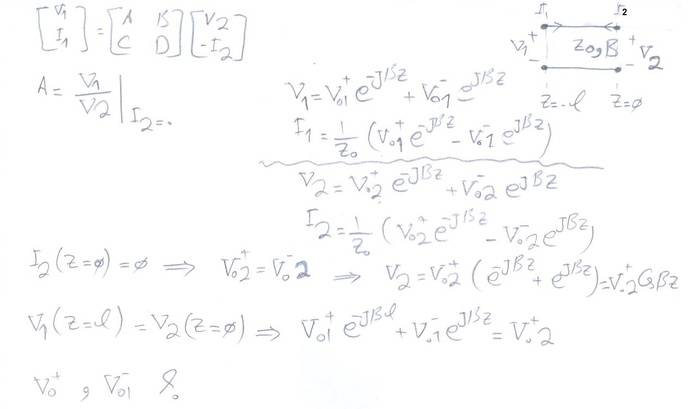
I want to obtain ABCD matrix element value.At first I tried to find A element value with boundary conditions but I don't know how can I find relationship between V(1)+ and V(1)- .
3721568100_1430153626.jpg


Any help appreciate
 
Physics news on Phys.org
Do you know how to determine the reflection coefficient ρ at position 1? 'Cause that's what Vo1-/Vo1+ is.
A convenient way to find ρ is to put the source at z = 0 and the load at z = L where L is the physical length of the transmission line.
 
  • Like
Likes   Reactions: baby_1
Thank you dear rude man
Before post this thread I think that I can use reflection coefficient too but as you know I don't have any other information before point 1 and my Z0 in this equation is unknown.
6490641500_1430751437.jpg


In post 1 you seem to state that Z0 was known. Anyway, it has to be known or you can't find the abcd parameters.
 
Thank you for accompany me
Here is my question we don't have any information before Point 1(Z1) how can define relationship between V+ and V-?
9658672700_1430761152.jpg
 
I'm having trouble understanding what you say and what you write.
Let me instead suggest:
V1 = V2+e + V2-e-jθ
V2 = V2+ + V2-
Γ2 = V2-/V2+ = (Z2 - Z0)/(Z2 + Z0).
Z2 = V2/I2
You can eliminate the + and - waves using the above.
And there are similar equations for I1, I2+ and I2-.
You wind up with
V1 = AV2 + BI2
I1 = CE2 + DI2
where A, B, C and D contain only θ and Z0.
 
Last edited:

Similar threads

  • · Replies 0 ·
Replies
0
Views
3K
  • · Replies 5 ·
Replies
5
Views
3K
  • · Replies 12 ·
Replies
12
Views
3K
  • · Replies 2 ·
Replies
2
Views
890
  • · Replies 3 ·
Replies
3
Views
2K
  • · Replies 2 ·
Replies
2
Views
2K
  • · Replies 3 ·
Replies
3
Views
2K
Replies
0
Views
1K
Replies
2
Views
1K
  • · Replies 9 ·
Replies
9
Views
2K