How to derive the reflected Mach number relationship?

Click For Summary

Discussion Overview

The discussion revolves around the derivation of the reflected Mach number relationship in the context of gas dynamics, particularly focusing on reflected waves and shock conditions. Participants explore the theoretical aspects and challenges associated with this topic.

Discussion Character

  • Technical explanation
  • Conceptual clarification
  • Debate/contested

Main Points Raised

  • One participant expresses difficulty in finding the derivation for the reflected Mach number (Mr) and seeks assistance.
  • Another participant notes that deriving this relationship is complex and suggests changing the frame of reference to one with a stationary shock, emphasizing the importance of the velocity jump condition.
  • It is mentioned that the terms under the radical in the equations come from normal shock relations, but the full derivation is not provided in the discussion.
  • A participant references the textbook "Compressible Flow" by Anderson, noting that it does not include the derivation and states that it is left as an exercise for the reader.
  • There is a suggestion that following the relevant chapter in the textbook and applying the previously mentioned rules could lead to a successful derivation.

Areas of Agreement / Disagreement

Participants generally agree on the complexity of the topic and the usefulness of the textbook, but there is no consensus on a specific derivation method or solution, as the discussion remains unresolved.

Contextual Notes

Limitations include the lack of a complete derivation presented in the discussion and the dependence on specific assumptions regarding shock conditions and frame of reference.

theudster
Messages
3
Reaction score
0
TL;DR
Deriving reflected mach number relationship
Hi,

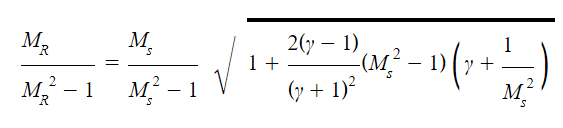
when learnig about reflected waves, I keep coming up with this equation;
1589803143295.png

to calculate the reflected mach number (Mr).
I can't seem to find the derivation for this and would appreciate your help

Thank you
 
Physics news on Phys.org
This is honestly one of the trickier topics in elementary gas dynamics. There are a few general rules you should keep in mind:
  1. Always change your frame of reference to one with a stationary shock, where possible.
  2. For situations like this, the important jump condition is the velocity jump, ##u_2/u_1##.
If you keep those in mind, you can solve for the ratio for the incident shock and then for the reflected shock and relate the two. The terms under the radical come from normal shock relations. It's not really something that makes a lot of sense to reproduce here in full, though. Do you have a relevant textbook handy?
 
  • Like
Likes   Reactions: Astronuc
boneh3ad said:
This is honestly one of the trickier topics in elementary gas dynamics. There are a few general rules you should keep in mind:
  1. Always change your frame of reference to one with a stationary shock, where possible.
  2. For situations like this, the important jump condition is the velocity jump, ##u_2/u_1##.
If you keep those in mind, you can solve for the ratio for the incident shock and then for the reflected shock and relate the two. The terms under the radical come from normal shock relations. It's not really something that makes a lot of sense to reproduce here in full, though. Do you have a relevant textbook handy?
I have Compressible FLow by Anderson, but he doesn't provide the derivation
 
Anderson also says "the derivation is left as an exercise for the reader." If you follow along with that chapter and follow the two rules I mentioned, you ought to be able to derive this on your own. It's a good exercise.
 
  • Like
Likes   Reactions: Astronuc

Similar threads

  • · Replies 4 ·
Replies
4
Views
3K
Replies
8
Views
2K
  • · Replies 1 ·
Replies
1
Views
3K
Replies
1
Views
2K
  • · Replies 6 ·
Replies
6
Views
2K
  • · Replies 4 ·
Replies
4
Views
4K
  • · Replies 3 ·
Replies
3
Views
7K
  • · Replies 14 ·
Replies
14
Views
3K
Replies
4
Views
16K
  • · Replies 5 ·
Replies
5
Views
10K