How to determine how much torque a hollow cylinder can take?

Click For Summary

Discussion Overview

The discussion revolves around determining the amount of torque a hollow cylinder can withstand before buckling occurs. Participants explore the necessary parameters and calculations involved, including material properties and potential methods for analysis. The context includes theoretical considerations and practical implications for design.

Discussion Character

  • Exploratory
  • Technical explanation
  • Debate/contested
  • Mathematical reasoning

Main Points Raised

  • One participant inquires about the necessary parameters for calculating the torque capacity of a hollow cylinder, suggesting tensile strength, wall thickness, and diameter are important.
  • Another participant mentions the need for additional material properties such as Young's modulus (E), shear modulus (G), or Poisson's ratio.
  • Concerns are raised about the complexity of deriving a simple formula for torque capacity, with a suggestion that finite element analysis may be required.
  • One participant draws a parallel between the buckling of thin tubes in torsion and the buckling of thin flat plates under shear, noting the difficulty of calculations involved.
  • There is a question about whether the participant is referring to buckling failure or overstressing failure, indicating a need for clarification on the type of failure being considered.
  • A later reply introduces the term "shell buckling" and references a resource that may provide relevant information for the discussion.
  • Another participant expresses a personal interest in the topic rather than it being a homework problem.
  • One participant mentions their background as a programmer and their intention to learn more about the relevant engineering concepts.

Areas of Agreement / Disagreement

Participants do not reach a consensus on the best approach to calculate the torque capacity of the hollow cylinder, with multiple competing views and uncertainties remaining regarding the methods and definitions involved.

Contextual Notes

There are limitations in the discussion regarding the assumptions made about material properties and the complexity of the calculations required for accurate analysis. The discussion also reflects varying interpretations of failure modes (buckling vs. overstressing).

Who May Find This Useful

This discussion may be of interest to engineers, materials scientists, and students exploring the mechanics of materials, particularly in relation to torsion and structural stability.

Maxxon
Messages
4
Reaction score
0
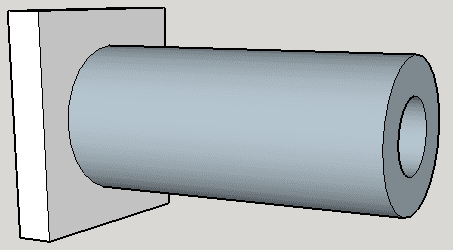
I'd like to calculate how much torque a hollow cylinder along its axis can take before it will start to buckle. The cylinder is held at one end, and the torque is applied equally in discrete intervals along the length of the cylinder.
Pek8r.png

In the example image above, the hollow cylinder is mounted on a slab which is immovable.

I'm guessing I need to know the tensile strength of the material the hollow cylinder is made of, the thickness of the cylinder wall and the diameter of the cylinder. Is that correct?

Is there a formula that I can use to calculate this information?
 
Engineering news on Phys.org
Maxxon said:
I'd like to calculate how much torque a hollow cylinder along its axis can take before it will start to buckle. The cylinder is held at one end, and the torque is applied equally in discrete intervals along the length of the cylinder.

Pek8r.png

In the example image above, the hollow cylinder is mounted on a slab which is immovable.

I'm guessing I need to know the tensile strength of the material the hollow cylinder is made of, the thickness of the cylinder wall and the diameter of the cylinder. Is that correct?
That's a start. You'll also need to know E, G, or Poisson's ratio for the material, as well, for starters.

Is there a formula that I can use to calculate this information?
Are you talking about the amount of torque required to cause buckling?

If so, based on the history of this problem given in this paper:

http://www.tech.plym.ac.uk/sme/fpcm/FPCM06\FPCM-6_14.PDF

I doubt there is a simple formula which is also accurate, even for shafts which can be considered "thin wall", i.e., where the shear stress distribution across the thickness of the wall can be treated as constant.

More likely than not, you will have to analyze this shaft using finite element techniques, and then keep your fingers crossed, unless you have a way to do some experiments on an actual shaft and compare these empirical results with the results of a numerical analysis.
 
Thin tubes buckle in torsion in a way similar in concept to the way that stressed thin flat plates buckle when subject to edge shear .

Doesn't help much to know that though - the actual calculations are horrendous even for simple cases .

Also quite small imperfections in tube or quite minor distortions in applied loads can make calculated failure condition meaningless .

Far safer to use an alternative design that can be analysed easier or which is intrinsically more stable anyway if requirement is a critical one ..
 
Just a thought though - do you actually mean failure by buckling or do you really mean just simple failure of a thicker tube by overstressing ??
 
SteamKing said:
That's a start. You'll also need to know E, G, or Poisson's ratio for the material, as well, for starters.Are you talking about the amount of torque required to cause buckling?

If so, based on the history of this problem given in this paper:

http://www.tech.plym.ac.uk/sme/fpcm/FPCM06\FPCM-6_14.PDF

I doubt there is a simple formula which is also accurate, even for shafts which can be considered "thin wall", i.e., where the shear stress distribution across the thickness of the wall can be treated as constant.

More likely than not, you will have to analyze this shaft using finite element techniques, and then keep your fingers crossed, unless you have a way to do some experiments on an actual shaft and compare these empirical results with the results of a numerical analysis.
Thanks. I'm not an engineer (I'm a programmer), but I'll look up these terms and see what I can learn.
 
  • #10
Nidum said:
Just a thought though - do you actually mean failure by buckling or do you really mean just simple failure of a thicker tube by overstressing ??
Buckling or any deformation. I've been reading up on ultrasonic motors and wish to rotate a shaft (probably a hollow cylinder as it has a better weight to strength ratio) using a bunch in parallel to increase the torque on it.
 
  • #11
Tell us more ?
 

Similar threads

  • · Replies 5 ·
Replies
5
Views
2K
  • · Replies 8 ·
Replies
8
Views
3K
  • · Replies 9 ·
Replies
9
Views
2K
Replies
23
Views
3K
Replies
1
Views
2K
  • · Replies 5 ·
Replies
5
Views
3K
Replies
15
Views
3K
  • · Replies 10 ·
Replies
10
Views
13K
  • · Replies 1 ·
Replies
1
Views
2K
  • · Replies 7 ·
Replies
7
Views
6K