How to Determine Maximum M and T in a Cantilever Shaft?

Click For Summary
SUMMARY

The discussion focuses on determining the maximum moment (M) and torque (T) for a cantilever shaft of fixed length (1.2m) under tensile axial loading and torsional loadings. The formula used for calculating the radius (c) of the shaft is c=((2/(π*τ))*√(M^2+T^2))^1/3, where τ is the allowable shearing stress. Participants emphasize the importance of using established formulas for combined loading and suggest breaking down the problem into simpler sub-problems to analyze the beam effectively. The goal is to find the optimal combination of M and T to minimize the shaft's radius and weight.

PREREQUISITES
  • Understanding of cantilever beam mechanics
  • Familiarity with shear and bending stress calculations
  • Knowledge of material properties, including yield strength and allowable shearing stress
  • Proficiency in using Excel for engineering calculations
NEXT STEPS
  • Research the application of Von Mises stress criteria for combined loading scenarios
  • Learn how to plot stress distributions along a cantilever beam using software tools
  • Explore established formulas for cantilever shaft design in engineering textbooks
  • Investigate methods for optimizing material selection based on weight and strength
USEFUL FOR

Mechanical engineers, structural analysts, and students involved in shaft design and optimization projects will benefit from this discussion.

Vircona
Messages
4
Reaction score
0
Hey, all,

So I posted a similar thread yesterday about my project design issue, but I've made progress on it by taking a different approach. For the project, I have a cantilever shaft of fixed length (1.2m) and a tensile axial loading, and two torsional loadings in the same direction at different points on the outer edge of the shaft (opposite end of its support). I need to design the lightest-weight solid shaft that will withstand the forces without yielding due to stress.

I'm using a formula designed for this purpose:

c=((2/(π*τ))*√(M^2+T^2))^1/3

where c is radius, τ is allowable shearing stress, M is moment, and T is torque.

I have my maximum allowable shearing stress an have the equation for c set up in an excel file. The only issue I'm having is finding the highest combination of M and T, since the point of maximum moment and the point of maximum torque are unlikely to be the same. This point should give me the minimum allowable radius, which would obviously lead to the lightest shaft (I only have 3 materials to choose from, so I can check their weights vs. yield strengths manually).

Basically, can anyone help me find the largest value of M^2 + T^2 in a cantilever shaft?

EDIT: Note that the project PDF is shown below but has been changed. I'm ONLY concerned with a solid rod now -- not hollow or composite.
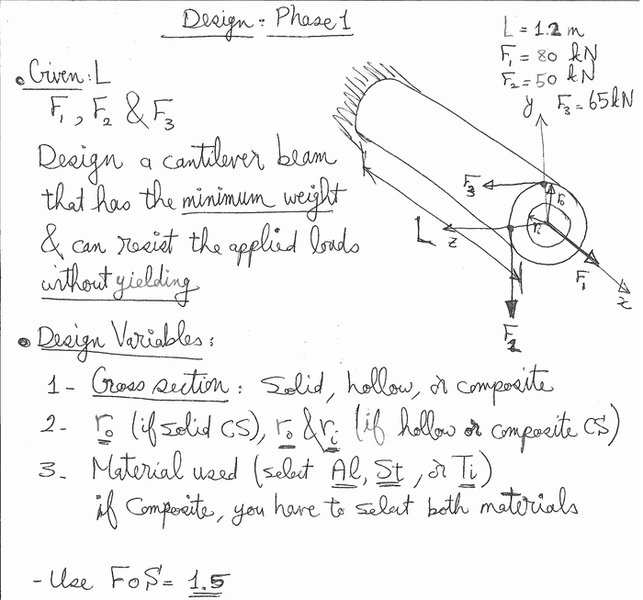
cGie27h.png
 
Engineering news on Phys.org
I don't know where that formula is coming from but it does not include axial stresses or transverse shear stresses . Beyond that, looks like max moment and shear occur simultaneously at the fixed end of the beam at some point along the circumference . I would use Von Mise approach or similar formula for combined shear and bending and axial stress.

Edit: I just realized you have been receiving help already from SteamKing in a separate post, so you should continue to post your questions and workings in that thread rather than start a new one, since essentially it is the same topic.
 
Last edited:
I would surely check that design formula; it does not look like any shaft design equation I know about!

As far as finding the maximum of the sum you mentioned, I suggest that you write out the expressions for each and if they are complicated, use a computer to generate a plot of the sum versus position along the shaft. It is an easy thing to do.
 
Vircona said:
Hey, all,

So I posted a similar thread yesterday about my project design issue, but I've made progress on it by taking a different approach. For the project, I have a cantilever shaft of fixed length (1.2m) and a tensile axial loading, and two torsional loadings in the same direction at different points on the outer edge of the shaft (opposite end of its support). I need to design the lightest-weight solid shaft that will withstand the forces without yielding due to stress.

I'm using a formula designed for this purpose:

c=((2/(π*τ))*√(M^2+T^2))^1/3

where c is radius, τ is allowable shearing stress, M is moment, and T is torque.

I'm with OldEngr63 and Phantomjay in their comments on this formula. At first glance, the units don't even appear to give length on the RHS which should match units on the LHS for radius.

Did you "design" this formula?

I have my maximum allowable shearing stress an have the equation for c set up in an excel file. The only issue I'm having is finding the highest combination of M and T, since the point of maximum moment and the point of maximum torque are unlikely to be the same. This point should give me the minimum allowable radius, which would obviously lead to the lightest shaft (I only have 3 materials to choose from, so I can check their weights vs. yield strengths manually).

Basically, can anyone help me find the largest value of M^2 + T^2 in a cantilever shaft?

EDIT: Note that the project PDF is shown below but has been changed. I'm ONLY concerned with a solid rod now -- not hollow or composite.
It's better to break up a combined loading problem into several sub-problems which analyze the beam using simple loadings, one at a time. Remember, stresses from individual loads can be combined once the smaller sub-problems are solved. There is no need to "invent" dubious formulas for different situations ... the tried and true formulas from your texts are the ones you should be applying. After all, that's why they're being taught to you in the course.
 

Similar threads

  • · Replies 16 ·
Replies
16
Views
2K
  • · Replies 7 ·
Replies
7
Views
3K
Replies
19
Views
9K
Replies
2
Views
3K
  • · Replies 1 ·
Replies
1
Views
4K
Replies
15
Views
2K
  • · Replies 4 ·
Replies
4
Views
2K
Replies
2
Views
2K
Replies
4
Views
2K
  • · Replies 5 ·
Replies
5
Views
3K