How to determine the angles using geometry (specific example)

Join the discussion
Ask a follow-up here, or get your own question answered by working scientists, mathematicians and engineers — people, not an autocomplete.
Real named experts · corrections over time · the nuance an AI answer skips
10 replies · 2K views
bolzano95
Messages
89
Reaction score
7
Homework Statement
The following problem is taken from a physics problem, but I insulated the geometrical part for better understanding.
Relevant Equations
α=?
β=?
I'm trying to find angles α and β.

No additional information except: d, h, a.
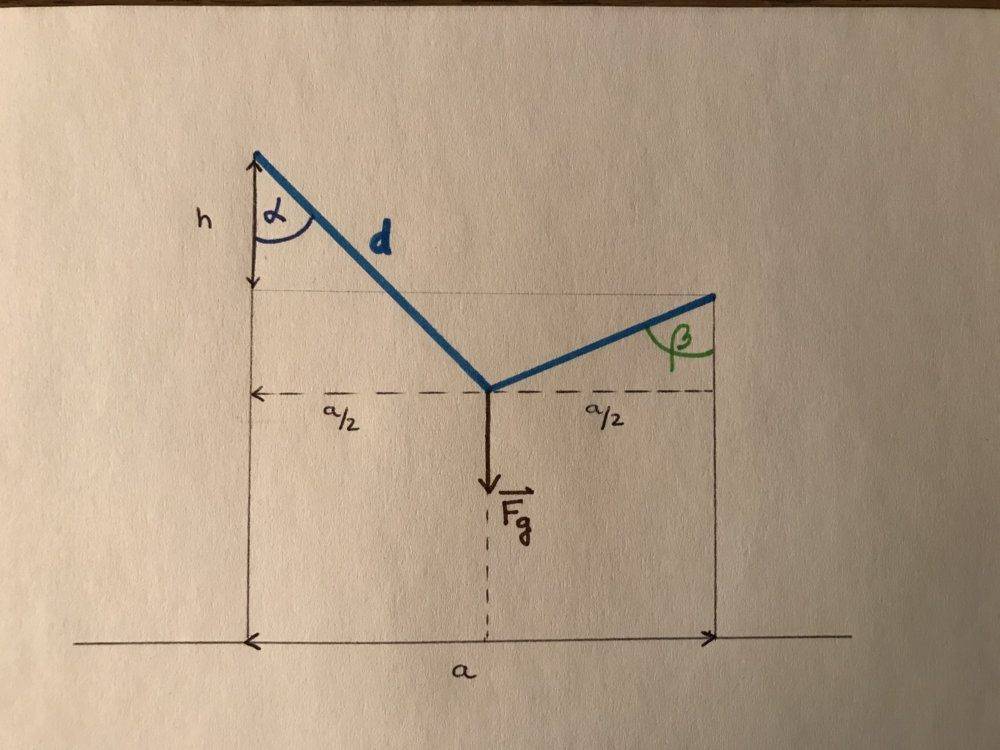
attachment.html.jpeg


I already tried to figure it out by using isosceles triangles, but this is only true when there is a equilibrium of forces. I thought there are similar triangles incorporated, but I get too many unknown variables and not enough equations. I also tried using trapeziums but it doesn't pan out.

Maybe I overlooked something? Or is there a possibility that this problem is unsolvable?
 
Physics news on Phys.org
BvU said:
What is d ?
d= complete length of a rope :smile:
 
At PF we don't like to give full soluitons, just ask guiding questions and give hints.
I like to think 'if you can draw it, you can calculate it'

Top left triangle is known: you have two sides and an angle (not ##\alpha##). So you have third side. So you have two sides and an angle (not ##\beta##) of the other triangle ... bingo !
 
Seems to me that you have two equations in two unknowns. If you can find the "heights" of the two triangles then you're golden: you'll be able to find the angles given two sides of each triangle.

You know that the sum of the two hypotenuses (hypoteni?) is d. You have a relationship between the height of the smaller triangle and the larger one. Two equations, two unknowns. Sweat the algebra and you should arrive at a result.
 
BvU said:
Top left triangle is known
Not quite. h is the difference in heights of the two triangles.

@bolzano95 , you can find all the sides of the right hand triangle in terms of a and beta.
Combining these with h and d you can find all the sides of the left hand triangle.
What equations does that give you?
 
haruspex said:
Not quite. h is the difference in heights of the two triangles.
As I posted, I missed the post that d is the full length of the blue line o:) and thought it was the hypothenusa.

@bolzano95 : I still miss the full physics problem statement. What about the non equilibrium remark ?
 
Recall your definitions of sin and cos.

Let d1 be the part of d on the left, d2 on the right. So d = d1+d2.

Then what is d1 sin alpha, d1 cos alpha, d2 sin beta, and d2 cos beta? What equations can you write relating these items?
 
gneill and BvU... I GOT IT! YES!

If I use a pythagorean theorem to express a "height" of the right hand triangle: ##x^2= d^2_2-\frac{1}{4}a^2## and then put it in a equation of the left hand triangle ##(h+x)^2+\frac{1}{4}a^2=d^2_1=(d-d_2)^2## I get ##d_2## and my life is solved! YES!

Orodruin, BvU: I thought about posting the whole problem on the forum, but I was only struggeling with geometric aspect. If you want (and insist :) I can post the whole problem here. But again, in my opinion the physics part is not vital for understanding with what I was having problem with. Let me know about the problem!
 
  • Like
Likes   Reactions: gneill