How to Determine the Equation of a Circle from Given Diameter Coordinates?

  • Context: MHB 
  • Thread starter Thread starter mathdad
  • Start date Start date
  • Tags Tags
    Circle
Click For Summary

Discussion Overview

The discussion revolves around determining the equation of a circle given the coordinates of its diameter endpoints, specifically points P(-4, -2) and Q(6, 4). Participants explore the calculation of the midpoint, radius, and the standard form of the circle's equation, while addressing potential errors in these calculations.

Discussion Character

  • Technical explanation
  • Debate/contested
  • Mathematical reasoning

Main Points Raised

  • One participant calculates the midpoint as (5, 3) and derives the equation of the circle as (x - 5)^2 + (y - 3)^2 = 136.
  • Another participant challenges the midpoint calculation, asserting it should be (1, 1), and states that the radius is half the diameter, leading to a revised equation of (x - 1)^2 + (y - 1)^2 = 34.
  • Some participants express uncertainty about the correctness of the radius and midpoint calculations, suggesting that errors were made in applying the formulas.
  • There is a humorous exchange regarding the etiquette of providing help in the forum, with references to "trampling" when one participant feels their guidance was overlooked.

Areas of Agreement / Disagreement

Participants do not reach a consensus on the correct midpoint or radius calculations, and multiple competing views on the equation of the circle remain unresolved.

Contextual Notes

Participants highlight potential errors in the application of the midpoint formula and the determination of the radius, indicating that the discussion may depend on the correct interpretation of these mathematical concepts.
mathdad
Messages
1,280
Reaction score
0
Determine the equation of the circle in standard form, given the coordinate of the diameter PQ.

P(-4, -2) and Q(6, 4)

Midpoint is (5, 3).

d = sqrt{(6-(-4))^2 + (4-(-2))

d = sqrt{(10)^2 + (6)^2}

d = sqrt{100 + 36}

d = r = sqrt{136}

Let d = distance = radius

(x - h)^2 + (y - k)^2 = r^2

(x - 5)^2 + (y - 3)^2 = [sqrt{136}]^2

(x - 5)^2 + (y - 3)^2 = 136

Correct?
 
Mathematics news on Phys.org
RTCNTC said:
Determine the equation of the circle in standard form, given the coordinate of the diameter PQ.

P(-4, -2) and Q(6, 4)

Midpoint is (5, 3).

d = sqrt{(6-(-4))^2 + (4-(-2))

d = sqrt{(10)^2 + (6)^2}

d = sqrt{100 + 36}

d = r = sqrt{136}

Let d = distance = radius

(x - h)^2 + (y - k)^2 = r^2

(x - 5)^2 + (y - 3)^2 = [sqrt{136}]^2

(x - 5)^2 + (y - 3)^2 = 136

Correct?

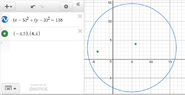
Let's graph your circle and the points P and Q as a check:

View attachment 7481

Hmmm...looks like the radius and center points aren't correct.

Can you spot the errors you made in applying the mid-point formula, and in determining the length of the radius?
 

Attachments

  • rtcntc_circle.png
    rtcntc_circle.png
    13.9 KB · Views: 126
MarkFL said:
Let's graph your circle and the points P and Q as a check:
Hmmm...looks like the radius and center points aren't correct.

Can you spot the errors you made in applying the mid-point formula, and in determining the length of the radius?

On my way to work now. I will work out the math later this evening. I like the geometric picture. I would like to see more like it when answering questions involving algebra and geometry.
 
RTCNTC said:
Determine the equation of the circle in standard form, given the coordinate of the diameter PQ.

P(-4, -2) and Q(6, 4)
So you are given the coordinates of the endpoints of the diameter PQ.
Midpoint is (5, 3).
No, the midpoint is ((-4+ 6)/2, (-2+ 4)/2)= (1, 1).

d = sqrt{(6-(-4))^2 + (4-(-2))

d = sqrt{(10)^2 + (6)^2}

d = sqrt{100 + 36}

d = r = sqrt{136}
No, the diameter is not the radius! The radius is half the diameter, \sqrt{136}/2= \sqrt{34}

Let d = distance = radius

(x - h)^2 + (y - k)^2 = r^2

(x - 5)^2 + (y - 3)^2 = [sqrt{136}]^2

(x - 5)^2 + (y - 3)^2 = 136

Correct?
No, it is not.
 
(x - h)^2 + (y - k)^2 = r^2

(x - 1)^2 + (y - 1)^2 = sqrt{136}/2

(x - 1)^2 + (y - 1)^2 = [sqrt{34}]^2

(x - 1)^2 + (y - 1)^2 = 34

Correct?
 
MarkFL said:
...Can you spot the errors you made in applying the mid-point formula, and in determining the length of the radius?

HallsofIvy said:
So you are given the coordinates of the endpoints of the diameter PQ.

No, the midpoint is ((-4+ 6)/2, (-2+ 4)/2)= (1, 1).

No, the diameter is not the radius! The radius is half the diameter, \sqrt{136}/2= \sqrt{34}

No, it is not.

Jumanji-3.jpg
 
What is the connection between my reply and the angry elephant picture?
 
RTCNTC said:
What is the connection between my reply and the angry elephant picture?

I asked you to spot the errors you made, and then another person came along and obliviously answered the entire problem...this is called "trampling" and is against MHB's rules.

MHB Rule #14 said:
Do not explain hints prematurely. When you see someone already helping a member and waiting for the original poster to give feedback, do not give more hints or a full solution. Wait at least 24 hours for the original poster to respond.

Thus, I posted a picture of an elephant trampling a car as a humorous way to object to having my help trampled.
 
MarkFL said:
I asked you to spot the errors you made, and then another person came along and obliviously answered the entire problem...this is called "trampling" and is against MHB's rules.
Thus, I posted a picture of an elephant trampling a car as a humorous way to object to having my help trampled.
Thanks for explaining the picture to me. I will continue to post from the David Cohen precalculus textbook until I receive my Michael Kelly precalculus Quick Review book in about two weeks.
 

Similar threads

Replies
6
Views
1K
  • · Replies 7 ·
Replies
7
Views
3K
  • · Replies 9 ·
Replies
9
Views
2K
  • · Replies 4 ·
Replies
4
Views
1K
  • · Replies 4 ·
Replies
4
Views
2K
  • · Replies 2 ·
Replies
2
Views
2K
  • · Replies 7 ·
Replies
7
Views
3K
  • · Replies 2 ·
Replies
2
Views
1K
  • · Replies 8 ·
Replies
8
Views
2K
  • · Replies 1 ·
Replies
1
Views
8K