How to Determine Velocity from a Force-Time Graph?

  • Thread starter Thread starter Stasis
  • Start date Start date
  • Tags Tags
    Graph Velocity
Click For Summary

Homework Help Overview

The discussion revolves around determining velocity from a force-time graph, specifically focusing on a problem involving a 3.4 kg object subjected to a force. Participants explore the concepts of impulse and its relationship to velocity, as well as the implications of initial conditions on final velocity calculations.

Discussion Character

  • Exploratory, Conceptual clarification, Mathematical reasoning, Assumption checking

Approaches and Questions Raised

  • Participants discuss the calculation of impulse as the area under the force-time graph and question the appropriateness of using F=ma for deriving velocity. Some suggest alternative formulations for impulse and its connection to momentum. Others express confusion about the correct methodology and seek clarification on their reasoning.

Discussion Status

The discussion is active, with participants providing insights into the relationship between impulse and velocity. Some guidance has been offered regarding the correct interpretation of impulse and its calculation, but there remains a lack of consensus on the best approach to the problem. Participants are exploring different interpretations and methods.

Contextual Notes

Some participants express uncertainty about their initial calculations and the assumptions made regarding acceleration and velocity. There is a recognition that the problem involves multiple scenarios based on initial conditions, which may affect the final outcomes.

Stasis
Messages
3
Reaction score
0
Hey all, I've been attempting this all week and can't get my head around what the proper way to calculate the answers for this query is so...

1. Homework Statement
The force shown in the force-time diagram acts on a 3.4 kg object.
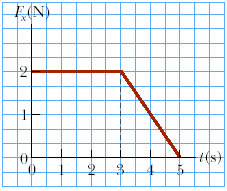
p6-11.gif

(a) Find the impulse of the force.
(b) Find the final velocity of the mass if it is initially at rest.
(c) Find the final velocity of the mass if it is initially moving along the x-axis with a velocity of -1.8 m/s.

2. Homework Equations

F=ma

Possibly kinematics

The Attempt at a Solution


Well I got the correct answers already:
A) 8 (area under the line in the graph, (3*2) + (2*2/2)
B) 2.34m/s
C) 0.548

The thing is I accidentally found the answers for this, I decided to start with the acceleration via:
A=F/M
A1=1.764
A2=0.59

On a whim I added these together and submitted (practice server) and it was correct, I repeated this a few times and it was always correct.

For C) I just removed this value from my answer from B)

What is the correct way I should have done this? I can't seem to work out the result any other way :S

Any help is appreciated.
 
Physics news on Phys.org
You shouldn't use F=ma (you can, but it's not what you want). How would you be able to derive the velocity from the impulse? To think about this, how else can you write a formula for impulse?
 
Cake said:
You shouldn't use F=ma (you can, but it's not what you want). How would you be able to derive the velocity from the impulse? To think about this, how else can you write a formula for impulse?
Hmmm v=u+a*t ? since I have U and T but then that falls back on acquiring A via A=f/m which isn't quite right either?

Sorry, this particular h/w question has me stumped
 
Hello Stasis, welcome to PF :smile: !

First about a). You know about F = ma, but how did you know that the impulse of the force is the area under the graph ?

Impulse (or momentum) is ##\vec p = m\vec v## . And acceleration is the change in ##\vec v## per unit time. ##\vec a = {d\vec v\over dt}##, to be precise. For small time steps, if the acceleration can be considered nearly constant, we write ##\Delta \vec v = \vec a \Delta t## and (in fact, even better): ##\Delta p = \vec F \Delta t##. Here we have everything in one single direction, so we can drop the vector thingy. And the area under the curve is the sum of all these little ##\Delta p = F \Delta t## contributions. In other words, $$\quad p(5) - p(0) = \int_0^5 F dt
$$
This is more or less the same as what you do: you take the (constant) acceleration 2/3.4 and for constant acceleration v = at so you get v = (2/3.4) * 3 which is the same as 2*3 /3.4, i.e. the area under the line / mass. And for the last two seconds you take the average acceleration (2-0)/2 = 1 to get 1/3.4 * 2 = 0.59 m/s. And (2-0)/2 * 2 is also the area under the line.


Answer b) follows from a) if you divide by m. Since p(0) = 0 you get v(5) from this area directly.

And answer c) follows if you substitute the proper p(0). And since m is constant, you can indeed also just subtract the 1.8 (i.e. add the -1.8 m/s).
 
Stasis said:
Hey all, I've been attempting this all week and can't get my head around what the proper way to calculate the answers for this query is so...

1. Homework Statement

The force shown in the force-time diagram acts on a 3.4 kg object.
p6-11.gif

(a) Find the impulse of the force.
(b) Find the final velocity of the mass if it is initially at rest.
(c) Find the final velocity of the mass if it is initially moving along the x-axis with a velocity of -1.8 m/s.
...

The Attempt at a Solution


Well I got the correct answers already:
A) 8 (area under the line in the graph, (3*2) + (2*2/2)
B) 2.34m/s
C) 0.548

The thing is I accidentally found the answers for this, I decided to start with the acceleration via:
A=F/M
A1=1.764
A2=0.59

On a whim I added these together and submitted (practice server) and it was correct, I repeated this a few times and it was always correct.

For C) I just removed this value from my answer from B)

What is the correct way I should have done this? I can't seem to work out the result any other way :S

Any help is appreciated.
Impulse is the area under the graph of Force versus time . Generally calculated (using Calculus) as ##\displaystyle\ \int_{t_1}^{t_2} \vec{F}\cdot\,dt\ ## .
So, what you did for part (A) is absolutely correct.

For part (B):
Use the Impulse - Momentum Theorem, which says that the change in momentum of an object from time t1 to time t2 is equal to the Impulse of the net Force on the object from time t1 to time t2 .

For part (C):
What you did does give the correct answer.
The Impulse is the same for (C) and (B), so the change in momentum is the same for both parts. Therefore, the change in velocity is the same for both parts.
Your method gives the same change in velocity for both parts (B) and (C).
 
Wow you're all so helpful, thank you all for the responses! I believe I understand better now :)
 
Stasis said:
The thing is I accidentally found the answers for this, I decided to start with the acceleration via:
A=F/Me overall speed change.
A1=1.764
A2=0.59
In case it is not clear from the other replies, the reason this worked is that you have calculated changes in speed, not accelerations.
I.e., you did not use a=F/M. 1.764 is an impulse (∫F.dt) not a force (F), so the formula you really used was Δv = ∫F.dt/m. Adding the two speed changes gives the overall speed change.
 

Similar threads

  • · Replies 2 ·
Replies
2
Views
5K
Replies
1
Views
3K
  • · Replies 4 ·
Replies
4
Views
4K
  • · Replies 20 ·
Replies
20
Views
4K
Replies
5
Views
2K
Replies
25
Views
3K
  • · Replies 56 ·
2
Replies
56
Views
4K
Replies
26
Views
4K
Replies
57
Views
3K
  • · Replies 24 ·
Replies
24
Views
1K