How to Find Critical Points of function f(x,y,z)

  • Context: Graduate 
  • Thread starter Thread starter Gh. Soleimani
  • Start date Start date
Click For Summary
SUMMARY

This discussion focuses on finding critical points of the function ƒ(x, y, z) = x + yz - xy using first and second partial derivatives. The first partial derivatives are given as ∂ƒ/∂x = 1 - y, ∂ƒ/∂y = z - x, and ∂ƒ/∂z = y, leading to critical points at the sets {(x, 0, x)} and {(x, 1, x)}. The Hessian matrix, derived from the second derivatives, is evaluated to determine local maxima, minima, and saddle points. The determinant of the Hessian matrix indicates whether critical points are degenerate or non-degenerate, with the discussion highlighting the need for further analysis through contour mapping or machine learning models.

PREREQUISITES
  • Understanding of multivariable calculus, specifically partial derivatives.
  • Familiarity with Hessian matrices and their role in optimization.
  • Knowledge of eigenvalues and their significance in determining critical points.
  • Basic concepts of vector fields and gradients in calculus.
NEXT STEPS
  • Study the properties of Hessian matrices in detail, focusing on their symmetry and determinant.
  • Learn how to compute and interpret eigenvalues of matrices in the context of optimization.
  • Explore contour mapping techniques for visualizing critical points in multivariable functions.
  • Investigate machine learning models that can assist in analyzing critical points in complex functions.
USEFUL FOR

Students and professionals in mathematics, particularly those specializing in calculus and optimization, as well as data scientists interested in applying mathematical concepts to machine learning models.

Gh. Soleimani
Messages
49
Reaction score
3
TL;DR
undefined critical points for first partial derivatives
Hi everybody

If we have not any answers for critical points after first partial derivatives equal to zero, how can we continue to find local MAX, local MIN and Saddle point?. For example: Suppose we have below equations for first partial derivatives:


∂ƒ/∂x = y + 5 , ∂ƒ/∂y = 2z , ∂ƒ/∂z = y
As you can see, for ∇ƒ= 0 , there are not any answers (undefined)
 
Physics news on Phys.org
The three first partials are zero at (x, -5, 0) and (x, 0, 0), with x being arbitrary.
 
Gh. Soleimani said:
∂ƒ/∂x = y + 5 , ∂ƒ/∂y = 2z , ∂ƒ/∂z = y
As you can see, for ∇ƒ= 0 , there are not any answers (undefined)

There is a fundamental problem here: \nabla \times (y + 5, 2z, y) = (-1,0,-1) is not zero, so (y + 5, 2z, y) cannot be the gradient of a function.

Mark44 said:
The three first partials are zero at (x, -5, 0) and (x, 0, 0), with x being arbitrary.

y + 5 and y do not vanish simultaneously.
 
  • Like
Likes   Reactions: mathwonk and FactChecker
pasmith said:
y + 5 and y do not vanish simultaneously.
Yes, I understand that.
 
Sorry. I think that I took a mistake to introduce the function. First of all, let me write true function as follows:


ƒ(x, y, z) = x +yz - xy


∇ƒ = (1-y) i +(z-x) j + y k

where:

∂ƒ/∂x = 1 - y =0

∂ƒ/∂y = z - x =0

∂ƒ/∂z = y =0

As you can see, there are not any answer for critical point because we have: 1- y =0 , also y =0

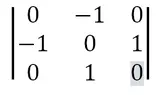
My question is: Can we make below H - matrix and evaluate eigenvalues?


H matrix.webp
 

Attachments

  • H matrix.webp
    H matrix.webp
    2.2 KB · Views: 36
I agree with your values for the first partials; namely, ##f_x = 1 - y, f_y = z - x; f_z = y##, but I disagree that there are no critical points.

The three first partials are zero at on the sets of points {(x, 0, x)} and {(x, 1, x)}, where x is arbitrary. The first set is a line in the x-z plane and the second set is a line in the plane y = 1.

Setting the first partials to zero results in the following matrix equation, but I'm not sure that doing this is helpful or why you need to find eigenvalues.

##\begin{bmatrix} 0&1&0 \\1&0&-1 \\0 & 1& 0\end{bmatrix} \begin{bmatrix} x\\y \\ z\end{bmatrix} = \begin{bmatrix} 1\\ 0 \\ 0\end{bmatrix}##
 
Last edited:
  • Like
Likes   Reactions: Gh. Soleimani
Mark44 said:
I agree with your values for the first partials; namely, ##f_x = 1 - y, f_y = z - x; f_z = y##, but I disagree that there are no critical points.

The three first partials are zero at on the sets of points {(x, 0, x)} and {(x, 1, x)}, where x is arbitrary. The first set is a line in the x-z plane and the second set is a line in the plane y = 1.

Setting the first partials to zero results in the following matrix equation, but I'm not sure that doing this is helpful or why you need to find eigenvalues.

##\begin{bmatrix} 0&1&0 \\1&0&-1 \\0 & 1& 0\end{bmatrix} \begin{bmatrix} x\\y \\ z\end{bmatrix} = \begin{bmatrix} 1\\ 0 \\ 0\end{bmatrix}##
Thank you so much for your answer.

Finally, I need to obtain local minimum, local maximum and saddle points. As you know, we have to use Hessian matrix which will be made by second derivative. In fact, to examine eigenvalues of H - matrix in critical point says to us where is local minimum and local maximum.

2.webp
 
##|H| = \begin{vmatrix} 0&1&0 \\1&0&-1 \\0 & 1& 0\end{vmatrix}## does not depend on the values of x, y, or z. What do you get for |H|?

According to this wiki article, https://en.wikipedia.org/wiki/Hessian_matrix, if det(H) = 0 at a critical point, the critical point is degenerate. If det(H) is not 0, the critical point is non-degenerate.
 
  • Like
Likes   Reactions: Gh. Soleimani
Yes. You are right. Here, the eigenvalue of the “H” matrix is equal to zero; therefore, the test is inclusive, and I have to use a contour map to obtain the local minimum/maximum and saddle point.
But perhaps there is another way, which is to utilize some data analysis models by machine for a selected domain.
 
  • #10
Mark44 said:
##|H| = \begin{vmatrix} 0&1&0 \\1&0&-1 \\0 & 1& 0\end{vmatrix}## does not depend on the values of x, y, or z. What do you get for |H|?

According to this wiki article, https://en.wikipedia.org/wiki/Hessian_matrix, if det(H) = 0 at a critical point, the critical point is degenerate. If det(H) is not 0, the critical point is non-degenerate.

A Hessian matrix must be symmetric; this matrix is not. This is a consequence of the problem I noted in my earlier post: the vector field specified by the OP is not the gradient of a scalar function.
 

Similar threads

  • · Replies 8 ·
Replies
8
Views
868
  • · Replies 6 ·
Replies
6
Views
3K
  • · Replies 11 ·
Replies
11
Views
2K
  • · Replies 17 ·
Replies
17
Views
3K
  • · Replies 16 ·
Replies
16
Views
3K
  • · Replies 1 ·
Replies
1
Views
3K
  • · Replies 1 ·
Replies
1
Views
2K
  • · Replies 32 ·
2
Replies
32
Views
4K
  • · Replies 1 ·
Replies
1
Views
2K
  • · Replies 1 ·
Replies
1
Views
3K