How to find the frequency of the second wave?

Click For Summary

Homework Help Overview

The discussion revolves around determining the frequency of a second wave in relation to a known wave, using concepts of beat frequency and waveform analysis.

Discussion Character

  • Exploratory, Conceptual clarification, Problem interpretation

Approaches and Questions Raised

  • Participants explore the relationship between the frequencies of two waves and the resulting beat frequency. Questions are raised about how to interpret the waveforms and the implications of observed characteristics.

Discussion Status

Participants are actively engaging with the problem, with some providing insights into the relationship between the frequencies and the beat frequency. There is an ongoing exploration of how to apply the relevant equations and observations from the waveforms.

Contextual Notes

There are reminders about forum rules regarding the provision of complete solutions, emphasizing the need for participants to demonstrate their own understanding and reasoning in the discussion.

nineteen
Messages
68
Reaction score
12
Homework Statement
I have provided the question as a photograph. Please refer to that.
Relevant Equations
Beat frequency = Frequency of wave 2 - Frequency of wave 1
I don’t understand how to approach this. So I couldn’t make an attempt at a solution. Please help me understand better. Thank you in advance.
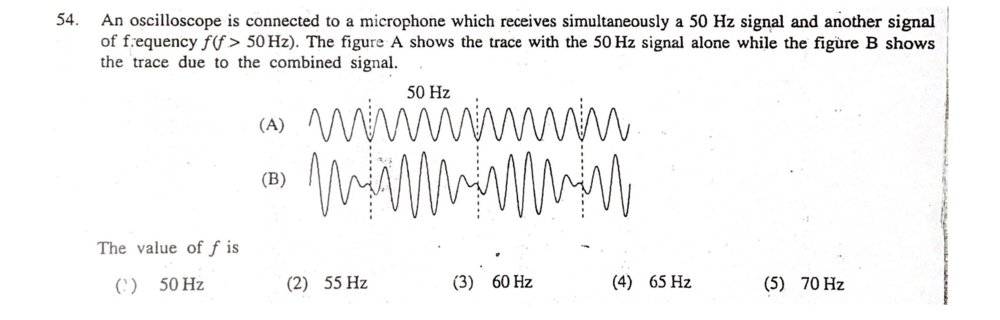
1993D20D-145A-4DC4-926D-165C709BEB78.jpeg
 
Physics news on Phys.org
As you write in the equations section , beat frequency=frequency of wave 2-frequency of wave 1.
The beat frequency is the frequency of the combined signal, that is signal (B). Frequency of wave 1 is the frequency of signal (A), while frequency of wave 2 is the frequency of the unknown signal (C).

What can you tell, by observing the waveforms A and B, about the frequency of signal (A) in relation to the frequency of signal (B)? How many times bigger or how many times smaller is the frequency of signal (A) than that of (B)?
 
  • Like
Likes   Reactions: nineteen
Delta2 said:
As you write in the equations section , beat frequency=frequency of wave 2-frequency of wave 1.
The beat frequency is the frequency of the combined signal, that is signal (B). Frequency of wave 1 is the frequency of signal (A), while frequency of wave 2 is the frequency of the unknown signal (C).

What can you tell, by observing the waveforms A and B, about the frequency of signal (A) in relation to the frequency of signal (B)? How many times bigger or how many times smaller is the frequency of signal (A) than that of (B)?

Hey, I know the answer also, the answer is 60Hz. I just want an explanation of how it came because.
 
The correct answer is 3) 60Hz. I just want an explanation on how it became the answer.
 
nineteen said:
The correct answer is 3) 60Hz. I just want an explanation on how it became the answer.
It is not entirely clear whether you asking how the equation you quote is justified or how to apply it in this case. Maybe both?
For how to apply, look at B. The magnitudes of the rapid oscillations are at a minimum where the vertical dotted lines have been drawn. So from one such line to the next is one period of the beat. Given that A shows 50Hz, what is the beat frequency in B?
 
  • Like
Likes   Reactions: nineteen
It is against the rules of these forums to provide you with a full detailed solution, without you showing some effort to participate in the solution steps.
So please participate and try to answer my question (or Haruspex's question in post #5). What can you say about the frequency of the combined signal B just by observing the waveforms in the figure and especially by comparing the parts between the dotted lines?
 
Last edited:
  • Like
Likes   Reactions: nineteen
Delta2 said:
It is against the rules of these forums to provide you with a full detailed solution, without you showing some effort to participate in the solution steps.
So please participate and try to answer my question (or Haruspex's question in post #5). What can you say about the frequency of the combined signal B just by observing the waveforms in the figure and especially by comparing the parts between the dotted lines?

I found the way. 5 waves in a certain time duration gives 50Hz. For the same time duration it only shows 1 beat in wave form B. Given that, after combining the 50Hz frequency and the frequency f the beats per that certain time is 1. As the equation says the beat frequency is the difference between the two combined frequencies, and here the difference of the two frequencies gives 1 beat per unit time. 5 waves gives 50 Hz (5 x 10) and 1 beat should also give the multiplication of it by 10 as its frequency. So the real beat frequency is 10 Hz. The question mentions that the frequency f is greater than 50 Hz. So what frequency greater than 50 Hz here gives difference between it and 50 Hz as 10 Hz. None other than 60 Hz. So the answer is 60 Hz. Am I correct?

@haruspex you also please check whether my solution is right or wrong.

Thank you both @Delta2 and @haruspex
 
Well, you are correct mostly. The only thing that seems abit vague to me is your explanation on why the beat frequency is 10Hz. Other than that all is good.
 

Similar threads

  • · Replies 6 ·
Replies
6
Views
2K
  • · Replies 5 ·
Replies
5
Views
2K
  • · Replies 7 ·
Replies
7
Views
2K
Replies
16
Views
3K
Replies
5
Views
1K
Replies
2
Views
1K
  • · Replies 6 ·
Replies
6
Views
2K
  • · Replies 22 ·
Replies
22
Views
3K
  • · Replies 29 ·
Replies
29
Views
2K
  • · Replies 1 ·
Replies
1
Views
4K