How to form the stress tensor component from the equilibrium equation?

Click For Summary

Homework Help Overview

The discussion revolves around forming the stress tensor components from equilibrium equations in the context of mechanics of materials, specifically under conditions of plane stress.

Discussion Character

  • Exploratory, Assumption checking, Problem interpretation

Approaches and Questions Raised

  • Participants explore the implications of the equilibrium equation div(σ)=0 and discuss the form of the stress tensor components. There are questions about boundary conditions and their relevance to the problem. Some participants express uncertainty about the linearity of the proposed functions.

Discussion Status

The discussion is active, with participants questioning the boundary conditions and their impact on the stress tensor formulation. There is a focus on understanding the implications of the equilibrium equations rather than solving them outright.

Contextual Notes

Participants note specific boundary conditions related to constant pressure on lateral surfaces and no stress on the top and bottom surfaces, which are under consideration in the context of the problem.

lachgar
Messages
6
Reaction score
0
Homework Statement
An elastic homogene and isotrope cuboid that is under a constant pressure (-p) in its 4 lateral surfaces. We neglect the weight .
Relevant Equations
equilibre equation, bondary conditions, s
Good evening everybody.
This is my suggestion for answer.
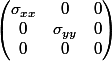
The tensor is diagonal and the compression is a plane stress
ile_TEX.gif


equilibre equation div(σ)=0
so:

ile_TEX.gif


So, does that means that
ile_TEX.gif
= f(y.z) = Ay+Bz and
ile_TEX.gif
=f(x.z)= Cx+Dz
A,B,C and D are constants.
Is that what the question meant?
Thank you in advance.
 
Physics news on Phys.org
What are the boundary conditions?
 
Hi. Thanks for replying.
As shown in the picture, all lateral surfaces are under a constant pressure.
There is no stress on the superior S(z=h/2) and inferior S(z=-h/2) surfaces. (h is the thickness).
The red arrow represent the stress vector, and the black one represent the unit normal vector of the surface.
bondary conditions.png

Thank you.
 
So, to repeat my question, what does this imply for the boundary conditions?
 
The bondary conditions are:

T(ex)=-p ex
T(-ex)=p ex
T(ey) =-p ey
T(-ey) = p ey
T is the stress vector.
 
So how does this relate to your solution?
 
The question was posed as:
-Using the equilibre equations, give the form of
ile_tex-gif.gif
and
ile_tex-gif.gif
?
 
Yes, and you started this thread by writing down differential equations for them. To solve differential equations you need boundary conditions.
 
it's not demanded to solve it, it's bout giving the general form

So,can we just say that

ile_tex-gif-gif.gif
= f(y.z) = Ay+Bz

How can I be sure that it's a linear form, I mean we only know that it depends on y and z.
 
  • #10
Thank you
 

Similar threads

  • · Replies 6 ·
Replies
6
Views
3K
Replies
1
Views
2K
  • · Replies 2 ·
Replies
2
Views
2K
  • · Replies 4 ·
Replies
4
Views
1K
  • · Replies 8 ·
Replies
8
Views
5K
  • · Replies 17 ·
Replies
17
Views
3K
  • · Replies 4 ·
Replies
4
Views
3K
Replies
1
Views
5K
  • · Replies 1 ·
Replies
1
Views
3K
  • · Replies 2 ·
Replies
2
Views
5K