yeyintkoko
- 14
- 0
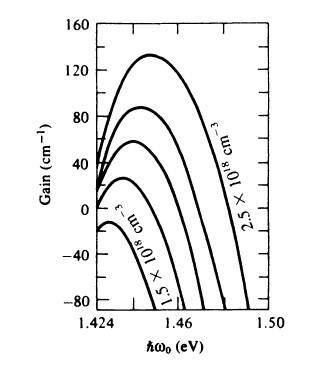
How can i calculate this plot (photon energy dependence of the optical gain (or loss = negative gain) of GaAs with the injected carrier density as a parameter?
Show calculated plot based on this equation

Given parameter:
mc=0.067 me; (effective mass of electrons in conduction band)
mv=0.48 me; (effective mass of holes in valence band)
T2~0.5 ps; (lifetime for coherent interaction of electrons with a monochromatic field)
Eg=1.43 eV; (energy band gap of GaAs)
taung~3x10⁻⁹s; (recombination lifetime)
1/mr=1/mc+1/mv; ( reduced effective mass)
n= 3.6: (refractive index for GaAs)
How can i find this value
ħω (energy of photon)- this should be ħω>Eg. How can i determine this energy?
λ0
ω0 ( if i known λ0, can i get ω0? (ω=c/λ))
[ƒc(ω)-ƒv(ω)]
Really I need your help. I am new for semiconductor laser. Please anyone help me.
Thanks!
Show calculated plot based on this equation
Given parameter:
mc=0.067 me; (effective mass of electrons in conduction band)
mv=0.48 me; (effective mass of holes in valence band)
T2~0.5 ps; (lifetime for coherent interaction of electrons with a monochromatic field)
Eg=1.43 eV; (energy band gap of GaAs)
taung~3x10⁻⁹s; (recombination lifetime)
1/mr=1/mc+1/mv; ( reduced effective mass)
n= 3.6: (refractive index for GaAs)
How can i find this value
ħω (energy of photon)- this should be ħω>Eg. How can i determine this energy?
λ0
ω0 ( if i known λ0, can i get ω0? (ω=c/λ))
[ƒc(ω)-ƒv(ω)]
Really I need your help. I am new for semiconductor laser. Please anyone help me.
Thanks!