How to increase the voltage by using CS5173?

  • Thread starter Thread starter ling1995
  • Start date Start date
  • Tags Tags
    increase Voltage
Click For Summary

Discussion Overview

The discussion revolves around the challenges of increasing voltage from 24V to 36V using the CS5173 chip. Participants explore potential causes for the chip burning out and seek clarification on the use of inductors in the circuit design, including whether they are coupled transformers or standalone inductors.

Discussion Character

  • Technical explanation
  • Debate/contested

Main Points Raised

  • One participant expresses difficulty in raising the voltage and questions whether the components in their circuit are coupled transformers or absolute inductors.
  • Another participant warns about exceeding the absolute maximum rating of Vcc, suggesting a maximum operating point of 30V for reliability.
  • A suggestion is made to add diodes or zener diodes in series with VCC before the capacitor to protect the circuit.
  • There is a request for clarification on how to determine if the inductors are coupled, with a follow-up question about the implications of using coupled versus uncoupled inductors.
  • A participant explains that ordinary single inductors are not polarized, while coupled inductors require attention to polarity, referencing the transformer dot convention.
  • Another participant provides a link to an example of coupled inductors and asks for more details about the specific components being used in the original circuit, as well as the conditions under which the chip fails.

Areas of Agreement / Disagreement

Participants do not reach a consensus on the cause of the chip failure or the configuration of the inductors. Multiple viewpoints and suggestions are presented, indicating ongoing uncertainty and exploration of the topic.

Contextual Notes

Participants express concerns about the maximum voltage ratings and the implications of using coupled versus uncoupled inductors, but specific assumptions and conditions related to the circuit design remain unresolved.

ling1995
Messages
2
Reaction score
0
Hello~all,thanks for taking time to read my thread. I'm in hot water now,Can anybody here help me out?
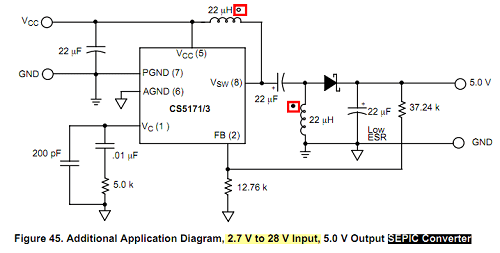
Please look at the following picture,I would like to rise the voltage from 24V to 36V. And I did it according to the datasheet of CS5173. However,the chip always burned out ! I can’t understand what occurred ? Does anyone know ?Are the two parts in the picture of 22uH coupling transformers? Or they are absolute inductance?

Thank you in advance!
Wishes~
3.20.1.png
 
Engineering news on Phys.org
Per the datasheet that you have referenced, the absolute maximum rating of Vcc is 35 V. You can exceed that at your peril. Never operate at the absolute maximum rating. All test conditions in the datasheet indicate a 30 V maximum, that is probably a good maximum operating point for long term reliability.

Those dots are for reference when using coupled inductors. If the 2 inductors are coupled, then the polarity dots should be observed. If not coupled then it does not matter.
 
  • Like
Likes   Reactions: ling1995
Put a few diodes or zenner in series with VCC before the capacitor?
 
ling1995 said:
I would like to rise the voltage from 24V to 36V.

which voltage ?
 
lewando said:
Per the datasheet that you have referenced, the absolute maximum rating of Vcc is 35 V. You can exceed that at your peril. Never operate at the absolute maximum rating. All test conditions in the datasheet indicate a 30 V maximum, that is probably a good maximum operating point for long term reliability.

Those dots are for reference when using coupled inductors. If the 2 inductors are coupled, then the polarity dots should be observed. If not coupled then it does not matter.
But how do I know if them are coupled inductors? Could you explain it more clearly?Thank you!
 
An ordinary single inductor isn't polarised, you can fit it either way around. With two coupled inductors (aka transformer) the polarity of one inductor with respect to the other matters. That's why they put a dot. Google transformer dot convention.
 
  • Like
Likes   Reactions: ling1995
Here is an example of coupled inductors:
http://www.coilcraft.com/pdfs/msd1260.pdf

The circuit you provided in your OP shows polarization if you choose to use coupled inductors. You do not need to use coupled inductors. Since you have built something already, why don't you tell us what specific components you are using. Also include what diode are you using.

ling1995 said:
However,the chip always burned out !
Does this mean it never worked? Even at 24 V? Or is there a specific input voltage that makes it fail? What output current are you trying to provide when it fails?
 
  • Like
Likes   Reactions: ling1995

Similar threads

Replies
4
Views
3K
Replies
7
Views
2K
Replies
9
Views
2K
  • · Replies 4 ·
Replies
4
Views
6K
Replies
12
Views
5K
Replies
1
Views
1K
Replies
1
Views
3K
Replies
11
Views
3K
  • · Replies 1 ·
Replies
1
Views
5K
  • · Replies 2 ·
Replies
2
Views
3K