How to make a water rocket fly high?

  • Thread starter Thread starter zeo2396
  • Start date Start date
  • Tags Tags
    Rocket Water
Click For Summary

Homework Help Overview

The discussion revolves around the design and performance of a water rocket, specifically focusing on stability, fin design, weight distribution, and the deployment of a parachute. Participants are exploring factors that influence the rocket's flight path and altitude.

Discussion Character

  • Exploratory, Assumption checking, Problem interpretation

Approaches and Questions Raised

  • The original poster attempts to understand why their rocket flies in a twisty manner and questions the effectiveness of using four fins versus three. They inquire about materials for fins and their placement on the bottle.
  • Participants suggest that stability may be affected by the attachment of the fins and the distribution of weight in the nose cone. They discuss the importance of fin area and center of gravity.
  • Questions are raised about the optimal amount of water to fill in the bottle and the appropriate pressure for launching.
  • There is curiosity about how to ensure the nose cone releases properly to deploy the parachute.

Discussion Status

Contextual Notes

Participants are working within the constraints of a homework assignment, which may limit the resources and methods they can use. There is a focus on practical experimentation and iterative testing of the rocket's design.

zeo2396
Messages
9
Reaction score
0
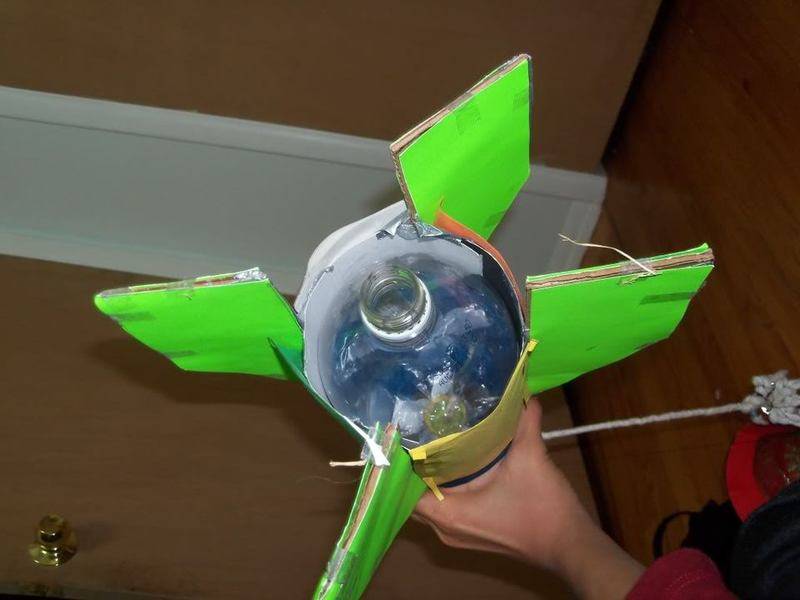
I did a bottle rocket yesterday (2 liter bottle). I made 4 fins and the end of the fins touch the ground instead of the bottle's opening. I also equip my rocket with a parachute (hide under the nose cone). In addition, I added a modeling clay to my nosecone too! When I tested it, my teacher said I should fill a rocket 3/4 with water and pump to 100 psi. I did as he said and my rocket fly short and twisty. My teacher said that I did something wrong with my rocket because it lost the balance when it fly. I have no idea what can I add to my rocket to make it fly straight up (not twisty) and high in the sky.

1. Do you think my rocket fly twisty because of 4 fins? I think I should made 3 instead of 4. Also, what is the good material to make rocket's fins (carton, or paper..)? Should I stick the fins at the half of the bottle or near the bottle opening to keep it easily to stand?
2. I add clay to my nose cone to make it heavier and easier to release the parachute under it. I didn't stick my nosecone to the rocket body but it didn't drop out when it fly to release the parachute. What can I do make my nosecone drop out when it reach the maximum height. My parachute didn't come out, is it because the way i fold it is wrong!

3. What amount of water do you think I should add to my 2 liter bottle rocket? (1/4 or 2/4 or 3/4) and what is the best "psi" should I pump to?

4. Should I make my rocket heavy or light (specially is the nosecone)?

I hope you answer my question and give me some of your great ideas to make my rocket fly high and straight and to active the parachute easily!

Thank you very much!:shy:

Here are my rocket's pictures:

1.Full view
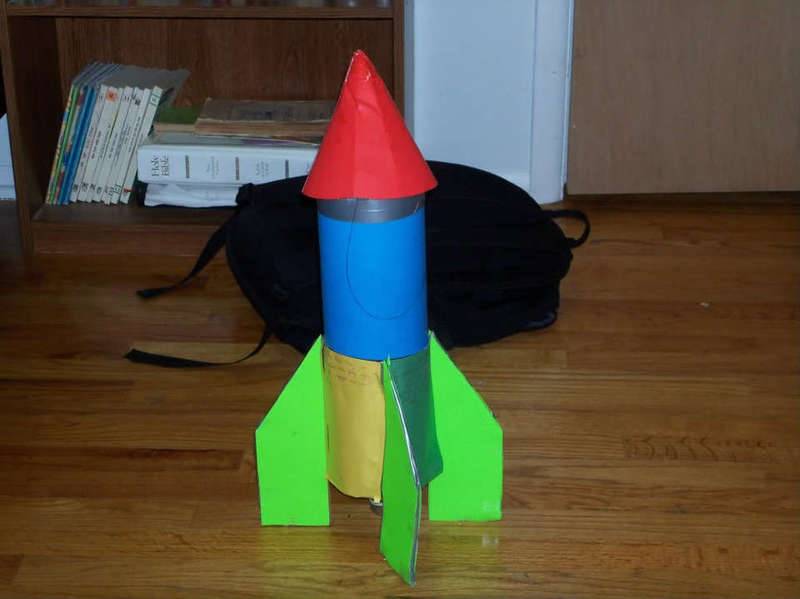
100_9909-1.jpg


2. Fins touch the ground instead of the bottle's opening:
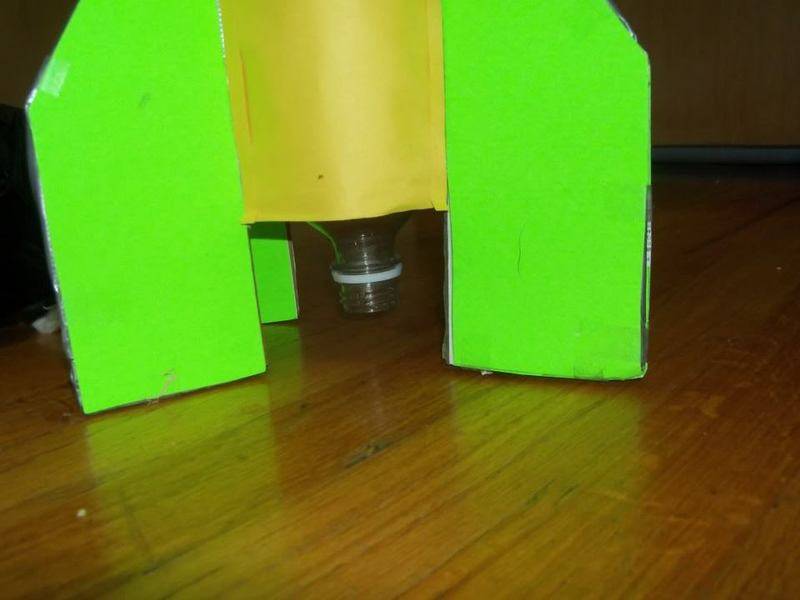
100_9905.jpg


3.When the nosecone come off the rocket, the parachute release:
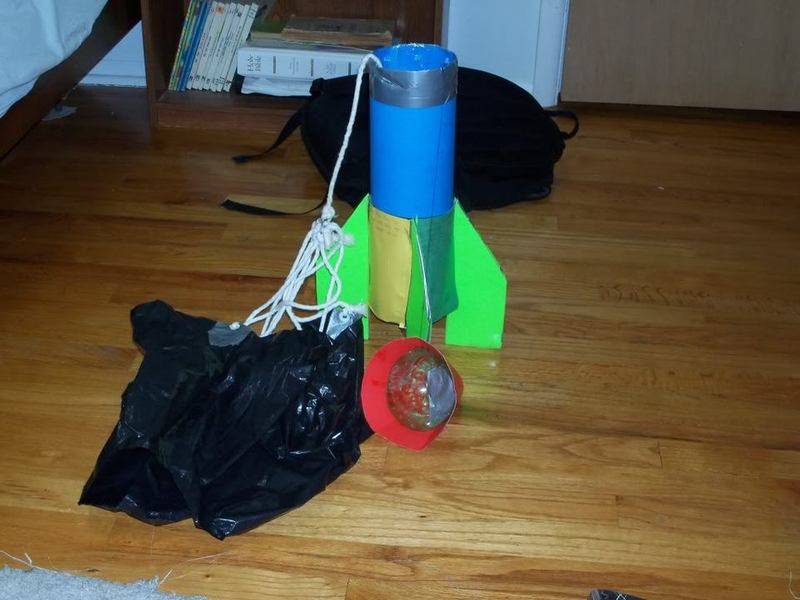
100_9908.jpg


4. 4 Fins:
100_9907.jpg
 
Last edited:
Physics news on Phys.org
It sounds like your rocket was unstable. For stability, you need a sufficient amount of fin area (4 is better than 3 in this regard, and larger fins are also better), and you also need the center of gravity to be far enough forward. The noseweight helps with this (though too much weight in the nose will hinder altitude, since you're making the rocket heavier). The fins should be as far back as possible, and in the free airstream (not just behind the main bottle). Another key is for the fins to be stiff and solidly attached. If they can just flap around in the airstream, they won't do much to aid stability.

As for pressure and quantity of water? 100PSI and 3/4 full should be pretty good to get close to max altitude, but for test flights, I would go with 40PSI and around half full. That way you can see what's happening a bit better, and it won't have as much energy if something goes wrong. Then, once you get it working, you can ramp up to the 100psi 3/4 full flight.

Do you have any pictures of your design?
 
cjl said:
It sounds like your rocket was unstable. For stability, you need a sufficient amount of fin area (4 is better than 3 in this regard, and larger fins are also better), and you also need the center of gravity to be far enough forward. The noseweight helps with this (though too much weight in the nose will hinder altitude, since you're making the rocket heavier). The fins should be as far back as possible, and in the free airstream (not just behind the main bottle). Another key is for the fins to be stiff and solidly attached. If they can just flap around in the airstream, they won't do much to aid stability.

As for pressure and quantity of water? 100PSI and 3/4 full should be pretty good to get close to max altitude, but for test flights, I would go with 40PSI and around half full. That way you can see what's happening a bit better, and it won't have as much energy if something goes wrong. Then, once you get it working, you can ramp up to the 100psi 3/4 full flight.

Do you have any pictures of your design?

Here are my rocket's pictures:

1.Full view
100_9909-1.jpg


2. Fins touch the ground instead of the bottle's opening:
100_9905.jpg


3.When the nosecone come off the rocket, the parachute release:
100_9908.jpg


4. 4 Fins:
100_9907.jpg


Do you know how to stabilize my rocket?
 

Attachments

  • 100_9908.jpg
    100_9908.jpg
    51.9 KB · Views: 1,061
  • 100_9905.jpg
    100_9905.jpg
    31.6 KB · Views: 981
  • 100_9909-1.jpg
    100_9909-1.jpg
    33.6 KB · Views: 1,424
Last edited:
Your fin area and placement looks fine - I think the problem is the attachment. Fins which can flop around freely provide almost no stabilization. You should really find some way of attaching them more securely. That should probably fix your stabilization problems.
 

Similar threads

  • · Replies 14 ·
Replies
14
Views
2K
  • · Replies 53 ·
2
Replies
53
Views
5K
  • · Replies 24 ·
Replies
24
Views
4K
Replies
8
Views
6K
  • · Replies 25 ·
Replies
25
Views
3K
  • · Replies 5 ·
Replies
5
Views
3K
  • · Replies 3 ·
Replies
3
Views
3K
  • · Replies 15 ·
Replies
15
Views
2K
  • · Replies 8 ·
Replies
8
Views
2K
  • · Replies 20 ·
Replies
20
Views
7K