How to Solve a Composition of Functions g(f(x))?

  • Context: MHB 
  • Thread starter Thread starter Ebone_Love
  • Start date Start date
  • Tags Tags
    Composition Functions
Click For Summary
SUMMARY

The discussion focuses on solving the composition of functions \( g(f(x)) \) where \( f(x) = \frac{1}{x} - 4 \) and \( g(x) = \frac{2}{x} + 4 \). Participants clarify that to simplify \( g(f(x)) \), one must substitute \( f(x) \) into \( g(x) \), leading to the expression \( g(f(x)) = 2(x - 4) + 4 \), which simplifies to \( 2x - 4 \). The conversation also includes a step-by-step breakdown of the algebraic manipulation required to arrive at the final simplified form.

PREREQUISITES
  • Understanding of function composition
  • Familiarity with algebraic manipulation
  • Knowledge of rational functions
  • Ability to interpret mathematical notation
NEXT STEPS
  • Study function composition in detail
  • Learn about simplifying rational expressions
  • Explore graphing techniques for composite functions
  • Investigate the properties of rational functions and their transformations
USEFUL FOR

Students, educators, and anyone interested in advanced algebra, particularly those working with function composition and simplification techniques.

Ebone_Love
Messages
5
Reaction score
0
g(f(x))=\( g(f(x))=2/(1/x-4)+4 \)
 
Mathematics news on Phys.org
Ebone_Love said:
g(f(x))=\( g(f(x))=2/(1/x-4)+4 \)
What is your question? If it's to find a possible combination of f(x) and g(x), then
[math]f(x) = \dfrac{1}{x} - 4[/math]

and
[math]g(x) = \dfrac{2}{x} + 4[/math]
will do the trick.

-Dan
 
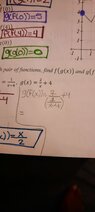
Thank you, but I already know f(x) and g(x). I am trying to solve the equation for \( g(f(x)) \)
 
I need help solving the written part of the question in the attached photo.
 

Attachments

  • 20210627_212029.jpg
    20210627_212029.jpg
    373.3 KB · Views: 135
You have g(f(x)). What are you trying to "solve?" Are you trying to graph it? Make a table?

[math]
\begin{array}{ l c r } x & f(x) & g(x) \\ -2 & -1/6 & -8 \\ -1 & -1/5 & -6 \\ 0 & -1/4 & -4 \\ 1 & -1/3 & -2 \\ 2 & -1/2 & 0 \\ \end{array}
[/math]Also: g(f(x)) = 2/( 1/(x - 4) ) + 4. You need an extra set of parenthesis.

-Dan
 
I am so sorry I forgot what I wanted to say 😂, which was that I wanted to simplify g(f(x)).
 
Then you have to put $f(x) $ in $g(f(x))$ and solve. Considering the picture you have sent $f(x) = $ $1 \over (x-4)$ and $g(x)=$ $2 \over x$ $+4$
so we have $g(f(x))= 2(x-4) + 4 = 2x + 4$
 
Thank you topsquark.
 
Ebone_Love said:
g(f(x))=\( g(f(x))=2/(1/x-4)+4 \)
$\frac{2}{\frac{1}{x}- 4}+ 4= \frac{2}{\frac{1}{x}- \frac{4x}{x}}+ 4= \frac{2}{\frac{1-4x}{x}}+ 4= \frac{2x}{1- 4x}+ 4$.

That would satisfy me but you could continue as
$\frac{2x}{1- 4x}+ \frac{4(1- 4x)}{1- 4x}= \frac{2x+ 4- 16x}{1- 4x}= \frac{4- 14x}{1- 4x}$.
 
  • #10
DaalChawal said:
Then you have to put $f(x) $ in $g(f(x))$ and solve. Considering the picture you have sent $f(x) = $ $1 \over (x-4)$ and $g(x)=$ $2 \over x$ $+4$
so we have $g(f(x))= 2(x-4) + 4 = 2x + 4$
No, 2(x- 4)+ 4= 2x- 8+ 4= 2x- 4.
 

Similar threads

Replies
1
Views
1K
  • · Replies 3 ·
Replies
3
Views
2K
  • · Replies 2 ·
Replies
2
Views
1K
  • · Replies 2 ·
Replies
2
Views
1K
  • · Replies 5 ·
Replies
5
Views
1K
  • · Replies 4 ·
Replies
4
Views
2K
  • · Replies 6 ·
Replies
6
Views
2K
  • · Replies 10 ·
Replies
10
Views
2K
  • · Replies 2 ·
Replies
2
Views
1K
  • · Replies 3 ·
Replies
3
Views
1K