Discussion Overview
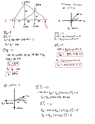
The discussion revolves around solving a statics truss problem at joint C using the joint method. Participants are exploring the steps involved in analyzing forces at various joints within the truss structure, specifically focusing on joint C and the implications of choosing different nodes for analysis.
Discussion Character
- Homework-related
- Technical explanation
- Mathematical reasoning
- Exploratory
Main Points Raised
- One participant expresses difficulty in continuing the problem at joint C and requests assistance using the joint method.
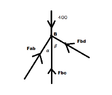
- Another participant suggests analyzing node B first, as it has only two unknown forces, which would simplify the analysis before proceeding to joint C.
- A participant provides equations for the forces at joint B, indicating how to set up the free body diagram and the relationships between the forces.
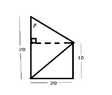
- There is a discussion about determining angles $\alpha$ and $\beta$, with one participant confirming the value of $\beta$ as 63.4 degrees.
- A later post introduces the idea of solving the problem using the method of sections, indicating an alternative approach to the joint method.
Areas of Agreement / Disagreement
Participants generally agree on the approach of analyzing node B before joint C due to the number of unknowns. However, there is no consensus on the overall strategy, as one participant introduces the method of sections as an alternative, suggesting multiple competing views remain.
Contextual Notes
Participants have not resolved the implications of their chosen methods or the specific values of forces at joint C, and there are unresolved mathematical steps related to the angles and forces involved.
Who May Find This Useful
This discussion may be useful for students and practitioners working on statics problems, particularly those involving truss analysis and the application of the joint method and method of sections.