How to Solve a Trigonometry Word Problem Involving Distances

Click For Summary
SUMMARY

This discussion focuses on solving a trigonometry word problem involving distances, specifically calculating the angle of elevation based on given lengths. The user successfully determined the length of PQ as 0.3 miles (1584 feet) using a proportion. The conversation emphasizes the importance of distinguishing between horizontal distances on a map and the actual slope distances when calculating angles of elevation. The user ultimately seeks clarification on how to visualize the incline of the road for better understanding.

PREREQUISITES
  • Understanding of basic trigonometry concepts, including angles and slopes.
  • Familiarity with proportions and unit conversions (e.g., inches to miles).
  • Ability to interpret elevation drawings and maps.
  • Knowledge of how to calculate angles using trigonometric functions.
NEXT STEPS
  • Learn how to calculate angles of elevation using the tangent function.
  • Research methods for converting between different units of measurement (e.g., inches to miles).
  • Study the principles of creating elevation drawings from plan views.
  • Explore real-world applications of trigonometry in engineering and architecture.
USEFUL FOR

Students studying trigonometry, educators teaching math concepts, and professionals in fields requiring spatial analysis, such as engineering and architecture.

nmnna
Messages
22
Reaction score
3
Homework Statement
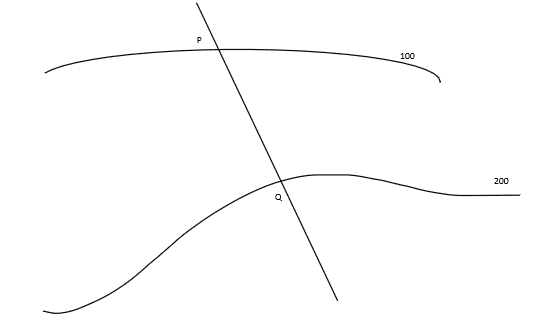
A map shows a straight road crossing two contour levels 100ft., 200ft. at P, Q. The length of PQ is 1.2 inches, and the scale of the map is 4 inches to the mile. What average angle does the road make with the horizontal?
Relevant Equations
$$\tan(\alpha) = \frac{opposite \ side}{adjacent \ side}$$
The sketch:
1616055720828.png

First of all find the length of PQ on i.e
$$4 \ inches - 1 \ mile$$
$$1.2 \ inches - x \ mile$$
$$x = \frac{1.2}{4} = 0.3 \ mile = 1584 \ ft$$

Now, I do not understand where shall I draw the horizontal, and the connection between the lengths of the contours, so I'll be grateful if you give me some hints for solving this problem.
Thank you.
 
Last edited by a moderator:
Physics news on Phys.org
Why don't you draw the road incline from the side?
 
PeroK said:
Why don't you draw the road incline from the side?
1616059506536.png

Like this?
 
No. From the side. So you can see the road going uphill!
 
PeroK said:
No. From the side. So you can see the road going uphill!
You mean from the opposite side? Sorry for my dumbness..
 
A map is a "Plan". You want an "End Elevation" or "Side Elevation":

 
PeroK said:
A map is a "Plan". You want an "End Elevation" or "Side Elevation":


I think I understand now.
So the difference between the heights of the road is 100, I have the length of PQ, what I need to do now is to calculate the angle, right?
 
nmnna said:
I think I understand now.
So the difference between the heights of the road is 100, I have the length of PQ, what I need to do now is to calculate the angle, right?
Note that the distances on a map (you should be able to find out this sort of thing yourself from the Internet) are horizontal distances, not the hypoteneuse of slopes.
 
  • Like
Likes   Reactions: nmnna
PeroK said:
Note that the distances on a map (you should be able to find out this sort of thing yourself from the Internet) are horizontal distances, not the hypoteneuse of slopes.
Okey, sorry for the trouble
 

Similar threads

  • · Replies 7 ·
Replies
7
Views
4K
  • · Replies 3 ·
Replies
3
Views
4K
  • · Replies 4 ·
Replies
4
Views
2K
Replies
5
Views
9K
Replies
6
Views
4K
  • · Replies 3 ·
Replies
3
Views
3K
  • · Replies 72 ·
3
Replies
72
Views
9K
  • · Replies 8 ·
Replies
8
Views
4K
  • · Replies 2 ·
Replies
2
Views
2K
Replies
2
Views
700