How to understand linear momentum?

Click For Summary

Homework Help Overview

The discussion revolves around understanding linear momentum and its relationship with force and kinetic energy. The original poster expresses confusion regarding the force required to bring two bodies with the same linear momentum to rest, noting discrepancies in their behavior during exercises.

Discussion Character

  • Conceptual clarification, Assumption checking

Approaches and Questions Raised

  • Participants explore the relationship between linear momentum and force, questioning how different scenarios affect the force needed to stop bodies with the same momentum. There is a mention of comparing forces over distance versus time.

Discussion Status

Some participants have offered insights into the differences between kinetic energy and momentum, suggesting that the original poster consider the time it takes for the bodies to come to rest. There is an acknowledgment of the complexity involved in these concepts, and participants are engaging with the ideas presented.

Contextual Notes

There are references to homework guidelines and the need for clarity in distinguishing between kinetic energy and momentum, indicating that these concepts are central to the discussion.

Javier Mont
Messages
9
Reaction score
0
I understand for linear momentum the measure of the dificulty to take a body to the rest. But when I do the next exercises, I find that it requires less force for one body compared to the other with same linear momentum.
Can someone explain me what to understand in an intuitive way what to expect when I see a certain magnitud of linear momentum from a body?
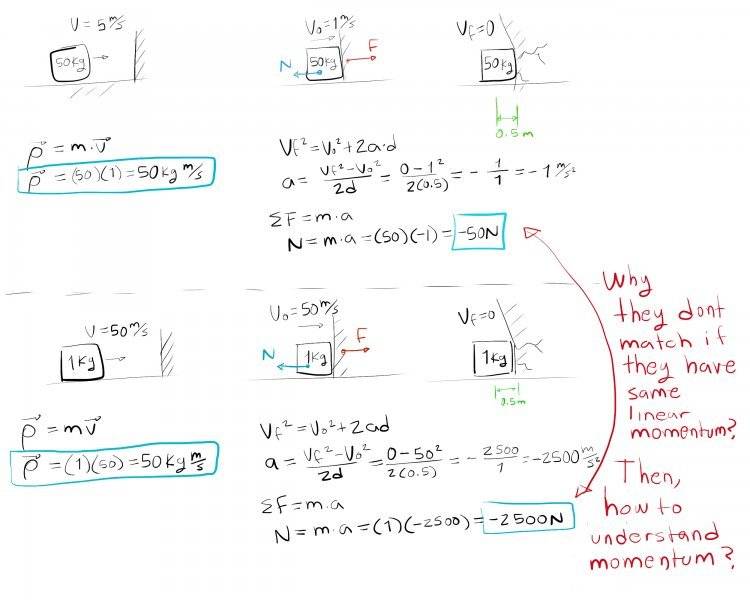
193E321A2.jpg
 

Attachments

  • 193E321A2.jpg
    193E321A2.jpg
    40.4 KB · Views: 895
Last edited by a moderator:
Physics news on Phys.org
Hello Javier, :welcome:

Actually, PF culture asks you post questions like this in the homework forums. Never mind, I'll ask a mentor.
<Moderator's note: thread moved>

Can you check how long it takes for the two bodies to come to rest ? That's where a difference between the two cases comes in !

A line of thought that may help you:

Acceleration is the time derivative of velocity : ##\vec a = {d\vec v\over dt}##. For a body of a given mass m, multiply this equation with m: $$m\vec a = m {d\vec v\over dt}$$On the left you have (according to Newton) ##\vec F## and on the right there is ##d\vec p\over dt## (since m is a constant) and you get $$\vec F ={ d\vec p\over dt}$$.

Now the cases in your picture: both bodies come to rest over a distance of 0.5 m and you calculate the force needed to achieve this (assuming it is constant). So you compare the products ##\ F\ d\ \ ##. This product has the dimension of energy and in fact you compare the kinetic energies of the two bodies. Kinetic energy is ##{1\over 2}mv^2## so it's no wonder you results differ by a factor of 50 !

If you calculate the forces needed to stop the two bodies in the same time instead of over the same distance , the result may be more to your liking...:smile:
 
Last edited by a moderator:
  • Like
Likes   Reactions: Javier Mont
BvU said:
Now the cases in your picture: both bodies come to rest over a distance of 0.5 m and you calculate the force needed to achieve this (assuming it is constant). So you compare the products F d F d \ F\ d\ \ . This product has the dimension of energy and in fact you compare the kinetic energies of the two bodies. Kinetic energy is 12mv212mv2{1\over 2}mv^2 so it's no wonder you results differ by a factor of 50 !

If you calculate the forces needed to stop the two bodies in the same time instead of over the same distance , the result may be more to your liking...:smile:
Yes. It is important to realize the difference between Kinetic Energy and Momentum. Early Science failed to distinguish between the two and had a lot of problems of the sort that the OP quotes.
 
  • Like
Likes   Reactions: Javier Mont
BvU said:
Hello Javier, :welcome:

Actually, PF culture asks you post questions like this in the homework forums. Never mind, I'll ask a mentor.
<Moderator's note: thread moved>

Can you check how long it takes for the two bodies to come to rest ? That's where a difference between the two cases comes in !

A line of thought that may help you:

Acceleration is the time derivative of velocity : ##\vec a = {d\vec v\over dt}##. For a body of a given mass m, multiply this equation with m: $$m\vec a = m {d\vec v\over dt}$$On the left you have (according to Newton) ##\vec F## and on the right there is ##d\vec p\over dt## (since m is a constant) and you get $$\vec F ={ d\vec p\over dt}$$.

Now the cases in your picture: both bodies come to rest over a distance of 0.5 m and you calculate the force needed to achieve this (assuming it is constant). So you compare the products ##\ F\ d\ \ ##. This product has the dimension of energy and in fact you compare the kinetic energies of the two bodies. Kinetic energy is ##{1\over 2}mv^2## so it's no wonder you results differ by a factor of 50 !

If you calculate the forces needed to stop the two bodies in the same time instead of over the same distance , the result may be more to your liking...:smile:

Thank you very much! You´re right! That difficult to take a body to rest (linear momentum) is the Force*time, no Force*distance. Thanks!
 
sophiecentaur said:
Yes. It is important to realize the difference between Kinetic Energy and Momentum. Early Science failed to distinguish between the two and had a lot of problems of the sort that the OP quotes.
Interesting
 

Similar threads

  • · Replies 5 ·
Replies
5
Views
2K
Replies
335
Views
17K
Replies
7
Views
2K
  • · Replies 10 ·
Replies
10
Views
2K
  • · Replies 62 ·
3
Replies
62
Views
14K
  • · Replies 3 ·
Replies
3
Views
2K
Replies
26
Views
2K
  • · Replies 13 ·
Replies
13
Views
1K
Replies
4
Views
1K
  • · Replies 12 ·
Replies
12
Views
3K
