How to visualize the maths behind a formula?

Click For Summary

Discussion Overview

The discussion revolves around understanding the mathematical representation of physical formulas, particularly the diffusion coefficient formula for solids. Participants explore the challenges of visualizing and interpreting the relationships between variables in equations, emphasizing the need for deeper comprehension rather than rote memorization.

Discussion Character

  • Exploratory
  • Technical explanation
  • Conceptual clarification
  • Debate/contested
  • Mathematical reasoning

Main Points Raised

  • One participant expresses frustration with memorizing formulas without understanding their meaning, particularly with complex operations like division and exponentiation.
  • Another participant suggests using graphical programs to visualize how changing constants in the diffusion coefficient formula affects the curve, indicating that ##D## depends exponentially on ##\alpha##.
  • There is a discussion about the negative exponential in formulas, with one participant explaining how it relates to decay over time and the significance of the parameter ##\alpha##.
  • Some participants note that understanding the significance of a formula requires knowledge of differential equations and the physical phenomena they model.
  • A participant points out that understanding the relationships in formulas cannot be achieved by merely analyzing each arithmetic operation in isolation.
  • There is mention of the importance of the variable ##T## in the diffusion coefficient formula and how it influences the behavior of the equation.

Areas of Agreement / Disagreement

Participants express a range of views on the best approach to understanding formulas, with no clear consensus on a single method. Some agree on the importance of visualizing equations, while others emphasize the need for a deeper understanding of the underlying mathematics and physics.

Contextual Notes

Participants highlight the complexity of the diffusion coefficient formula and the need for a solid grasp of differential equations to fully understand its implications. There are unresolved questions about the significance of certain parameters and their effects on the formula's behavior.

Who May Find This Useful

Students and individuals interested in physics, engineering, and mathematics who seek to deepen their understanding of mathematical formulas and their applications in physical contexts.

ward0
Messages
1
Reaction score
0
TL;DR
Most of physics is expressed through mathematical notation. When there's lots of division, multiplication, exponentiation of various terms, I struggle to find meaning in equations
I just finished my freshman year in computer engineering at my college, and after some physics and materials science classes I noticed a pattern. Everybody—at least in my class, I don't about the rest of the world—is just memorizing formulas, myself included. I'm really trying to not just memorize then and instead understand them, and I'm struggling a lot.

Formulas are just a way to express ideas through mathematical notation, I (think) know this much. When they're simple (e.g., the average velocity formula), I can grasp the meaning of an addition, a subtraction, but I even struggle finding meaning when there's division and multiplication sometimes, let alone exponentiation.

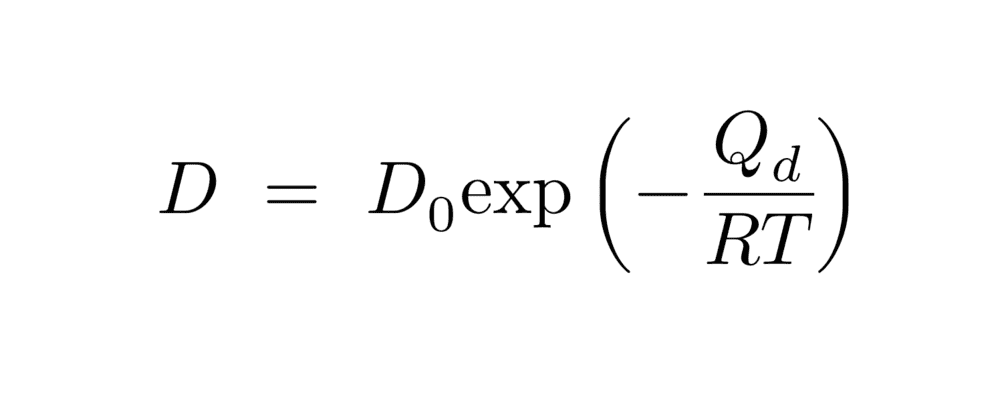
For example sake, here's the diffusion coefficient formula for solids (Callister, 2010):
diffusion_coefficient.png

I don't a have a clue on what it means. I can explain each term independently, I know its application, but I don't know their relation, and this happens in almost every formula presented to me. No one actually bothered explaining this to me, and I just realized now that I pass through formulas and never actually understand them.
Btw I (think, at least) am ok on pure maths, I understood integrals and differentiation without problem, I also know what they mean graphically.

I came here for help, suggestions on reading, articles, even videos, anything. I really want to understand how to visualize these equations and know why it has the terms it has and what they're doing there. If anyone could help me I'd be very grateful.
 
Mathematics news on Phys.org
Not sure whether this is actually a mathematical rather than a physics question.

The first thing you do is grasp the main information: In your example you have ##D=D_0e^\alpha##, which means that ##D## depends exponentially on ##\alpha##. Assuming ##D_0> 0## this automatically means a graph like this:

1576661999416.png


One way to understand is to use a graphic program and play with the constants ##D_0## and ##\alpha## to see how the curve changes. Now ##\alpha## is the next part of the equation. What is here the main information? ##Q_d## and ##R## are constants, so we have basically ##\alpha \sim \dfrac{1}{T}##.

This changes our initial graph, since we now have ##D \sim e^{1/T}##, a quantity which quickly (exponentially) decreases with (linearly) increasing temperature:

1576662559058.png


This reminds of a radioactive decay over time.

Conclusion: The diffusion coefficient decreases exponentially with increasing temperature. The specific curves depend on the gas involved.

I only used Wikipedia to look up the meaning of your variables. The rest was just what the formula told me. Hence I learned something about the diffusion coefficient without even knowing what is measured to determine it.

Edit: I've missed the minus in the exponent, which makes the function look like the one in the post below!
 
Last edited:
  • Informative
Likes   Reactions: ward0
ward0 said:
Summary:: Most of physics is expressed through mathematical notation. When there's lots of division, multiplication, exponentiation of various terms, I struggle to find meaning in equations

For example sake, here's the diffusion coefficient formula for solids (Callister, 2010):
View attachment 254296
I don't a have a clue on what it means. I

That's not a particularly easy equation to grasp. First, however, you have to look at the negative exponential, which comes up a lot in physics. Often it involves the time parameter. For example:

##X = X_0 \exp(-\alpha t)##

That says that a quantity ##X## starts at ##X_0## at ##t = 0## and decays to zero over time. How quicky it decays depends on ##\alpha##. A larger ##\alpha## gives a faster decay. I'm assuming here that ##\alpha## is a positive quantity.

Note also that in a formula like this the quantity ##\alpha t## must be dimensionless. I.e. alpha must have the units of inverse time, i.e. frequency or angular frequency.

For example, you see this also in simple harmonic motion: ##x = A\cos(\omega t)##, where ##\omega## is the angular frequency with units of inverse time and ##\omega t## is dimensionless.

Your equation is more complicated because of the ##1/T##. Assuming ##T## is the important variable, and ##Q_d/R## is some constant of the system in question, ##D## has starts at a zero value at absolute zero (##T=0 \ K##) and increases towards a hypothetical maximum of ##D_0## as ##T \rightarrow \infty##. I.e. you have an equation of the form:

##D = D_0 \exp(-\frac{\alpha}{T})##

Note that I've assumed that ##\alpha## is positive here.

This looks like the right-hand side here, with ##y = D## and ##x = T##:

1576674789741.png


Note that ##D## will increase fairly rapidly to something close to ##D_0## and then flatten out.
 
Last edited:
fresh_42 said:
Not sure whether this is actually a mathematical rather than a physics question.

The first thing you do is grasp the main information: In your example you have ##D=D_0e^\alpha##, which means that ##D## depends exponentially on ##\alpha##. Assuming ##D_0> 0## this automatically means a graph like this:

View attachment 254297

One way to understand is to use a graphic program and play with the constants ##D_0## and ##\alpha## to see how the curve changes. Now ##\alpha## is the next part of the equation. What is here the main information? ##Q_d## and ##R## are constants, so we have basically ##\alpha \sim \dfrac{1}{T}##.

This changes our initial graph, since we now have ##D \sim e^{1/T}##, a quantity which quickly (exponentially) decreases with (linearly) increasing temperature:

View attachment 254298

This reminds of a radioactive decay over time.

Conclusion: The diffusion coefficient decreases exponentially with increasing temperature. The specific curves depend on the gas involved.

I only used Wikipedia to look up the meaning of your variables. The rest was just what the formula told me. Hence I learned something about the diffusion coefficient without even knowing what is measured to determine it.

I would have assumed that the quantity ##Q_d## is positive, in which case we have a different graph. See above.
 
Last edited by a moderator:
PeroK said:
I would have assumed that the quantity ##Q_d## is positive, in which case we have a different graph. See above.
Damn, I've missed the minus sign ...
 
ward0 said:
Formulas are just a way to express ideas through mathematical notation, I (think) know this much. When they're simple (e.g., the average velocity formula), I can grasp the meaning of an addition, a subtraction, but I even struggle finding meaning when there's division and multiplication sometimes, let alone exponentiation.

I think you are commenting about understanding the significance or reason behind a formula rather than understanding how to execute the formula to produce a numerical result.. You are correct that formulas state mathematical ideas. However, the significance of a formula cannot be appreciated by seeking a verbal explanation for why each arithmetical operation in the formula occurs. Taking that approach is analogous to the approach of looking at each individual word in a sentence and combining their definitions to produce the meaning of the sentence as a whole. This works well in many disciplines, but it does not work in mathematics.

Btw I (think, at least) am ok on pure maths, I understood integrals and differentiation without problem, I also know what they mean graphically.
To understand the frequent occurrence of exponentials in formulas, you need to understand differential equations. Have you studied them? Very often, understanding a formula in physics involves understanding why a certain differential equation is a model for a physical phenomena and then understanding why certain mathematical functions are solutions to that differential equation.
 
Last edited:
  • Like
Likes   Reactions: symbolipoint
ward0,
Maybe your complaint is because the instruction is on engineering and applications, and not on understanding? I could not tell you for certain. Answering your question is not easy. Stephen Tashi gave a good response.
 
One thing I like to do: think about how a particular variable, such as T affects the value of the left-hand side, when it approaches extremes.
  • What happens when T gets very small (approaches zero)?
  • Are there limits on what values that T can take?
  • What happens as T gets very large?
Answering these can help you to somewhat understand what is going on between T and D. No graphing software required.
What about the other quantities?

Another thing to think about, the argument of an exponential or logarithm is nearly always dimensionless. For example if you have a variable inside a log that you don't know what it means, you should be able to figure out what dimensions it needs to be to cancel out the others.
 

Similar threads

Replies
9
Views
4K
  • · Replies 7 ·
Replies
7
Views
3K
  • · Replies 6 ·
Replies
6
Views
3K
  • · Replies 12 ·
Replies
12
Views
3K
Replies
4
Views
2K
  • · Replies 17 ·
Replies
17
Views
3K
  • · Replies 4 ·
Replies
4
Views
2K
  • · Replies 4 ·
Replies
4
Views
2K
  • · Replies 13 ·
Replies
13
Views
3K
  • · Replies 3 ·
Replies
3
Views
2K