How was the damping scale of the CMB calculated?

  • Context: Undergrad 
  • Thread starter Thread starter Quarkly
  • Start date Start date
Click For Summary
SUMMARY

The damping scale of the Cosmic Microwave Background (CMB) is calculated using the equation $$k_D^{-2}=\int \frac{1}{6(1+R)}\left( \frac {16}{15}+ \frac{R^2}{(1+R)}\right)\frac{1}{\dot\tau} d\eta$$ as outlined in Wayne Hu's lecture notes. The limiting forms of this equation are $$\lim\limits_{R \to 0}k_D^{-2}= \frac{1}{6}\frac{16}{15}\int \frac{1}{\dot\tau} d\eta$$ and $$\lim\limits_{R \to \infty}k_D^{-2}= \frac{1}{6}\int \frac{1}{\dot\tau} d\eta$$, leading to the final formula $$k_D=\frac{\sqrt{6}}{\sqrt{\eta \dot\tau^{-1}}}$$. The discussion clarifies why the limit as $$R \to 0$$ is discarded and emphasizes the significance of $$R$$ and $$\dot\tau$$ as functions of conformal time $$\eta$$.

PREREQUISITES
  • Understanding of the Cosmic Microwave Background (CMB) theory
  • Familiarity with conformal time and its significance in cosmology
  • Knowledge of integral calculus, particularly in the context of physics
  • Basic understanding of baryon-photon momentum ratio (R) and optical depth (τ)
NEXT STEPS
  • Study the derivation of the damping scale in the context of CMB using Wayne Hu's lecture notes
  • Explore the implications of the baryon-photon momentum ratio on cosmic evolution
  • Learn about the role of optical depth in cosmological models
  • Investigate integration techniques, particularly integration by parts, in physical equations
USEFUL FOR

Astronomers, cosmologists, and physics students interested in understanding the calculations behind the damping scale of the CMB and its implications for the early universe.

Quarkly
Messages
7
Reaction score
1
TL;DR
I ran across this equation in some lecture notes and I'm not able to follow the derivation.
I'm reading through the lecture notes of Wayne Hu regarding the Damping Scale of the CMB. He give the following steps to calculating the damping scale, ##k_D##:$$k_D^{-2}=\int \frac{1}{6(1+R)}\left( \frac {16}{15}+ \frac{R^2}{(1+R)}\right)\frac{1}{\dot\tau} d\eta$$Limiting forms:$$\lim\limits_{R \to 0}k_D^{-2}= \frac{1}{6}\frac{16}{15}\int \frac{1}{\dot\tau} d\eta$$
$$\lim\limits_{R \to \infty}k_D^{-2}= \frac{1}{6}\int \frac{1}{\dot\tau} d\eta$$and finally$$k_D=\frac{\sqrt{6}}{\sqrt{\eta \dot\tau^{-1}}}$$I see roughly what he's doing, but my math is rusty. Could anyone explain in greater detail how he arrived at ##k_D##? For example, why did he discard the limit as ##{R \to 0}##? Why is only ##{R \to \infty}## used in the final formula? Why was he able to extract everything but ##\frac{1}{\dot\tau}## from the integral (since R is also a function of ##\eta##)?

While function ##f(\eta)=\frac{1}{6(1+R(\eta))}\left( \frac {16}{15}+ \frac{R(\eta)^2}{(1+R(\eta))}\right)## is relatively constant, it does change with ##\eta## and looks like this:
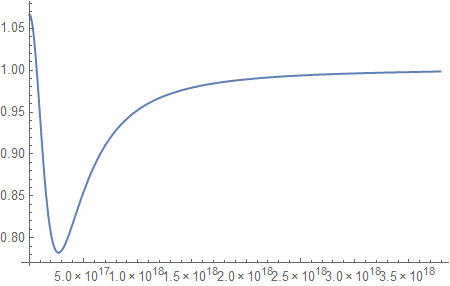
Graph1.png

and the function ##g(\eta)=\frac{1}{\dot\tau(\eta)}## looks like this:
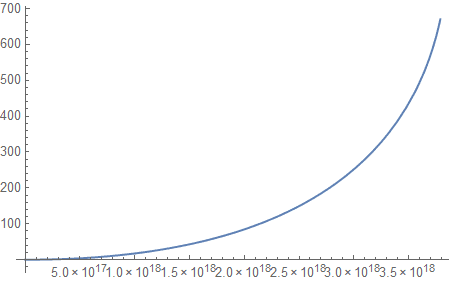
Graph2.png

The bottom axis is ##\eta##.
 
  • Like
Likes   Reactions: Delta2
Physics news on Phys.org
Hello.
I would like to know more information to elaborate. Integral in your post means integral over the region [-infinity, +infinity] or any other ?
 
mitochan said:
Hello.
I would like to know more information to elaborate. Integral in your post means integral over the region [-infinity, +infinity] or any other ?
There are several sources for this equation. Some write it as an indefinite integral, others write it as $$k_D^{-2}(\eta)=\int_0^{\eta} \frac{1}{6(1+R)}\left( \frac {16}{15}+ \frac{R^2}{(1+R)}\right)\frac{1}{\dot\tau} d\eta$$I believe this is the more rigorous form. Both R and ##\dot\tau## are functions of ##\eta##. I believe the author of these notes may have been trying to solve the integral in parts as ##R[0]## and ##\dot\tau[0]## are undefined.
 
Thanks for your explanation.

I would like to confirm my understanding on your graphs.

--As R is relative baryon-photon momentum ratio,
f(0)=1/6 * 16/15 where R=0 no baryon existed and f(+infinity)= 1/6 where R=+infinity all photon momentum will be reduced to zero by expansion of universe.
Your first graph read f(0)=1.066 and f(+infinity)=1 so it seems graph of 6f with coefficient 6 multiplied.

-- Is unit of base ##\eta## axis second? If so around 5 E+17 points on the graph is where we are.
 
mitochan said:
--As R is relative baryon-photon momentum ratio,
f(0)=1/6 * 16/15 where R=0 no baryon existed and f(+infinity)= 1/6 where R=+infinity all photon momentum will be reduced to zero by expansion of universe.
Your first graph read f(0)=1.066 and f(+infinity)=1 so it seems graph of 6f with coefficient 6 multiplied.

-- Is unit of base ##\eta## axis second? If so around 5 E+17 points on the graph is where we are.
Many apologies. You are correct. The graph for ##f(\eta)=\frac{1}{6(1+R(\eta))}\left( \frac {16}{15}+ \frac{R(\eta)^2}{(1+R(\eta))}\right)## looks like this (I forgot the factor of 1/6 in the original plot):
Graph1.png

Not sure what you're asking in the second question. The bottom axis is conformal time and the units are seconds. And, yes, ##3.5 \times 10^{18} s## is ##\eta_0##, the present time (according to the model).

Also, the form is correct, but the units were wrong on the optical depth plot. Here are the correct units in km. (though, this should be immaterial for the answer).

Graph2.png
 
Last edited:
Thanks for your clarification.

With assumption and observation that

--The author refers value of ##\eta## around ##\eta_0##, the age of universe for us,
13.8 billion year = 4.35 E+17 second,

--The second graph curve in the region ##\eta [0,\eta_0]## read g(##\eta##) be small positive constant (not zero, I expect) , and

--due to decline in the first graph curve in the region ##[0,\eta_0]## integral coefficient seems a little bit less (or more?) than 1/6 but the difference is negligible in our approximation,

I think the integral would become 1/6 ##g(\eta)\eta##. I do not think this relation hold for any value of ##\eta##, much more than ##\eta_0##, for an example.
 
Your answer is little more than an opinion. I was looking for a derivation likely involving integration by parts, but something that took me step-by-step from the first equation to the authors analytical solution (or a disproof, if the author was wrong).
 

Similar threads

  • · Replies 16 ·
Replies
16
Views
3K
  • · Replies 12 ·
Replies
12
Views
3K
  • · Replies 4 ·
Replies
4
Views
2K
  • · Replies 8 ·
Replies
8
Views
2K
  • · Replies 3 ·
Replies
3
Views
2K
  • · Replies 0 ·
Replies
0
Views
2K
  • · Replies 3 ·
Replies
3
Views
3K
  • · Replies 2 ·
Replies
2
Views
6K
Replies
3
Views
3K
  • · Replies 8 ·
Replies
8
Views
3K