How would a radial component of induced electric field makes flux ≠ 0

  • Level: High School 
  • Thread starter Thread starter KnightTheConqueror
  • Start date Start date
  • Tags Tags
    Induced electric field
Join the discussion
Registration is free. Ask a follow-up in this thread, or start your own.
2 replies · 2K views
KnightTheConqueror
Messages
16
Reaction score
8
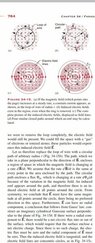
I don't understand this paragraph of Resnick halliday Krane where it says that if a radial component of induced electric field exists, it would mean net electric flux is not zero. I guess I am not exactly able to visualise the gaussian surface and how the flux is not zero. Please help
 
Attachments
  • Screenshot_20240605_200039_Moon+ Reader Pro.jpg
    Screenshot_20240605_200039_Moon+ Reader Pro.jpg
    37.9 KB · Views: 106
Physics news on Phys.org
You appear to have a uniform magnetic field pointing out of the page. The Gaussian surface being considered is any arbitrary cylindrical surface with its axis pointing out of the page. The symmetry of the situation under rotation about the axis of our arbitrary cylinder means that if the electric field points outwards at any point on the surface it points outwards everywhere on the surface, so ##\vec E\cdot d\vec S## has the same value everywhere and hence the integral is necessarily non-zero.

Other symmetry arguments are available under these circumstances, but that seems to be the one they picked, if I understand right.
 
  • Like
Likes   Reactions: KnightTheConqueror
Thank you. After reading your answer I read the paragraph in the book again and now everything is clear