Hyperbolic tangent function for terminal velocity with Vo>Vt

Click For Summary

Discussion Overview

The discussion revolves around the calculation of the speed of an object transitioning from one medium to another with differing densities, particularly focusing on the implications of having an initial velocity greater than the calculated terminal velocity. The context includes theoretical modeling of motion through fluids and the dynamics of terminal velocity.

Discussion Character

  • Exploratory
  • Technical explanation
  • Debate/contested

Main Points Raised

  • One participant describes a scenario where an object falls from a less dense medium into a denser one, questioning how to calculate the speed after this transition with an initial velocity greater than the terminal velocity.
  • Another participant expresses confusion about the dependence of terminal velocity on time, clarifying that terminal velocity is determined by the balance of forces rather than time.
  • A different participant reiterates that terminal velocity is typically reached from an initial velocity of zero, questioning the relevance of initial conditions in the context of free fall.
  • Some participants suggest that the initial velocity should not affect the calculation of terminal velocity, while others imply that it may play a role in the dynamics as the object approaches terminal velocity.

Areas of Agreement / Disagreement

Participants express differing views on the role of initial velocity in determining the behavior of the object as it transitions into a new medium. There is no consensus on how to approach the calculation or the implications of having a non-zero initial velocity.

Contextual Notes

There are unresolved assumptions regarding the nature of the transition between media and the mathematical treatment of initial conditions in the context of terminal velocity. The discussion lacks clarity on how to model the dynamics when initial velocity exceeds terminal velocity.

Who May Find This Useful

This discussion may be of interest to those studying fluid dynamics, physics of motion through different media, or anyone exploring the concept of terminal velocity in varying conditions.

birk
Messages
2
Reaction score
0
Hi! First post on this forum, though not the first time visiting :)

I am working on a model of an object falling from one layer of air density into another layer with a higher density, effectively changing the acceleration from positive to negative instantly. (Somehow I am thinking of positive as the downwards direction here). The transition between the two "zones" is instantaneous. (One way to think of it could be an object (that sinks) that falls at a high velocity into water and is abruptly decelerated.)

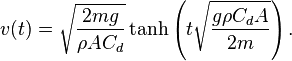
My question is: How does one calculate the speed of the object after it has entered the new medium? I have seen the following equation for terminal velocity on wikipedia and other sources:
989f4b502e83f94a99e0f04b32d52cbf.png


but this assumes an initial velocity of v_0=0

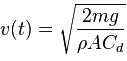
In my situation the initial velocity when entering the new medium is nearly the double of the terminal velocity that I have calculated from the first part:
copy.png


One solution I tried, which I quickly realized how stupid was, was to multiply the function by -1, but this left me with a terminal velocity that increased when the drag coefficient was increased, which is not really what one wants.

Any input would be very much appreciated!
 
Physics news on Phys.org
I have no background for this subject. However, it seems strange to me that the terminal velocity depends on t (which I presume is time).
 
mathman said:
I have no background for this subject. However, it seems strange to me that the terminal velocity depends on t (which I presume is time).

To answer your question: You are right, the terminal velocity does not depend on t (time). It depends in the various aerodynamic properties of the object falling and the medium that object is falling through + initial velocity. The definition of terminal velocity is that the forces from aerodynamic resistance (drag) are equal to the gravitational forces pulling the object down, effectively rendering a=0 and a constant, "terminal" velocity.

My question is rather regarding the velocity of an object tending towards a terminal velocity from a set t=0 with an initial v0.
For the above equation to work properly, it seems as if V0 HAS TO BE 0, which is obviously not working in my scenario. I found something that could indicate a possible answer:

https://books.google.no/books?id=iYALAAAAQBAJ&pg=PA188 (First third of the page, but it is somewhat unclear to me...)

but I feel I am in deep waters on this, so any help would be hugely appreciated!
 
Based on elementary considerations I don't understand why the initial velocity would matter. In free fall objects usually start at zero velocity and speed up due to the acceleration of gravity until terminal velocity is reached.
 

Similar threads

  • · Replies 8 ·
Replies
8
Views
2K
  • · Replies 7 ·
Replies
7
Views
9K
Replies
1
Views
2K
  • · Replies 3 ·
Replies
3
Views
20K
  • · Replies 7 ·
Replies
7
Views
4K
  • · Replies 1 ·
Replies
1
Views
8K
Replies
4
Views
8K
  • · Replies 11 ·
Replies
11
Views
3K
Replies
6
Views
4K
  • · Replies 2 ·
Replies
2
Views
4K