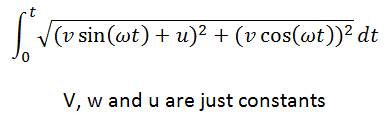
I don't know yet how to integrate this function....

  • Context: Undergrad 
  • Thread starter Thread starter pabilbado
  • Start date Start date
  • Tags Tags
    Function Integrate
Click For Summary

Discussion Overview

The discussion revolves around the integration of a function related to the path of an orbiting particle when its center of circular motion also translates. Participants explore the mathematical modeling of Earth's orbit and the implications of rotation on the trajectory of a point on its surface.

Discussion Character

  • Exploratory
  • Technical explanation
  • Conceptual clarification
  • Homework-related
  • Mathematical reasoning

Main Points Raised

  • One participant expresses difficulty in integrating a function that describes the motion of a point on Earth as it orbits the sun, seeking help with the integration process.
  • Another participant questions whether the problem is a homework assignment, which is clarified as a personal project related to calculating distance traveled by Earth around the sun for a birthday gift.
  • Some participants suggest approximating Earth's orbit as circular with a radius of 150 million kilometers, noting the eccentricity of Earth's orbit as a minor factor.
  • One participant emphasizes the need to account for both the translation of Earth around the sun and the rotation of Earth, leading to a more complex trajectory than a simple circular path.
  • A suggestion is made to use parametric equations to model the motion, with an emphasis on integrating the arc length, while acknowledging potential challenges with integrating functions involving trigonometric components.
  • A later reply mentions using a Taylor series to solve the integration problem by integrating term by term, indicating a prior solution approach.

Areas of Agreement / Disagreement

Participants generally agree on the complexity of the problem and the need for a nuanced approach to integration. However, there are multiple competing views on how to model the motion and the appropriateness of different mathematical techniques, leaving the discussion unresolved.

Contextual Notes

Participants express uncertainty regarding the integration of functions with trigonometric components and the implications of approximating Earth's orbit as a straight line. The discussion reflects varying assumptions about the mathematical modeling of motion in a rotating and translating frame.

Who May Find This Useful

This discussion may be useful for individuals interested in mathematical modeling of orbital mechanics, integration techniques, and the complexities of motion in a rotating reference frame.

pabilbado
Gold Member
Messages
17
Reaction score
1
I was just wondering about the path an orbiting particle takes when it's center of circular motion also translates. So as to calculate the distance traveled I know I have to get a function that relates velocity with respect to time and integrate it, but I can't doit, I get stuck integrating. I have search the Internet across and nothing. Possibly I don't know what I am looking for. Here is the function:
df40425500452af6d860f2e1c2e4efdb.png

I can simplify it but it continues being difficult:

ba863ee3701d465bae822f56ed19c330.png
 
Physics news on Phys.org
Is this a homework problem?
 
Dr. Courtney said:
Is this a homework problem?
No, is not. Two days ago it was my father's birthday (he is a nerdy engineer so he will like this kind of present) so I am trying to calculate how much kilometers he has traveled around the sun. And as an approximation I have made the Earth's orbit a straight line, and this is the result of a point on Earth rotating and translating.
 
pabilbado said:
No, is not. Two days ago it was my father's birthday (he is a nerdy engineer so he will like this kind of present) so I am trying to calculate how much kilometers he has traveled around the sun. And as an approximation I have made the Earth's orbit a straight line, and this is the result of a point on Earth rotating and translating.
I don't know how you can make an orbit a straight line.

If you want to know how far your father has traveled in his lifetime, assume that Earth's orbit is a circle with a radius of 150 million kilometers. Every year, the Earth makes one orbit of the sun, by definition. The eccentricity of Earth's orbit is about 0.017, so a circle is a good approximation for all practical purposes here.
 
SteamKing said:
I don't know how you can make an orbit a straight line.

If you want to know how far your father has traveled in his lifetime, assume that Earth's orbit is a circle with a radius of 150 million kilometers. Every year, the Earth makes one orbit of the sun, by definition. The eccentricity of Earth's orbit is about 0.017, so a circle is a good approximation for all practical purposes here.

Yeah, that's the easy way. What I want is to take into account the rotation of earth, while is moving around the sun. Because a point in the surface of the Earth does not travel a circular path around the sun but rather a really "curly" trajectory. So as a first approximation I have flattened Earth's orbit so it is just traveling in a straight line and I need to take into consideration the that the point is also rotating. That wwhat the integral is for.
 
Why not write the parametric equations as:

x(t) = Ra*cos(2*pi t/Ta) + Rb*cos(2*pi*t/Tb)*cos(latitude)
y(t) = Ra*sin(2*pi t/Ta) + Rb*sin(2*pi*t/Tb)*cos(latitude)

Use the arc length integral, substitute in, and integrate numerically.

Ra, Ta = radius and period of Earth's orbit
Rb = Earth's radius, Tb = one day

Hopefully, you can treat the latitude as constant.
 
Dr. Courtney said:
Why not write the parametric equations as:

x(t) = Ra*cos(2*pi t/Ta) + Rb*cos(2*pi*t/Tb)*cos(latitude)
y(t) = Ra*sin(2*pi t/Ta) + Rb*sin(2*pi*t/Tb)*cos(latitude)

Use the arc length integral, substitute in, and integrate numerically.

Ra, Ta = radius and period of Earth's orbit
Rb = Earth's radius, Tb = one day

Hopefully, you can treat the latitude as constant.
EDIT: thinking about it I believe I will be stuck with the same problem: integrating a function that has a trigonometric function inside a square root.

Yeah I thought about it, but I had two different directions, but I wasn't sure if I could just use the arc length for the first equation, then for the second one and sum them over. Is that what I have to do? If it wasn't the case just to satisfy my curiosity how could I integrate the first function I posted?(My approximate scenario would also yield a function for the movement of a particle around a translating and rotating sphere, wouldn't it?).
 
I forgot to post how I solved the problem. I did the taylor series and then I integrated term by term. I did it a long time ago, but i forgott to post it here.
 
Something so thoughtful and sweet should have a place on the refrigerator forever! :smile:
 

Similar threads

  • · Replies 1 ·
Replies
1
Views
2K
  • · Replies 1 ·
Replies
1
Views
3K
  • · Replies 16 ·
Replies
16
Views
3K
  • · Replies 1 ·
Replies
1
Views
2K
  • · Replies 6 ·
Replies
6
Views
2K
  • · Replies 2 ·
Replies
2
Views
2K
  • · Replies 9 ·
Replies
9
Views
3K
  • · Replies 2 ·
Replies
2
Views
3K
  • · Replies 5 ·
Replies
5
Views
3K
  • · Replies 20 ·
Replies
20
Views
3K