Discussion Overview
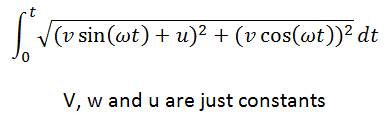
The discussion revolves around the integration of a function related to the path of an orbiting particle when its center of circular motion also translates. Participants explore the mathematical modeling of Earth's orbit and the implications of rotation on the trajectory of a point on its surface.
Discussion Character
- Exploratory
- Technical explanation
- Conceptual clarification
- Homework-related
- Mathematical reasoning
Main Points Raised
- One participant expresses difficulty in integrating a function that describes the motion of a point on Earth as it orbits the sun, seeking help with the integration process.
- Another participant questions whether the problem is a homework assignment, which is clarified as a personal project related to calculating distance traveled by Earth around the sun for a birthday gift.
- Some participants suggest approximating Earth's orbit as circular with a radius of 150 million kilometers, noting the eccentricity of Earth's orbit as a minor factor.
- One participant emphasizes the need to account for both the translation of Earth around the sun and the rotation of Earth, leading to a more complex trajectory than a simple circular path.
- A suggestion is made to use parametric equations to model the motion, with an emphasis on integrating the arc length, while acknowledging potential challenges with integrating functions involving trigonometric components.
- A later reply mentions using a Taylor series to solve the integration problem by integrating term by term, indicating a prior solution approach.
Areas of Agreement / Disagreement
Participants generally agree on the complexity of the problem and the need for a nuanced approach to integration. However, there are multiple competing views on how to model the motion and the appropriateness of different mathematical techniques, leaving the discussion unresolved.
Contextual Notes
Participants express uncertainty regarding the integration of functions with trigonometric components and the implications of approximating Earth's orbit as a straight line. The discussion reflects varying assumptions about the mathematical modeling of motion in a rotating and translating frame.
Who May Find This Useful
This discussion may be useful for individuals interested in mathematical modeling of orbital mechanics, integration techniques, and the complexities of motion in a rotating reference frame.