I finding resultants using sine/cosine law

Click For Summary

Homework Help Overview

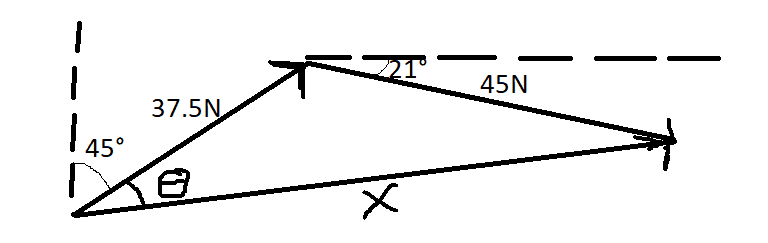
The discussion revolves around finding the resultant of two vectors: 37.5N directed northeast and 45N at an angle of 21° south of east. The original poster expresses difficulty in determining the angles necessary for calculating the resultant.

Discussion Character

  • Exploratory, Assumption checking, Problem interpretation

Approaches and Questions Raised

  • Participants discuss the need to find angles within the triangle formed by the vectors to calculate the resultant. Some suggest projecting vectors and questioning the angle between them. Others mention using the tip-to-tail method and vector components instead of relying solely on angles.

Discussion Status

There is an ongoing exploration of different methods for finding the resultant. Some participants have provided guidance on using vector components and the tip-to-tail method, while others have shared their own experiences and approaches. The discussion reflects a variety of interpretations without reaching a consensus.

Contextual Notes

Participants note the importance of showing effort in problem-solving as per forum rules. There is also mention of the law of cosines and its relationship to the dot product, indicating varying levels of familiarity with these concepts among participants.

EddyBenzen122
Messages
11
Reaction score
2
Homework Statement
None.
Relevant Equations
None.
I need help finding the resultant with vectors: 37.5N[NE] and 45N[21° S of E]
I just don't know a way to find the angles within this triangle to help me get the resultant, so can anybody help me out?
1632441291993.png
 
Physics news on Phys.org
According to forum rules, you must show some effort towards the solution before you get help. Please do so. Also, sine/cosine law is not an equation.
 
kuruman said:
According to forum rules, you must show some effort towards the solution before you get help. Please do so. Also, sine/cosine law is not an equation.
This is the best I could! I only need someone to help me figure out how I could find the angles within the triangle given so that I could find the resultant on my own.
 
EddyBenzen122 said:
This is the best I could! I only need someone to help me figure out how I could find the angles within the triangle given so that I could find the resultant on my own.
Project the first vector out beyond the tail of the second one. What is the angle between them?
 
haruspex said:
Project the first vector out beyond the tail of the second one. What is the angle between them?
Is this what you mean?
1632445129689.png
 
EddyBenzen122 said:
Is this what you mean?
View attachment 289612
Yes, I'm asking what the value of theta is in that diagram. But it does not depend on the force magnitudes, only on their directions.
 
You could, but you don't need to work with that triangle's angles to get the resultant.
The resultant is the vector-sum using the tip-to-tail "treasure map" method.
You are given enough information to get the x- and y-components of each given vector, and thus get the resultant.
Then you could use the resultant to get (say) the angle theta between that resultant and the first vector [using the dot product or law of cosines].
 
  • Like
Likes   Reactions: EddyBenzen122
1632654268488.png
 
  • Like
Likes   Reactions: EddyBenzen122
neilparker62 said:
I was able to solve it using the idea of interior alternates to find the angle opposite to the resultant and then I found the resultant using cosine law afterwards. That's all I really need for help, thanks, everyone!
 
  • #10
EddyBenzen122 said:
I was able to solve it using the idea of interior alternates to find the angle opposite to the resultant and then I found the resultant using cosine law afterwards. That's all I really need for help, thanks, everyone!

In my experience, many introductory students don’t know the law of cosines (which comes from the dot product of two vectors). So, congratulations.

To me, the problem suggests the tip-to-tail method for adding vectors graphically, but suggesting (from what it gave as given) one should add using components.

For two forces, either method (law of cosines or vector components) works well if one can construct the necessary quantities.
However, for more than two vectors, using vector components is likely easier and more direct.
(This method can be implemented in a computer program more easily than using the law of cosines several times in progression .)
So, learning to use components will likely be useful.

My $0.02.
 
  • Like
Likes   Reactions: EddyBenzen122

Similar threads

Replies
14
Views
2K
Replies
25
Views
2K
  • · Replies 10 ·
Replies
10
Views
2K
  • · Replies 2 ·
Replies
2
Views
8K
  • · Replies 3 ·
Replies
3
Views
901
  • · Replies 1 ·
Replies
1
Views
3K
Replies
2
Views
2K
  • · Replies 18 ·
Replies
18
Views
3K
Replies
14
Views
1K
  • · Replies 18 ·
Replies
18
Views
1K