Undergrad I would like to know the calculation process of this power spectrum

Click For Summary
SUMMARY

The discussion focuses on deriving the power spectrum formula from the Discrete Fourier Transform (DFT), specifically Eq(6.3) from a referenced paper. Participants emphasize the importance of manipulating the cosine function using Euler's formula to facilitate the summation process. The conversation highlights the need for a structured approach to handle complex calculations, suggesting that breaking down the problem into manageable parts is essential. Ultimately, one participant successfully completes the derivation after extensive effort and experimentation.

PREREQUISITES
  • Understanding of Discrete Fourier Transform (DFT)
  • Familiarity with Euler's formula and complex exponentials
  • Knowledge of trigonometric identities, particularly cosine representation
  • Basic algebraic manipulation skills for summation
NEXT STEPS
  • Study the derivation of the Discrete Fourier Transform (DFT) in detail
  • Learn how to apply Euler's formula in signal processing contexts
  • Explore the implications of cosine functions in Fourier analysis
  • Practice algebraic manipulation techniques for complex summations
USEFUL FOR

Mathematicians, physicists, and engineers involved in signal processing or Fourier analysis who seek to deepen their understanding of power spectrum derivation and related calculations.

arcTomato
Messages
104
Reaction score
27
TL;DR
Derive the formula of power spectrum from Discrete Fourier Transform.
Summary: Derive the formula of power spectrum from Discrete Fourier Transform.

Hi all
I don't know where should I post this, so if I am wrong, I apologize.(But this is almost math problem so )

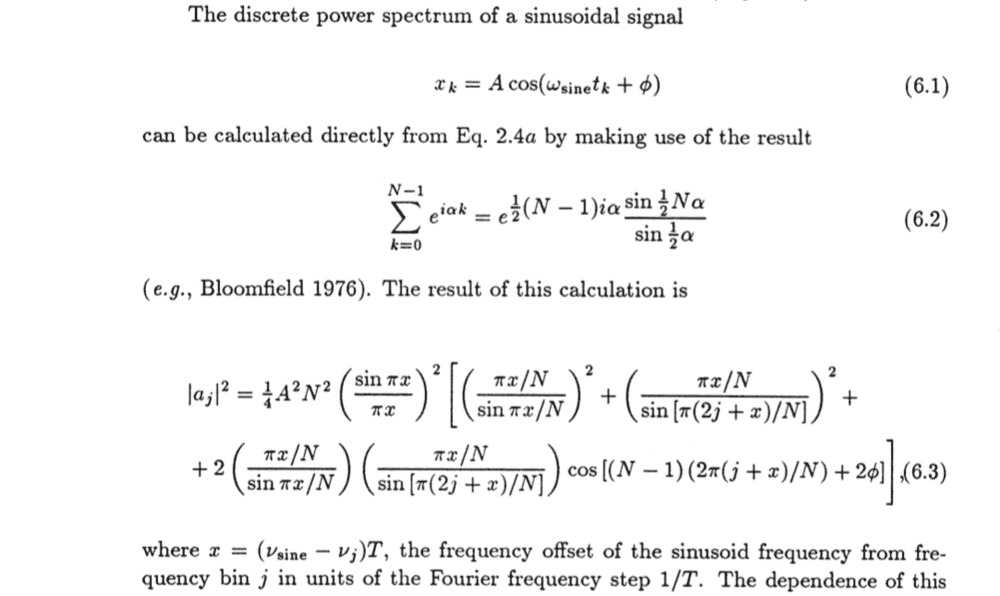
I would like to know the calculation process when derive Eq(6.3) in this paper.
スクリーンショット 2019-11-23 13.17.46.png
Eq 2.4a is ##a_{j}=\sum_{k=0}^{N-1} x_{k} e^{2 \pi i j k / N} \quad j=-\frac{N}{2}, \ldots, \frac{N}{2}-1## and ##t_k={kT/N}##, ##ω_{sine}=2πν_{sine}##

I think these are the all tool to derive Eq.(6.3). But I don't have much calculation power to derive. (I spent two weeks for this.)
This will be a tough calculation process but if you can do this(and I know PF's teachers can do this :D), PLEASE HELP ME!

Thank you.
 
Physics news on Phys.org
Sadly, we can’t help you at all unless you show us your work in attempting to solve this.
 
  • Like
Likes arcTomato
Thank you for replying, @jedishrfu!
ok, at first. I should calculate ##a_{j}=\sum_{k=0}^{n-1} A \cos \left(\omega_{sin} \frac{k T}{N}+\phi\right) e^{2 \pi i k / N}##.
I think I will use Eq(6.2),but I don't know how. I am already stuck here😭
 
First, I have no idea how to solve this. However, looking at the summation I see the e function and the ##x_k## factors.

the x’s are defined in terms of cos() so have you tried representing the cos() in terms of the e function. Doing that might allow you to split the summation into two summations both of which could use the hint they provided at 6.2.

https://webhome.phy.duke.edu/~rgb/Class/phy51/phy51/node15.html
 
thank you @jedishrfu!
I have already tried before, and become so messy.
but I will try again!
 
  • Like
Likes jedishrfu
Calling @fresh_42 do you have any thoughts to help here?

The derivation looks quite daunting aka messy.
 
  • Like
Likes arcTomato
arcTomato said:
I have already tried before, and become so messy.
I guess you can't avoid this. It looks as if a big, big blackboard would be helpful.

2.4. gives the structure ##a_j=\sum_k x_k e^{f(k)}##.
6.1. resolves the ##x_k##.
To apply 6.2. we need to put every non constant coefficient into a power of ##e##, which requires ##\cos g= \frac{1}{2}\left(e^{ig}+e^{-ig}\right)## where ##g=g(t_k,\phi,\omega)##.
Now we have two sums and the form which is necessary to apply 6.2 and should be done, i.e. have only some algebra to do to finish it.

Finally we have 6.3. which has again a cosine term, which is a bit disturbing. I do not see how it could be saved without resolving the cosine into powers of ##e##. I don't even see, whether 6.3. is true at all.

I would start and calculate some examples with e.g. N=3 and multiples of ##\pi## for the angles to see whether I can get 6.3. at all.
 
  • Like
Likes berkeman, arcTomato and jedishrfu
fresh_42 said:
I guess you can't avoid this. It looks as if a big, big blackboard would be helpful.

Thanks for your helping guys! @jedishrfu ,@fresh_42
Finally, I finished it!
I have used 3 A4 papers 😂
 
  • Like
Likes berkeman, fresh_42 and jedishrfu
You know in addition to a big blackboard youd also need hagoromo chalk. Mathematicians claim you can't make a mistake when using it.

Glad you figured it out.
 
  • Haha
Likes arcTomato

Similar threads

  • · Replies 1 ·
Replies
1
Views
3K
  • · Replies 5 ·
Replies
5
Views
3K
  • · Replies 10 ·
Replies
10
Views
2K
  • · Replies 17 ·
Replies
17
Views
2K
  • · Replies 8 ·
Replies
8
Views
2K
  • · Replies 2 ·
Replies
2
Views
2K
  • · Replies 1 ·
Replies
1
Views
3K
  • · Replies 5 ·
Replies
5
Views
3K
Replies
2
Views
2K
  • · Replies 3 ·
Replies
3
Views
2K