IB 11 Question: Circular Acceleration Problem Involving Forces

Click For Summary
SUMMARY

The discussion centers on solving a circular acceleration problem involving forces in an IB 11 SL physics context. The participant, JL, initially struggled with calculations related to total force, centripetal acceleration, and the force of gravity acting on a 10 kg mass. Key equations discussed include the relationship between total force and mass (m*a = m*g*tan(θ)) and centripetal acceleration (v²/r = g*tan(θ)). The participant ultimately identified a calculation error and clarified the use of trigonometric functions in determining the radius and total force.

PREREQUISITES
  • Understanding of Newton's laws of motion
  • Familiarity with trigonometric functions and their applications in physics
  • Knowledge of centripetal acceleration concepts
  • Basic grasp of gravitational force calculations
NEXT STEPS
  • Study the derivation and application of centripetal acceleration formulas
  • Learn about the relationship between forces in circular motion
  • Explore advanced trigonometric applications in physics problems
  • Practice solving problems involving forces and acceleration in rotational systems
USEFUL FOR

Students in the International Baccalaureate program, particularly those studying physics, as well as educators and tutors looking to assist students with circular motion and force calculations.

JerusalemLuver
Messages
11
Reaction score
0
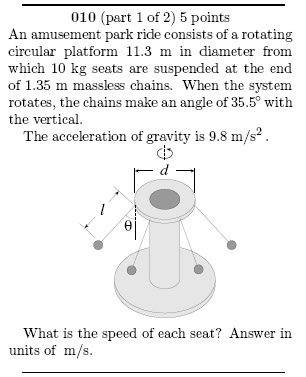
Hi, this question is a part of an 'online homework packet I received through my IB 11 SL course (ie. International Baccalaureate 11 Standard Leval). I submitted my first attempt to answer this question and had the wonderful "sorry your answer is incorrect" screen pop up. I was wondering if I could get some advice on howe to solve the question. Am I understanding the concept but doing something wrong when it comes to calculations? Or do I need a push in the right direction with concept?
Thanks:smile:
JL

1.
question10.jpg


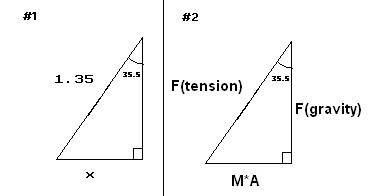
2.

trinaglews.jpg


  • (Total Force) = mass * acceleration
  • (Centrepital Acceleration) = (Velocity squared) / (Radius)
  • (Force of Gravity) = (mass)*(9.8)
  • (Radius) = (Diameter)/2


3.
  • Using trig. Radius = (sin35.5 *1.35) + (diameter/2) =6.43394899 m
  • (Force of Gravity) = 9.8 * 10 kg = 98 N
  • Using trig (Total Force) = mass*acceleration = (tan 35.5 *Force of Gravity)= 69.990272065
  • (Acceleration) = (Total Force)/mass = 69.990272065/10 =6.9990272065 m/s^2

I first tried to calculate the radius adding the bottom part of the first triangle to half of the diameter.I'm fairly certain of the radius but if anyone thinks up another method or thinks that this method is incorrect please let me know.
I secondly calculated the Force of gravity on the 10 kg seat
Using the second triangle I used trig to solve for the total force
I then substituted the Total force (ie. Mass * Acceleration) and mass to solve for Acceleration.

 
Physics news on Phys.org
As you can all pretty much see that was my first post, if I'm doing anything wrong, (asking the wrong kind of question, not clear, whatever it is) let me know, thx
 
Everything seems to be fine. Although you could have made life a bit easier for yourself:

m a = m g \tan(\theta)

\frac{v^2}{r} = g \tan(\theta)

What value do you then get for the speed?
 
Last edited:
actually sumone in my class told me that i should have used 90(degrees) minus theta in my second triangle , it works but i don't know why??
 
wait no i got it, my bad it was a calculation error!:blushing:
 
?
 
The book claims the answer is that all the magnitudes are the same because "the gravitational force on the penguin is the same". I'm having trouble understanding this. I thought the buoyant force was equal to the weight of the fluid displaced. Weight depends on mass which depends on density. Therefore, due to the differing densities the buoyant force will be different in each case? Is this incorrect?

Similar threads

  • · Replies 4 ·
Replies
4
Views
1K
Replies
2
Views
2K
  • · Replies 11 ·
Replies
11
Views
2K
  • · Replies 56 ·
2
Replies
56
Views
4K
  • · Replies 9 ·
Replies
9
Views
2K
  • · Replies 9 ·
Replies
9
Views
3K
  • · Replies 3 ·
Replies
3
Views
2K
  • · Replies 3 ·
Replies
3
Views
2K
  • · Replies 2 ·
Replies
2
Views
3K
  • · Replies 3 ·
Replies
3
Views
2K