Ideal Transformer: Vp/Vs, Ip/Is, Np/Ns Ratios

  • Context: Undergrad 
  • Thread starter Thread starter Volcano
  • Start date Start date
  • Tags Tags
    Transformer
Click For Summary
SUMMARY

The discussion centers on the behavior of ideal transformers, specifically the relationships between voltage (Vp, Vs), current (Ip, Is), and turns ratios (Np, Ns). It is established that in an ideal transformer, if the primary voltage (Vp) increases, the secondary voltage (Vs) also increases proportionally due to the constant turns ratio (Np/Ns). However, as load resistance increases, the secondary current (Is) decreases, leading to a decrease in primary current (Ip) while maintaining constant voltages. The power remains constant across both primary and secondary sides, confirming that the efficiency of an ideal transformer is 100%.

PREREQUISITES
  • Understanding of transformer principles and operation
  • Familiarity with Ohm's Law and power equations
  • Knowledge of electrical circuit components, particularly resistors
  • Basic grasp of electrical engineering concepts related to voltage and current ratios
NEXT STEPS
  • Study the mathematical relationships in transformer equations, focusing on {P_s} = {I_s}{V_s} = {P_p} = {I_p}{V_p}
  • Explore the implications of load resistance changes on transformer performance
  • Learn about different types of transformers and their applications in voltage and current transformation
  • Investigate real-world transformer efficiency and factors affecting it beyond ideal conditions
USEFUL FOR

Electrical engineers, students studying power systems, and professionals involved in designing or analyzing transformer circuits will benefit from this discussion.

Volcano
Messages
147
Reaction score
0
Hi,

http://en.wikipedia.org/wiki/Transformer

related picture:
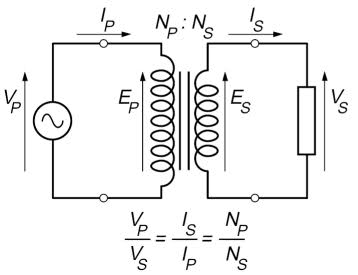
11760pt.jpg


Above link, says: "If the voltage is increased, then the current is decreased by the same factor."

I didn't understand. Is this means, if I increase Vp, Ip will decrease? Or means Is will decrease?

One more... Suppose an ideal transformer. Vp/Vs , Np/Ns and Is/Ip ratios are equal(like given pic). If I increase Vp then Vs will too because Np/Ns ratio is constant. So, Vp/Vs ratio will be equal to Np/Np everytime. Let's suppose, load resistance is variable(potentiometer) and resistance is increasing;

1. Vs won't change. Because Vp, Np, Ns didn't change.
2. Is will decrease. Because Vs = Is * R(Ohm Law).
3. Ip will decrease like Is.

As a result: If transformer is ideal and ONLY load(resistance) decrease, neither Vp nor Vs don't change. Only both Ip and Is decrease. Surely if load(resistance) increase both circuits decrease but both voltages stay the same.

Am I right?
 
Last edited:
Physics news on Phys.org
The best way to look at this is to realize that transformers transfer power.
The effect of changing the voltage or current or impedance by the turns ratio is a very convenient and useful side effect.
We actually distinguish (select) transformer types according to whether we want to change the voltage, current or impedance.
Having chosen what property we wish to change the othere follow like sheep, from Joules and Ohms laws.

Now power = volts x amps for both the primary and the secondary

The power stays constant for an ideal transformer since the efficiency = 100%

{P_s} = {I_s}{V_s} = {P_p} = {I_p}{V_p}

Does this help?
 
Yes, i know that equation. And I suppose am right. But asked to be sure. If load resistance change, both currents change but voltages not, isn't it?
 
Yes.
 
thank you :)
 

Similar threads

  • · Replies 2 ·
Replies
2
Views
2K
  • · Replies 1 ·
Replies
1
Views
3K
Replies
4
Views
2K
  • · Replies 3 ·
Replies
3
Views
2K
  • · Replies 27 ·
Replies
27
Views
6K
  • · Replies 5 ·
Replies
5
Views
3K
  • · Replies 2 ·
Replies
2
Views
2K
  • · Replies 3 ·
Replies
3
Views
7K
Replies
2
Views
2K
  • · Replies 2 ·
Replies
2
Views
3K