Homework Help Overview
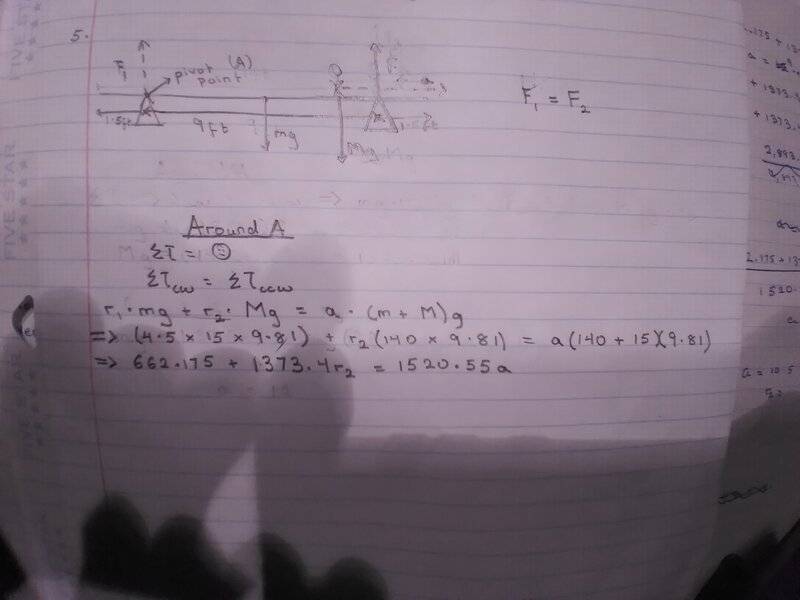
The discussion revolves around a physics problem involving torque and forces acting on a plank supported at two points. Participants are trying to understand the role of various forces and distances, particularly the significance of the variable r2 in the context of tipping and balance.
Discussion Character
- Exploratory, Conceptual clarification, Problem interpretation, Assumption checking
Approaches and Questions Raised
- Participants discuss the forces acting on the plank, including the weights of the plank and a person, and how they relate to the pivot point. There are questions about the definitions of variables and the setup of the problem, particularly regarding the torque equations and the conditions for tipping.
Discussion Status
Some participants are clarifying their understanding of the problem setup and the forces involved. There is an exploration of different methods to approach the problem, including the suggestion to use the second support as a pivot point. While some participants express confusion, others are beginning to grasp the concepts involved.
Contextual Notes
Participants note that the diagram provided is difficult to interpret, and there are concerns about the definitions of certain variables. The discussion includes the realization that the first support may not exert any force if the plank is tipping, which raises questions about the balance of moments in the system.