Impact Energy Absorbed by a Material

Click For Summary

Discussion Overview

The discussion revolves around the impact energy absorbed by materials, specifically focusing on a force sensing system utilizing piezoelectric sensors to measure impact forces during collisions. Participants explore the relationship between the material properties of the cover (TPU or PLA), the dimensions of the cover, and the impact force transmitted to the sensors.

Discussion Character

  • Exploratory
  • Technical explanation
  • Debate/contested
  • Experimental/applied

Main Points Raised

  • One participant seeks to determine the impact energy absorbed by the cover material and how much is transmitted to the sensors, proposing that material properties and dimensions could lead to a calculable relationship.
  • Another participant suggests using Finite Element Analysis (FEA) to analyze stress distribution and patterns, noting that piezoelectric sensors can be sensitive to both shear and normal stress.
  • A participant confirms that the aluminum block will be rigidly supported, which may influence the absorption of impact energy by the elastomer and the force sensed.
  • There is a discussion about the limitations of the Tekscan piezoelectric sensor, with one participant expressing concerns about calibration and debugging time compared to load cells.
  • Alternative force sensing methods are proposed, including pressure-sensitive sheets and mechanical materials that change color under compression, although these suggestions are not fully explored.
  • A participant describes a load cell setup involving strain gauges, suggesting it may yield better results despite the initial complexity of implementation.

Areas of Agreement / Disagreement

Participants express differing opinions on the effectiveness of piezoelectric sensors versus load cells for measuring force, with no consensus on the best approach. There is also uncertainty regarding the extent of impact energy absorption by the cover materials and how this relates to the sensor readings.

Contextual Notes

Participants acknowledge the complexity of the problem, including the need for calibration and the potential for varying stress distributions under impact. The discussion does not resolve the mathematical relationships or assumptions necessary for accurate calculations.

Who May Find This Useful

This discussion may be useful for engineers and researchers involved in force measurement, material science, and sensor technology, particularly those exploring impact dynamics and sensor integration in experimental setups.

ConnorM
Messages
77
Reaction score
1
Problem
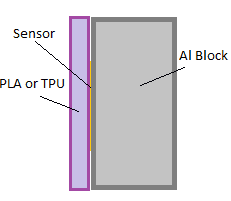
I am designing a force sensing system with piezoelectric force sensors to determine the impact force on an object during a collision. The sensor will be placed between an aluminum block and either a TPU or PLA 3D printed "cover". The cover will be 5cm thick.
upload_2017-11-6_20-2-5.png


Attempt
My goal is to determine how much impact energy will be absorbed by the cover material and how much will be transmitted to the sensors sensing surface (5cm*5cm). Once I know this I think that I should be able to take the value measured by the force sensor and sub it into some function to relate it to the impact force on the outer surface of the cover material.

If I have the material properties of PLA and TPU (Young's modulus, density, etc), the dimensions of the cover, the impact force area, and the force value measured by the sensor, is it possible to come up with some equation?

Maybe this is too complex and the force on the outside of the material will almost 100% be transmitted to the sensor.
Could someone let me know what they think and what steps I should take going forward?
 

Attachments

  • upload_2017-11-6_20-1-56.png
    upload_2017-11-6_20-1-56.png
    1.1 KB · Views: 818
  • upload_2017-11-6_20-2-5.png
    upload_2017-11-6_20-2-5.png
    1.1 KB · Views: 911
Engineering news on Phys.org
FEA is your friend on this one. Be aware that piezoelectric sensors can be sensitive to both shear and normal stress. Also do not be surprised if you find normal stress directly under the impact, and a ring of tensile and shear stress outside the area of impact. Run a number of cases and look for patterns. Look closely at the area of impact vs the size and location of the sensor.

If the aluminum block is rigidly supported, all of the impact energy will be absorbed by the elastomer. The sensor will see the force.
 
You are helping me out a lot haha, thank you.

The aluminum will be rigidly supported.

This is the piezoelectric sensor that I am looking at, A502 (https://www.tekscan.com/products-solutions/force-sensors/a502?tab=specifications). Tekscan, the manufacturer, suggests some ways to deal with shear stress on the sensors that I will be looking into (Best Practices in Mechanical Integration, https://www.tekscan.com/flexiforce-integration-guides). For my case I am looking to achieve a ball park measurement, I realize that designing a load cell may be better for my situation but I do not think that I will have the time to implement it along with my other work (managing microcontroller, accelerometers, sample rate, signal filtering, data logging, data processing...etc).

I will look into performing some FEA on this scenario and try to see if I can come up with some relationship.
I think that these piezoelectric sensors might be my best option for force sensing, right now I'm not aware of any other methods to sense force (other than load cells which I mentioned my issue with above). Would you have any other ideas for force sensors?
 
ConnorM said:
Would you have any other ideas for force sensors?
https://www.google.com/search?q=pressure+sensitive+sheet
See also the Google suggestions as you type in the above.

In addition to the above, I seem to recall a purely mechanical sheet material that permanently changes color upon a compression force. If I recall correctly it is used to evaluate force distribution of bolted connections such as pipe flanges and engine cylinder heads.
 
The Tekscan product will get the job done, but you will spend a lot of time calibrating and debugging. A load cell will probably be faster in the end, and will get better results. A load cell for your setup would be a ring behind the aluminum block, or better yet, machined into the aluminum block. Mount eight strain gages, 4 longitudinal and 4 circumferential, and wired into a full bridge with 2 gages in series in each leg. There's no need to go through all the strain gage calculations because you calibrate it with a known load, gain, and excitation voltage. The only calculation is for the wall thickness. A two inch diameter ring can be as little as one inch long.
 

Similar threads

  • · Replies 4 ·
Replies
4
Views
2K
  • · Replies 2 ·
Replies
2
Views
2K
Replies
13
Views
4K
  • · Replies 5 ·
Replies
5
Views
4K
Replies
2
Views
901
Replies
14
Views
4K
  • · Replies 16 ·
Replies
16
Views
3K
  • · Replies 24 ·
Replies
24
Views
4K
  • · Replies 2 ·
Replies
2
Views
2K
  • · Replies 5 ·
Replies
5
Views
1K