Impact force of pressure fired vessel (Help needed)

Click For Summary
SUMMARY

The discussion centers on calculating the impact force of a down hole oil tool weighing 63 kg (139 lbs) that experiences a pressure load of 53,879 lbs (239,665 Newtons) and drops 7 meters. The calculated acceleration is 3,800 m/s², leading to a final velocity of 230 m/s (514 mph) upon impact. The energy at this velocity is approximately 1.6 million Joules, equivalent to 340 grams of TNT. The impact force can reach up to 11 million pounds force, depending on whether the tool passes through a restriction of 1.35 inches or not, with various factors influencing the actual force experienced.

PREREQUISITES
  • Understanding of Newton's laws of motion, specifically F=ma.
  • Familiarity with the SUVAT equations for motion analysis.
  • Basic knowledge of pressure units, particularly psi and Newtons.
  • Concepts of energy calculation in physics, specifically kinetic energy.
NEXT STEPS
  • Research the effects of pressure differentials in fluid dynamics.
  • Learn about the mechanical properties of materials under high stress, including yield strength and shear strength.
  • Investigate the dynamics of impact forces in engineering applications.
  • Explore the implications of fluid behavior in confined spaces during rapid acceleration.
USEFUL FOR

Engineers, physicists, and professionals in the oil and gas industry who are involved in the design and analysis of down hole tools and their interactions with wellbore restrictions.

eightace148
Messages
7
Reaction score
0
Ok folks

I have a down hole oil tool which seals a well bore. it weighs 63KG (139 lbs)
I have worked out that it is being loaded up from above with 53879 lbs. by applied pressure/ hydrostatic pressure
if it was to instantly release and drop 7m what would the impact force be on a restriction below?
we can assume it is in air & disregard friction/ resistance etc

can anyone help out?
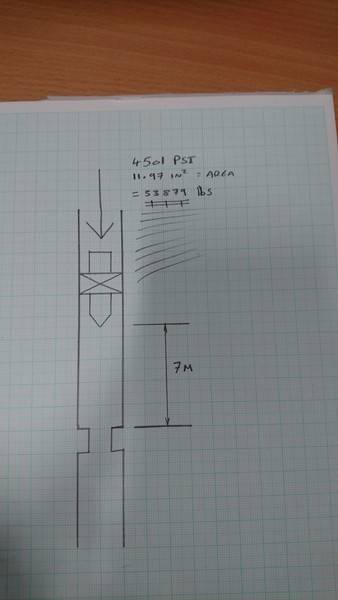
DSC_0137_zpsdy41mxeb.jpg
 
Engineering news on Phys.org
Yes and no. I prefer to work in SI units...

53,879 lbs force is 239,665 Newtons. Let's assume that force is constant and can be maintained as the 63kg tool accelerates over 7m..

Newton says F=ma so the acceleration a is..

a = F/m = 239,663/63 = 3800 m/s/s

That's much faster than gravity which is just 10m/s/s so we can ignore the help gravity provides.

If we assum constant acceleration then the SUVAT equation V2 = U2 + 2as can give us the velocity after 7m...

U = 0
a = 3800m/s/s
s = 7m

V = sqrt(2as)
= sqrt(2*3800*7) = 230 m/s

That's about 514 mph which I suspect is unrealistic? Can the hydraulic system really maintain the loading constant as it accelerates? I suspect the loading/pressure may drop off very rapidly?

Even if that velocity is correct it's not possible to work out the impact force on the obstruction without more information. For example how quickly the obstruction stops the tool? However you could work out the amount of energy the tool has..

If 230 m/s is correct the energy in the tool is given by

E = 0.5 m * V2 = 0.5 * 63 * 2302 = 1.6 M Joules

That's the equivalent of about 340 grams of TNT.
 
OK, very interesting.
Regarding requiring the distance it moved when hitting the restriction, this is one of the reason for asking. The said tool may of been blown through the restriction and I was trying to see if it was possible to determine whether the impact force could blow it through.

I have yield strength and shear area, although I know this wouldn't actually shear rather than deform/ wedge through. Let's say for instance the tool traveled through the restriction, which is 1.35in. Long. As a minimum. Would this give a maxium impact force?
 
Oh and yes I agree that the pressure would drop off quickly intact I believe it dropped off within a 10 second period which is what the recorder is incremented at. What I would also add is that around 2200psi was hydrostatic pressure so I would think this could be a constant forcing the tool down.
 
Regarding the pressure...

We can calculate how long the pressure would have to be maintained for the tool to accelerate at fast as calculated earlier over the full 7m. We can use..

V = U + at
where
U = initial velocity = 0
t = time
so
t = V/a = 230/3800 = 0.06 seconds.

Wow! The numbers say the tool goes from 0 to 514mph in 0.06 seconds!

Is the pressure differential really that high? What's in the space below the tool? Is the pipe empty below the tool?
 
Last edited:
eightace148 said:
Let's say for instance the tool traveled through the restriction, which is 1.35in. Long. As a minimum. Would this give a maxium impact force?

If we assume the tool only just makes it through the restriction then yes we can calculate an average force. First work out the deceleration. It will be enormous because we're talking about the tool decelerating from 514mph to zero in just over an inch! ...

Same equation..

V2 = U2 + 2as

only V is now zero and U is 230m/s.
s is 34mm or 0.034m

a = -U2/2s
= -777,941 m/s/s

To work out the average force we can use

F = ma
= 63 * 777,941 = 49 * 106 N

or about 11,000,000 pounds force.

If the tool easily goes through then the force will be lower. If the tool doesn't quite make it through the restriction that implies it stops even quicker and the force will be higher.
 
What is the pipe length (above the restriction) and I.D; the fluid density; the I.D. of the restriction; the pipe/restriction material; and the material surrounding the pipe at the point of the restriction?
Also, have you calculated the potential shearing stress on the restricting ring section with only a 2200 psi static pressure load?
 
excitant work!
yes I believe there is high potential for the high acceleration to be correct blink and you will miss it! If the tool did pass through the sub then it would be lying at the bottom of the well, so it will be a lower value , but the last measurement we can take is from when it passes through the restriction. so we can conclude that this would be the max load the restriction sub would impact the restriction, but more probable that it is lower.
Height above is something like 2300m tubing sizes differs, but the hydrostatic pressure is a given at 2200psi then an applied pressure which brings up to 4501psi.
the material of the restriction is of a harder and higher yield than that of the tool, which is also a fluted to allow bypass. this bit I can calculate out though. I have calculated the Bearing yield point of the Fluted No-Go sub on the bottom of the tool and that comes out to 4800 lbs, and the shear point which is 271,200 lbs. neither will be accurate as the yield will be the initial deform point and the shear is a perfect shear. This will be deformed and squashed / mashed if you like, very difficult to determine I would imagine. but looking at the calcs CWatters has provided then it looks plausible that this could happen.
 
My main concern is that the calculations above assume there is nothing below the tool to stop it accelerating. If there was fluid below the tool the pressure could rise very rapidly when it starts moving and slow the tool. I also ignored the fact that the mass of the fluid above the tool also has to be accelerated.
 
  • #10
yes I see what you mean, the fluid above the tool would be acting like an anchor. there may well of been fluid bellow also, its an unknown at this time.
 

Similar threads

Replies
13
Views
3K
Replies
1
Views
2K
  • · Replies 12 ·
Replies
12
Views
2K
  • · Replies 7 ·
Replies
7
Views
2K
  • · Replies 7 ·
Replies
7
Views
3K
Replies
1
Views
2K
  • · Replies 4 ·
Replies
4
Views
3K
  • · Replies 5 ·
Replies
5
Views
2K
  • · Replies 11 ·
Replies
11
Views
5K
  • · Replies 4 ·
Replies
4
Views
6K