Implications of mass energy not being conserved for ##\beta^+## decay

Click For Summary
SUMMARY

In the discussion on ##\beta^{+}## decay, it is established that mass energy is not conserved in the traditional sense; rather, energy conservation includes both mass and kinetic energy contributions. The decay process involves a proton transforming into a neutron, a positron, and an electron neutrino. The key takeaway is that while the sum of individual particle masses may not remain constant, the total energy, which includes kinetic energy, is conserved, allowing ##\beta^{+}## decay to occur without violating conservation laws.

PREREQUISITES
  • Understanding of particle physics, specifically beta decay processes.
  • Familiarity with conservation laws in physics, particularly energy conservation.
  • Knowledge of kinetic energy and its role in particle interactions.
  • Basic grasp of momentum conservation principles.
NEXT STEPS
  • Study the principles of energy conservation in particle physics.
  • Explore the mechanics of beta decay, focusing on the role of kinetic energy.
  • Learn about the implications of particle transformations in quantum mechanics.
  • Investigate other decay processes and their conservation laws, such as ##\beta^{-}## decay.
USEFUL FOR

This discussion is beneficial for physics students, particle physicists, and educators seeking to deepen their understanding of decay processes and conservation laws in quantum mechanics.

JD_PM
Messages
1,125
Reaction score
156
Homework Statement
Beta + decay
Relevant Equations
Beta + decay
##\beta^{+}## decay (a proton decays to a neutron + positron + electron neutrino) is a decay in which mass energy is not conserved.

I've been taught that if that ought to be the case for a decay/reaction, it would be forbidden (please see solution manual below):
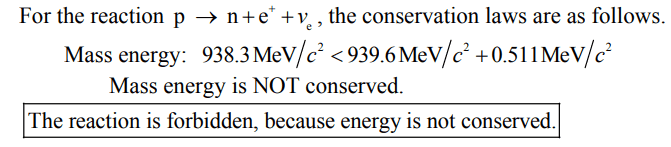
Captura de pantalla (776).png


But ##\beta^{+}## decay is observed to happen.

What am I missing here?
 
Physics news on Phys.org
JD_PM said:
Homework Statement: Beta + decay
Homework Equations: Beta + decay

What am I missing here?
Kinetic energy.
 
Orodruin said:
Kinetic energy.

To get the maximum kinetic energy for the positron (for instance) we have to assume that the neutron has no kinetic energy so that momentum is conserved like:

$$p_{ntr} = p_e$$

Where ntr means neutrino.

Was your comment pointing at this assumption?
 
JD_PM said:
To get the maximum kinetic energy for the positron (for instance) we have to assume that the neutron has no kinetic energy so that momentum is conserved like:

$$p_{ntr} = p_e$$

Where ntr means neutrino.

Was your comment pointing at this assumption?
No. There is no such thing as ”mass conservation” in the sense of needing the sum of the masses of individual particles to be the same before and after. The appropriate conservation law is energy and this has contributions from both the masses and the kinetic energies of the particles. So when you are just comparing the sums of the individual masses, you are missing kinetic energy.
 
  • Like
Likes   Reactions: JD_PM
OK I see it now thanks. Then this reaction is not forbidden, because energy (mass+ kinetic energies) is conserved for Beta + decay, right?
 
Yes
 

Similar threads

  • · Replies 12 ·
Replies
12
Views
2K
  • · Replies 2 ·
Replies
2
Views
2K
  • · Replies 3 ·
Replies
3
Views
4K
  • · Replies 32 ·
2
Replies
32
Views
4K
  • · Replies 9 ·
Replies
9
Views
2K
Replies
1
Views
3K
  • · Replies 3 ·
Replies
3
Views
4K
  • · Replies 5 ·
Replies
5
Views
3K
  • · Replies 11 ·
Replies
11
Views
8K
  • · Replies 8 ·
Replies
8
Views
3K