Implicit differentiation with exponential function

Click For Summary
SUMMARY

The discussion focuses on finding the derivative of the implicit function defined by the equation \(e^{xy} + x^2 + y^2 = 5\) at the point (2,0). The correct application of implicit differentiation leads to the expression \(\frac{dy}{dx} = -\frac{ye^{xy} + 2x}{xe^{xy} + 2y}\). At the specified point, the slope of the tangent line is calculated to be -2. The use of the product rule and chain rule is confirmed as necessary for differentiating the term \(e^{xy}\).

PREREQUISITES
  • Understanding of implicit differentiation
  • Familiarity with the product rule and chain rule in calculus
  • Knowledge of exponential functions and their derivatives
  • Ability to evaluate derivatives at specific points
NEXT STEPS
  • Study the application of implicit differentiation in more complex functions
  • Learn about the graphical interpretation of derivatives and tangent lines
  • Explore the use of the chain rule in higher dimensions
  • Investigate the behavior of exponential functions in calculus
USEFUL FOR

Students of calculus, mathematics educators, and anyone seeking to deepen their understanding of implicit differentiation and its applications in finding slopes of tangent lines.

coolbeans33
Messages
23
Reaction score
0
find dy/dx: exy+x2+y2= 5 at point (2,0)

I'm confused with finding the derivative with respect to x of exy.

this is what I did so far for just this part: exy*d(xy)/dx

exy*(y+x*dy/dx)

do I need to put the parentheses on here? I thought so because that is the part where I used the product rule. (but probably not, right?)

then for the entire function so far this is what I got:

exy*(y+x*dy/dx)+2x+2y*dy/dx=5

am I doing something wrong so far?
 
Physics news on Phys.org
coolbeans33 said:
find dy/dx: exy+x2+y2= 5 at point (2,0)

I'm confused with finding the derivative with respect to x of exy.

this is what I did so far for just this part: exy*d(xy)/dx

exy*(y+x*dy/dx)

do I need to put the parentheses on here? I thought so because that is the part where I used the product rule. (but probably not, right?)

then for the entire function so far this is what I got:

exy*(y+x*dy/dx)+2x+2y*dy/dx=5

am I doing something wrong so far?

Your differentiation of the left side looks good (yes you do need the parentheses as given by the chain rule), but the right side is a constant, so after implicitly differentiating with respect to $x$, what should it become?
 
MarkFL said:
Your differentiation of the left side looks good (yes you do need the parentheses as given by the chain rule), but the right side is a constant, so after implicitly differentiating with respect to $x$, what should it become?

srry I forgot to put the "equals zero" in.

So I solved for the derivative and I got:

yexy+2x/x*exy+2y

and the slope of the tangent line at pt (2,0) is 2.
 
We are given the implicit relation:

$$e^{xy}+x^2+y^2=5$$

Implicitly differentiating with respect to $x$, we find:

$$e^{xy}\left(x\frac{dy}{dx}+y \right)+2x+2y\frac{dy}{dx}=0$$

Next, we want to arrange this equation such that all terms having $$\frac{dy}{dx}$$ as a factor are on one side, and the rest is on the other side:

$$xe^{xy}\frac{dy}{dx}+2y\frac{dy}{dx}=-\left(ye^{xy}+2x \right)$$

Factor the left side:

$$\frac{dy}{dx}\left(xe^{xy}+2y \right)=-\left(ye^{xy}+2x \right)$$

Divide through by $$xe^{xy}+2y$$

$$\frac{dy}{dx}=-\frac{ye^{xy}+2x}{xe^{xy}+2y}$$

Hence:

$$\left.\frac{dy}{dx} \right|_{(x,y)=(2,0)}=-\frac{0\cdot e^{2\cdot0}+2\cdot2}{2\cdot e^{2\cdot0}+2\cdot0}=-\frac{4}{2}=-2$$

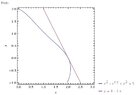
Here is a plot of the equation and its tangent line:

View attachment 1603
 

Attachments

  • coolbeans33.jpg
    coolbeans33.jpg
    10.2 KB · Views: 107

Similar threads

  • · Replies 2 ·
Replies
2
Views
1K
  • · Replies 3 ·
Replies
3
Views
2K
  • · Replies 1 ·
Replies
1
Views
1K
  • · Replies 9 ·
Replies
9
Views
2K
  • · Replies 16 ·
Replies
16
Views
3K
  • · Replies 9 ·
Replies
9
Views
3K
  • · Replies 4 ·
Replies
4
Views
1K
  • · Replies 1 ·
Replies
1
Views
3K
  • · Replies 2 ·
Replies
2
Views
1K
  • · Replies 3 ·
Replies
3
Views
2K