In Euclidian space, closed ball is equal to closure of open ball

Click For Summary
SUMMARY

In the context of metric spaces, the discussion establishes that in Euclidean space, specifically in ## \mathbb{R}^n ## with the standard metric, the closure of an open ball ## cl(B(c, r)) ## is equal to the closed ball ## \bar{B}(c, r) ##. The proof involves demonstrating both inclusions: first, that any point in the closure of the open ball can be approached by a sequence within the open ball, and second, that any point in the closed ball can be approximated by points in the open ball. The discussion also touches on the use of sequences to illustrate convergence and the properties of convex functions in relation to the proof.

PREREQUISITES
  • Understanding of metric spaces and their properties
  • Familiarity with open and closed balls in Euclidean space
  • Knowledge of convergence of sequences in metric spaces
  • Basic concepts of convex functions and their definitions
NEXT STEPS
  • Study the properties of metric spaces, focusing on open and closed sets
  • Learn about the convergence of sequences in ## \mathbb{R}^n ##
  • Explore the relationship between convex functions and topology
  • Investigate theorems related to closures and limits in metric spaces
USEFUL FOR

Mathematicians, students of real analysis, and anyone studying topology or metric spaces will benefit from this discussion, particularly those interested in the properties of open and closed sets in Euclidean spaces.

CGandC
Messages
326
Reaction score
34
Problem: Let ## (X,d) ## be a metric space, denote as ## B(c,r) = \{ x \in X : d(c,x) < r \} ## the open ball at radius ## r>0 ## around ## c \in X ##, denote as ## \bar{B}(c, r) = \{ x \in X : d(c,x) \leq r \} ## the closed ball and for all ## A \subset X ## we'll denote as ## cl(A) ## the closure of ## A ## ( sometimes denoted also as ## \bar{A} ## ).

Show that in ## \mathbb{R}^n ## with the standard metric it occurs that: ## cl(B(c, r))=\bar{B}(c, r) ##

Attempt:
## ( \subseteq ) ## Let ## \tau \in cl(B(c,r)) ##. There exists a sequence ## x_n \in B(c,r) ## s.t. ## x_n \rightarrow \tau ##
( From a theorem that says: ## x \in cl(B) \iff ## there exists a sequence ## x_n \in B ## , ## x_n \rightarrow x ## ).
Note that for all ## n \in \mathbb{N} ##, from the fact ## x_n \in B(c,r) ## we have ## d(c,x_n) < r ##. Also, since ## x_n \rightarrow \tau ## we have that ## d(x_n,\tau) \rightarrow 0 ##.
So by triangle inequality, we have for all ## n \in \mathbb{N} ## that ## d(c,x) \leq d(c,x_n) + d(x,x_n) ##, taking the limit we get ## d(c,x) \leq r ##.

## ( \supseteq ) ## Let ## \tau \in \bar{B}(c,r) ##, hence ## d(c,\tau) \leq r ##.
( Now we want to show that ## \tau \in cl(B(c,r)) ##, meaning for all ## r>0 ## we want to show ## B(\tau,r) \cap B(c,r) \neq \emptyset ## )
Let ## r>0 ##. Notice that ## \tau \in B(\tau,r) ## since ## d(\tau,\tau) =0 < r ##. In addition we have ## \tau \in \bar{B}(c,r) ## then ## d(\tau,c) \leq r ##.
If ## d(\tau,c)<r ## then ## \tau \in B(c,r) ##,
hence ## \tau \in B(\tau,r) \cap B(c,r) ##.
If ## d(\tau,c) = r ## then [ missing arguments for completing proof ].How to prove the "## ( \supseteq ) ##" side? I thought maybe I'd use the theorem "## x \in cl(B) \iff ## there exists a sequence ## x_n \in B ## , ## x_n \rightarrow x ## "; that means I'd show the existence of a sequence ## (x_k)_{k=1} \subseteq R^n ## s.t. ## (x_k)_{k=1} = ((x^{(1)}_i)_{i=1}^n,(x^{(2)}_i)_{i=1}^n,... ) ## s.t. ## x_k = (x^{(k)}_i)_{i=1}^n ## s.t. ## (x^{(k)}_i)_{i=1}^n \in R^n ## , but the question is how to define this sequence of sequences?
 
Physics news on Phys.org
You don't need a sequence of sequences.
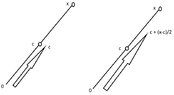
For a point ##x## on the boundary of the closed ball, why not just approach it by the sequence that goes along the line segment from ##c## to ##x##, starting at ##c## and at each step jumping to halfway between current location and ##x##. You should be able to prove that converges to ##x## and that all its points are in the open ball.
 
Ok, here's what I've did:
I started drawing an intuitive ( non-precise ) picture of what you've said,
1644591793832.png


I've noted that In the attempted proof I gave I had mistaken with the arbitrary ## r ## I introduced with the ## r ## given in the question. Here's my attempted proof based on your idea:


Let ## \tau \in cl(B(c,r)) ## be arbitrary. Hence ##d(c,\tau) \leq r##.
Take the sequence ## (x_m) \subseteq \mathbb{R}^n ## defined as follows,
For every ## m \in \mathbb{N} ##, ## x_m = c + \sum_{k=1}^{m}\frac{\tau-c}{2^i} = c + \frac{1}{2}\cdot(\tau-c)\sum_{k=0}^{m-1} \frac{1}{2^k} = c + ( \tau - c)\cdot(1-(\frac{1}{2})^m) ##
Note that ## \lim_{m\to\infty}x_m = \tau ##.
Also note that ## x_m ## is a vector equation, meaning that for all ## 1 \leq i \leq n ## , ## (x_m)_i = c_i + ( \tau_i - c_i)\cdot(1-(\frac{1}{2})^m) ##, from this, note that ## (x_m) \subseteq B(c,r) ## since for all ## m \in \mathbb{N} ## we have that ## d(c,x_m) = \sqrt{ \Bigg( c_1 - \bigg( c_1 + ( \tau_1 - c_1)\cdot(1-(\frac{1}{2})^m) \bigg) \Bigg)^2 + \cdots + \Bigg( c_n - \bigg( c_n + ( \tau_n - c_n)\cdot(1-(\frac{1}{2})^m) \bigg) \Bigg)^2 } =
( 1 - (\frac{1}{2})^m ) \sqrt{ ( \tau_1 - c_1)^2 + \cdots + ( \tau_n - c_n)^2 }.## Since ## d(c,\tau) \leq r ## we can see that ## d(c,x_m) < r ##, hence ## (x_m) \subseteq B(c,r) ##. So since ## \lim_{m\to\infty}x_m = \tau ## and ## \tau ## was arbitrary, we're finished.Do you think this is ok?
 

Attachments

  • 1644591787875.png
    1644591787875.png
    6.4 KB · Views: 225
Sometimes a general fact is much easier to prove because the key points are presented explicitly.

Let ##f:X\to \mathbb{R}## be a convex continuous function on the normed vector space ##X##. Then
$$\mathrm{cl}\,\{x\in X\mid f(x)<c\}=\{x\in X\mid f(x)\le c\}$$
 
Last edited:
  • Like
Likes   Reactions: sysprog
Thanks but I haven't learned about convex functions and normed vector spaces yet (I'm doing a real analysis course and just very little of the basics of topology are taught). It seems to me that If I can create such a function as you've said, the proof will be finished.
 
Convex function is a function such that the inequality
$$f(\lambda x_1+(1-\lambda)x_2)\le \lambda f(x_1)+(1-\lambda)f(x_2)$$
holds for all $$x_1,x_2\in X,\quad \lambda\in[0,1].$$
Take ##f(x)=\|\tilde x-x\|## and ##X=\mathbb{R}^m##
 
  • Like
Likes   Reactions: sysprog
wrobel said:
Convex function is a function such that the inequality
$$f(\lambda x_1+(1-\lambda)x_2)\le \lambda f(x_1)+(1-\lambda)f(x_2)$$
holds for all $$x_1,x_2\in X,\quad \lambda\in[0,1].$$
Take ##f(x)=\|\tilde x-x\|## and ##X=\mathbb{R}^m##

Ok now I understand how the general theorem you proposed relates to the problem. In the private case you proposed I get what I'm asked to prove. How do I prove the "## \supseteq ##" direction? got a hint please?

Here's what I've done ( had no clue how to proceed beyond the beginning ):
Let ## x ## be arbitrary such that ## f(x) \leq c ##. Let ## r>0 ##. We'll show that ## B(x,r) \subseteq \{ y \in X : f(y) < c \} ##. Let ## \tau \in B(x,r) ##, thus ## d(x,\tau)<r ##. [ I don't see how can I relate ## \tau ## to ## f ## in order to have ## f(\tau) < c ##. ]

I then thought maybe I'd find a sequence ## x_n \in \{ y \in X : f(y) < c \} ## which converges to ## x ## and that'd show ## x ## is in ## \mathrm{cl}\,\{x\in X\mid f(x)<c\} ## , but couldn't think of anything that'd help me allow to do that.

andrewkirk said:
@CGandC Yes your proof works.
Thanks for the help!
 

Similar threads

  • · Replies 17 ·
Replies
17
Views
2K
  • · Replies 4 ·
Replies
4
Views
2K
  • · Replies 2 ·
Replies
2
Views
2K
  • · Replies 1 ·
Replies
1
Views
2K
  • · Replies 2 ·
Replies
2
Views
2K
  • · Replies 0 ·
Replies
0
Views
2K
  • · Replies 4 ·
Replies
4
Views
2K
  • · Replies 15 ·
Replies
15
Views
2K
  • · Replies 2 ·
Replies
2
Views
2K
Replies
6
Views
2K