Foracle
- 29
- 8
- TL;DR
- Numerical solution of the wavefunction blows up when the frequency of oscillation of the wall is high. What does this mean?
I am trying to numerically solve (with Mathematica) a relativistic version of infinite square well with an oscillating wall using Klein-Gordon equation. Firstly, I transform my spatial coordinate ## x \to y = \frac{x}{L[t]} ## to make the wall look static (this transformation is used a lot in solving non-static boundary condition in the non-relativistic case), which brings Klein-Gordon equation to :
Input :

Output :

All constants have been set to 1

I tried to solve this system where ##L(t)=2+sin(1000 t)## using NDSolve :

Then I plot my result as a function of ##(y,t)## :
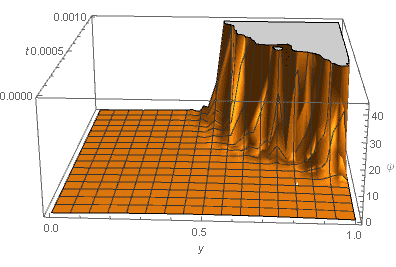
The wavefunction ##\psi## blows up. This doesn't happen when I tune the frequency down to 1, ##L(t)=2+sin(t)##
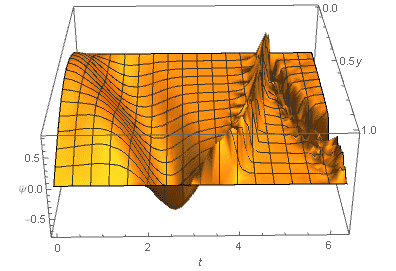
My question is why does ##\psi## blow up when the frequency of the oscillation is high and what does it mean? Does it have anything to do with particle production? Or did I just mess up my code?
Input :
Output :
All constants have been set to 1
I tried to solve this system where ##L(t)=2+sin(1000 t)## using NDSolve :
Then I plot my result as a function of ##(y,t)## :
The wavefunction ##\psi## blows up. This doesn't happen when I tune the frequency down to 1, ##L(t)=2+sin(t)##
My question is why does ##\psi## blow up when the frequency of the oscillation is high and what does it mean? Does it have anything to do with particle production? Or did I just mess up my code?
Attachments

Last edited: