Graduate Initial value ODE with shifting forcing function

Click For Summary
The discussion focuses on solving an initial value ordinary differential equation (ODE) using the Laplace Transform. The user derived the equation V(s) = [U(s+5) + 1] / (s - 12) and seeks assistance with the inverse transformation, specifically for U(s+5) / (s - 12). Participants clarify that U(t) represents the Heaviside step function, which has a known Laplace transform. They suggest applying the shifting property to find the Laplace transform of e^(at) * u(t), confirming that the transform of e^(-5t) * u(t) is 1 / (s + 5). The conversation emphasizes the importance of using standard Laplace transform tables for accurate calculations.
Houeto
Messages
9
Reaction score
0
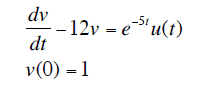
Use laplace Transform to solve this ode:
upload_2016-7-21_21-49-59.png


So I got:

sV(s)-V(0)-12V(s)=U(s+5)
V(s)(s-12)=U(s+5)+1
V(s)=[U(s+5)+1]/(s-12)

Now to go back to time domain with Inverse Laplace Transform...My question is, how to transform U(s+5)/(s-12)?

Any help?

Thanks guys
 
Physics news on Phys.org
I think it may help you to know that u(t) is the standard symbol for the step function, which has a known Laplace transform. Check your tables.
 
Thanks
 
@Twigg , can you shed some lights on Laplace Transform of e^(at)*u(t)?

Thanks
 
I'm pretty sure you just apply the shifting property to the Laplace transform of the Heaviside step function. The Laplace transform of ##u(t)## is ##\frac{1}{s}##, so the Laplace transform of ##e^{-5t} u(t)## is ##\frac{1}{s + 5}##. Just like you did in your first post.
 
  • Like
Likes Houeto
Thanks
 

Similar threads

  • · Replies 2 ·
Replies
2
Views
2K
  • · Replies 5 ·
Replies
5
Views
3K
  • · Replies 5 ·
Replies
5
Views
5K
  • · Replies 1 ·
Replies
1
Views
2K
  • · Replies 1 ·
Replies
1
Views
3K
  • · Replies 2 ·
Replies
2
Views
2K
Replies
9
Views
2K
Replies
5
Views
2K
Replies
1
Views
4K
  • · Replies 3 ·
Replies
3
Views
2K