Discussion Overview
The discussion revolves around determining the integration limits for a volume defined in cylindrical coordinates, constrained by a cylinder and several planes in the first octant. Participants explore the setup of triple integrals and the implications of the geometric constraints on the limits of integration.
Discussion Character
- Technical explanation
- Mathematical reasoning
- Debate/contested
Main Points Raised
- One participant seeks to find the integration limits for a volume defined by the cylinder \(y^2 + z^2 = 9\) and the planes \(x = 0\), \(y = 3x\), and \(z = 0\) in the first octant.
- Another participant suggests using cylindrical coordinates and poses questions about how to restrict the integration variables \(z\), \(r\), and \(\theta\) based on the constraints.
- There are differing opinions on the order of integration and the correct limits for \(z\), \(y\), and \(x\), with one participant proposing limits while another expresses uncertainty about their correctness.
- Some participants discuss the dependence of \(r\) on \(\theta\) or \(z\) and explore how to derive upper bounds for \(r\) based on the relationships between the variables.
- One participant expresses difficulty in following the technical reasoning and requests clarification in simpler terms.
- Another participant attempts to summarize the integral setup and asks for the functions defining the limits of integration, leading to further exploration of the relationships between the variables.
- There is a suggestion to visualize the bounded area, but participants face limitations in graphing capabilities.
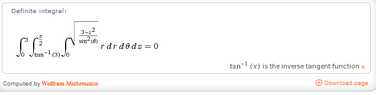
- At one point, a participant questions whether the integral evaluates to zero, while another disagrees and provides a detailed breakdown of the integral calculation.
Areas of Agreement / Disagreement
Participants express differing views on the correct limits of integration and the order of integration. There is no consensus on the final setup of the integral, and some participants remain uncertain about the reasoning and calculations presented.
Contextual Notes
Participants mention various constraints and relationships between variables, but there are unresolved aspects regarding the integration limits and the implications of the geometric constraints. The discussion reflects ongoing exploration rather than a settled conclusion.