Integral $\displaystyle\int \frac{1}{\sqrt[4]{1-x^4}}dx$ Solution

Click For Summary

Discussion Overview

The discussion centers around the integral $\displaystyle\int \frac{1}{\sqrt[4]{1-x^4}}dx$, exploring its properties, potential solutions, and related mathematical theories. Participants examine whether the integral can be expressed in terms of elementary functions and discuss various approaches to solving it, including definite integrals and transformations.

Discussion Character

  • Exploratory
  • Technical explanation
  • Debate/contested
  • Mathematical reasoning

Main Points Raised

  • Some participants assert that the integral does not have a solution in terms of elementary functions, referencing the theorem of Chebyshev.
  • Others present a definite integral formula discovered by Gauss, stating that $\int_0^1 \frac{1}{\sqrt[4]{1-x^4}}dx = \frac{\pi}{2M(\sqrt2)}$, where $M(x)$ is the arithmetic-geometric mean.
  • One participant proposes a transformation method to solve the integral, expressing it in terms of a new variable $t$ and outlining steps to convert the integral into a different form.
  • Another participant suggests using partial fraction decomposition to simplify the integral further, indicating a method to integrate term by term.
  • Some participants express uncertainty about the correctness of their proposed methods and solutions.

Areas of Agreement / Disagreement

Participants generally disagree on whether the integral can be expressed in terms of elementary functions, with some asserting it cannot and others providing methods to approach the problem. The discussion remains unresolved regarding the validity of the various proposed solutions.

Contextual Notes

Limitations include the dependence on the definitions of terms and the unresolved nature of the mathematical steps involved in the proposed solutions.
juantheron
Messages
243
Reaction score
1
$\displaystyle \int\frac{1}{\sqrt[4]{1-x^4}}dx$
 
Physics news on Phys.org
jacks said:
$\displaystyle \int\frac{1}{\sqrt[4]{1-x^4}}dx$

This does not have an integral in terms of elementary functions by the theorem of Chebyshev that you have had pointed at in an earlier post.

It can also be found >>here<< near expression (20)

CB
 
CaptainBlack said:
This does not have an integral in terms of elementary functions by the theorem of Chebyshev that you have had pointed at in an earlier post.

It can also be found >>here<< near expression (20)

CB

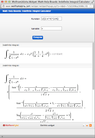
A quicker way to Wolfram straight from MHB is using one of our MHB Widgets.

View attachment 411

For your question this will use the same Wolfram indefinite integral calculator. Here's the output of your question.

View attachment 410
 

Attachments

  • Screen Shot 2012-10-15 at 2.55.19 AM.png
    Screen Shot 2012-10-15 at 2.55.19 AM.png
    19.5 KB · Views: 96
  • Screen Shot 2012-10-15 at 2.55.57 AM.png
    Screen Shot 2012-10-15 at 2.55.57 AM.png
    6.7 KB · Views: 89
There is a neat formula (discovered by Gauss) for the definite integral of $1/ \sqrt[4]{1-x^4}$, namely $$\int_0^1 \frac{1}{\sqrt[4]{1-x^4}}dx = \frac{\pi}{2M(\sqrt2)},$$ where $M(x)$ denotes the arithmetic-geometric mean of 1 and $x$. See the very interesting article An Eloquent Formula for the Perimeter of an Ellipse in last month's issue of the Notices of the American Math. Soc.
 
Opalg said:
There is a neat formula (discovered by Gauss) for the definite integral of $1/ \sqrt[4]{1-x^4}$, namely $$\int_0^1 \frac{1}{\sqrt[4]{1-x^4}}dx = \frac{\pi}{2M(\sqrt2)},$$ where $M(x)$ denotes the arithmetic-geometric mean of 1 and $x$. See the very interesting article An Eloquent Formula for the Perimeter of an Ellipse in last month's issue of the Notices of the American Math. Soc.

According to...

Gauss's Constant -- from Wolfram MathWorld

... the so called 'Gauss's constant' is defined as... $\displaystyle G= \frac{1}{\text{M}\ (1, \sqrt{2})} = \frac{2}{\pi} \int_{0}^{1} \frac{dx}{\sqrt{1-x^{4}}}$

Kind regards

$\chi$ $\sigma$
 
But I have solved like that way.

(Dont no whether it is Right or not)

$\displaystyle \int\frac{1}{\sqrt[4]{1-x^4}}dx$

Put $\displaystyle 1-x^4=t^4x^4\Leftrightarrow x^4 = \frac{1}{1+t^4}$

$\displaystyle4x^3 dx = -\frac{4t^3}{(1+t^4)^2}dt$

$\displaystyle dx = -\frac{t^3}{(1+t^4)^2.x^3}dt$

So Integral Convert into $\displaystyle -\int\frac{t^3}{(1+t^4)^2.x^3.tx}$

$\displaystyle - \int\frac{t^2}{(1+t^4)^2}.\frac{(1+t^4)}{1}dt$

$\displaystyle -\int\frac{t^2}{1+t^4}dt = -\frac{1}{2}\int\frac{(t^2+1)+(t^2-1)}{1+t^4}dt$

Now Let $\displaystyle \mathbb{I = \int \frac{t^2+1}{t^4+1}}$ and $\displaystyle\mathbb{J=\int\frac{t^2-1}{t^4+1}}dt$

after that we can solve for $\mathbb{I}$ and $\mathbb{J}$

Thanks
 
jacks said:
But I have solved like that way.

(Dont no whether it is Right or not)

$\displaystyle \int\frac{1}{\sqrt[4]{1-x^4}}dx$

Put $\displaystyle 1-x^4=t^4x^4\Leftrightarrow x^4 = \frac{1}{1+t^4}$

$\displaystyle4x^3 dx = -\frac{4t^3}{(1+t^4)^2}dt$

$\displaystyle dx = -\frac{t^3}{(1+t^4)^2.x^3}dt$

So Integral Convert into $\displaystyle -\int\frac{t^3}{(1+t^4)^2.x^3.tx}$

$\displaystyle - \int\frac{t^2}{(1+t^4)^2}.\frac{(1+t^4)}{1}dt$

$\displaystyle -\int\frac{t^2}{1+t^4}dt = -\frac{1}{2}\int\frac{(t^2+1)+(t^2-1)}{1+t^4}dt$

Now Let $\displaystyle \mathbb{I = \int \frac{t^2+1}{t^4+1}}$ and $\displaystyle\mathbb{J=\int\frac{t^2-1}{t^4+1}}dt$

after that we can solve for $\mathbb{I}$ and $\mathbb{J}$

Thanks

Very good!... pratically speacking You can directly solve the integral...

$\displaystyle - \int\frac{t^2}{1+t^4}dt = \frac{1}{4\ \sqrt{2}}\ [\ln (t^{2}+ \sqrt{2}\ t +1) - \ln (t^{2} - \sqrt{2}\ t +1) + 2\ \tan^{-1} (1+\sqrt{2}\ t) - 2\ \tan^{-1} (1- \sqrt{2}\ t)] + c$

Kind regards

$\chi$ $\sigma$
 
Last edited:
CaptainBlack said:
This does not have an integral in terms of elementary functions by the theorem of Chebyshev that you have had pointed at in an earlier post.

It can also be found >>here<< near expression (20)

CB

From...

Indefinite Integral -- from Wolfram MathWorld

Chebyshev proved that if $u$,$v$ and $w$ are rational numbers, then... $\displaystyle \int x^{u}\ (a + b\ x^{v})^{w}$ (1)...is integrable in terms of elementary functions iff $\frac{u+1}{v}$, $w$ or $w+\frac{u+1}{v}$ is an integer... In this case is $w=-\frac{1}{4}$, $u=0$ and $v=4$ so that... $\displaystyle w+\frac{u+1}{v}=0$ (2)

... and, if I remember well, $0 \in \mathbb{Z}$...

Kind regards

$\chi$ $\sigma$
 
To Chisigma

How can I calculate it Directily

$\displaystyle - \int\frac{t^2}{1+t^4}dt = \frac{1}{4\ \sqrt{2}}\ [\ln (t^{2}+ \sqrt{2}\ t +1) - \ln (t^{2} - \sqrt{2}\ t +1) + 2\ \tan^{-1} (1+\sqrt{2}\ t) - 2\ \tan^{-1} (1- \sqrt{2}\ t)] + c$

Thanks
 
  • #10
jacks said:
To Chisigma

How can I calculate it Directily

$\displaystyle - \int\frac{t^2}{1+t^4}dt = \frac{1}{4\ \sqrt{2}}\ [\ln (t^{2}+ \sqrt{2}\ t +1) - \ln (t^{2} - \sqrt{2}\ t +1) + 2\ \tan^{-1} (1+\sqrt{2}\ t) - 2\ \tan^{-1} (1- \sqrt{2}\ t)] + c$

Thanks

You can expand the function under integral sign in partial fractions...

$\displaystyle f(t)=\frac{t^{2}}{1+t^{4}}= \frac{r_{1}}{t-\sqrt{2}\ (1+i)} + \frac{r_{2}}{t-\sqrt{2}\ (1-i)} + \frac{r_{3}}{t+\sqrt{2}\ (1+i)} + \frac{r_{4}}{t+\sqrt{2}\ (1-i)}$ (1)

... where...

$\displaystyle r_{1}= \lim_{t \rightarrow \sqrt{2}\ (1+i)} (t-\sqrt{2}\ (1+i))\ f(t)$

$\displaystyle r_{2}= \lim_{t \rightarrow \sqrt{2}\ (1-i)} (t-\sqrt{2}\ (1-i))\ f(t)$

$\displaystyle r_{3}= \lim_{t \rightarrow - \sqrt{2}\ (1+i)} (t+\sqrt{2}\ (1+i))\ f(t)$

$\displaystyle r_{4}= \lim_{t \rightarrow -\sqrt{2}\ (1-i)} (t+\sqrt{2}\ (1-i))\ f(t)$ (4)

... and then integrate 'term by term'...

Kind regards

$\chi$ $\sigma$
 
Last edited:

Similar threads

  • · Replies 11 ·
Replies
11
Views
2K
  • · Replies 2 ·
Replies
2
Views
2K
  • · Replies 2 ·
Replies
2
Views
3K
  • · Replies 6 ·
Replies
6
Views
3K
  • · Replies 4 ·
Replies
4
Views
3K
  • · Replies 4 ·
Replies
4
Views
3K
  • · Replies 12 ·
Replies
12
Views
3K
  • · Replies 3 ·
Replies
3
Views
3K
  • · Replies 1 ·
Replies
1
Views
2K
  • · Replies 4 ·
Replies
4
Views
2K