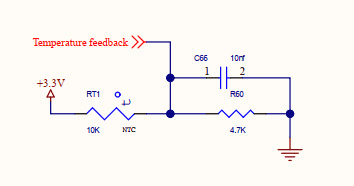
Interfacing of NTC thermistor with microcontroller

Click For Summary
SUMMARY

The discussion centers on interfacing an NTC thermistor with a microcontroller, specifically examining the voltage output at 25°C. The expected output voltage is 1.4V according to ST's documentation, while the calculated output is 1.05V based on a 10K NTC thermistor. The discrepancy is attributed to potential errors in documentation or assumptions about the thermistor's characteristics. The conversation highlights the importance of verifying component specifications and understanding the implications of tolerance in thermistor readings.

PREREQUISITES
  • Understanding of NTC thermistor characteristics and behavior
  • Familiarity with voltage divider calculations
  • Knowledge of ADC input specifications and impedance
  • Experience with ST microcontroller documentation and evaluation boards
NEXT STEPS
  • Review the ST datasheet for the STM32G431CB microcontroller for detailed ADC specifications
  • Investigate the tolerance specifications of NTC thermistors and their impact on readings
  • Learn about voltage divider circuits and their applications in sensor interfacing
  • Explore the Motor Workbench software for further insights into input characteristics and calibration
USEFUL FOR

Electronics engineers, embedded systems developers, and anyone involved in sensor interfacing and calibration of microcontroller-based systems.

PhysicsTest
Messages
256
Reaction score
27
Homework Statement
I want to understand the circuit for the NTC interfacing with the microcontroller
Relevant Equations
Voltage divider equation = V*R2/(R1+R2)
I am trying to understand a circuit where the NTC thermistor is interfaced with micro controller, but i am not able to understand the voltage output at 25DegC. According to the ST website the output of the circuit is 1.4V but as per my calculations it is 1.05V, i am not sure why. Please help.
1672152854535.png

My understanding is since it is 10K NTC thermistor at 25DegC the resistance is 10K. Is this assumption correct?
V_TempFeedback = 3.3 * 4.7/(10+4.7) = 3.3*4.7/14.7 = 1.055V.
 
Physics news on Phys.org
What is connected to the "Temperature feedback" net? Can you post a link to the ST website where they show this circuit? Thanks.
 
What schematic page has that circuit, and where do they calculate the 25C expected voltage?
 
Page no 6 and 4 to the micro. There is a software to be installed motor workbench in that it shows
1672154796997.png
 
What are the input characteristics of that B14 ADC input?
 
I never checked that i will check and update.
 
I guess if it's just an ADC input, it should be pretty high impedance compared to the NTC circuit. I don't have any ideas why they show a different value of the voltage divider output...
 
1) Your voltage divider calculation is correct, for the circuit as shown.
2) 10Kohm @ 25C is an extremely common thermistor value.
3) 1.4V to the ADC would correspond to 6.38Kohm for the thermistor. Assuming a high impedance input, which is almost always true.
4) I am suspicious of the "NTC thermistor info" given. Thermistors aren't specified by a voltage value unless an associated circuit is given. Whoever wrote this part seems to care more about software than hardware.
5) People/Companies make mistakes. Things can be misinterpreted.
6) You are stuck without a thermistor part number and a specification. Either you or ST is reporting inconsistent information. We can't figure it out either, without a research project that we all are unlikely to take on.
 
  • Like
Likes   Reactions: berkeman
  • #10
If two changes were made to the circuit, ST engineers would almost certainly have checked the numbers. So I look for single changes that could explain the difference.

If a different supply voltage to 3.3 volt, had been used, then Vs = 4.375 volt.
That is too far from any regular voltage, so is most unlikely.

If a different value fixed resistor had been used, then Rf = 7.368k
That is not an E value I recognise, so I keep the value 4k7.

If a different value thermistor had been used, then Rt = 6.378k @ 25 °C.
A value most unexpected for a thermistor.

So I can see no single change to the circuit that plausibly explains the change.
That only leaves us with a hypothetical error by a human.

1.4 only contains two significant digits. The A-D should give 3 digits.
What if the voltage had been read by the A-D converter as 1.04 volts.
Given a temperature error, that is close to the calculated 1.055 volts.
Then a typo removed the 0 to make it 1.4 volts in the documentation.
 
  • Informative
Likes   Reactions: berkeman
  • #11
  • Informative
  • Like
Likes   Reactions: PhysicsTest and berkeman
  • #12
I tried searching for another evaluation board to compare it, i found some useful information. On page14 found the following information
The document link evspin
1672239159896.png

1672239196029.png


If i do the calculations as per the equation
T = R40 = 4.7K = 4700
VREFP = 3.3V
VPC4 = 1.05V (as per ST it was 1.4V
then i get around 23.85DegC more or less equal to 25DegC.
 
  • #13
You might also check the tolerance of the NTC, they are often rated ±10% to ±20%. That would certainly cover the observed "error."
 
  • Like
Likes   Reactions: PhysicsTest
  • #14
Tom.G said:
You might also check the tolerance of the NTC, they are often rated ±10% to ±20%. That would certainly cover the observed "error."
Except that there are no observations in this case. It's all paperwork so far, I think.
 
  • #15
Wait, is the original note maybe saying that it's 1.4Vmax @ 70C? (to be sure the ADC input voltage is within its valid range)

1672327537186.png
 
  • #16
berkeman said:
Wait, is the original note maybe saying that it's 1.4Vmax @ 70C? (to be sure the ADC input voltage is within its valid range)

View attachment 319509
I read that as the maximum thermistor temperature.

Additionally supported by post #12 above.
 

Similar threads

  • · Replies 2 ·
Replies
2
Views
3K
  • · Replies 2 ·
Replies
2
Views
3K
Replies
7
Views
4K
  • · Replies 12 ·
Replies
12
Views
2K
Replies
16
Views
5K
  • · Replies 4 ·
Replies
4
Views
2K
  • · Replies 10 ·
Replies
10
Views
3K
  • · Replies 32 ·
2
Replies
32
Views
5K
  • · Replies 4 ·
Replies
4
Views
5K
  • · Replies 1 ·
Replies
1
Views
3K