Intergration by parts for sin(x)cos(x)

  • Context: Undergrad 
  • Thread starter Thread starter uzman1243
  • Start date Start date
  • Tags Tags
    Intergration parts
Click For Summary
SUMMARY

The forum discussion centers on the integration of sin(x)cos(x) using the integration by parts method, specifically the LIATE method. The user explores the implications of choosing u=cos(x) and dv=sin(x), leading to different forms of the integral. The discussion highlights that multiple correct answers can arise from different methods, such as substitution and trigonometric identities, ultimately differing only by a constant. This reinforces the concept that various integration techniques yield equivalent results.

PREREQUISITES
  • Understanding of integration techniques, specifically integration by parts.
  • Familiarity with the LIATE method for selecting u and dv.
  • Knowledge of trigonometric identities, particularly sin(2x) = 2sin(x)cos(x).
  • Basic concepts of antiderivatives and the reverse power rule.
NEXT STEPS
  • Study the LIATE method in detail for effective integration by parts.
  • Learn about trigonometric substitutions and their applications in integration.
  • Explore the concept of equivalence in integrals and how constants affect results.
  • Practice integrating functions using both substitution and integration by parts to compare outcomes.
USEFUL FOR

Students and educators in calculus, mathematicians exploring integration techniques, and anyone seeking to deepen their understanding of trigonometric integrals and their equivalences.
uzman1243
Messages
80
Reaction score
1
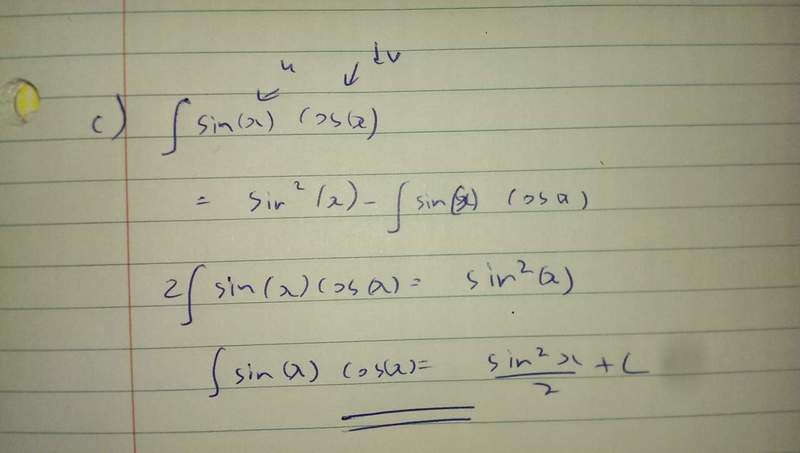
I know its easier to use the substitution method, by I'm trying to see how it'll work for integration by parts. I follow the LIATE method for integration by parts.

attachment.php?attachmentid=70182&stc=1&d=1401500731.jpg


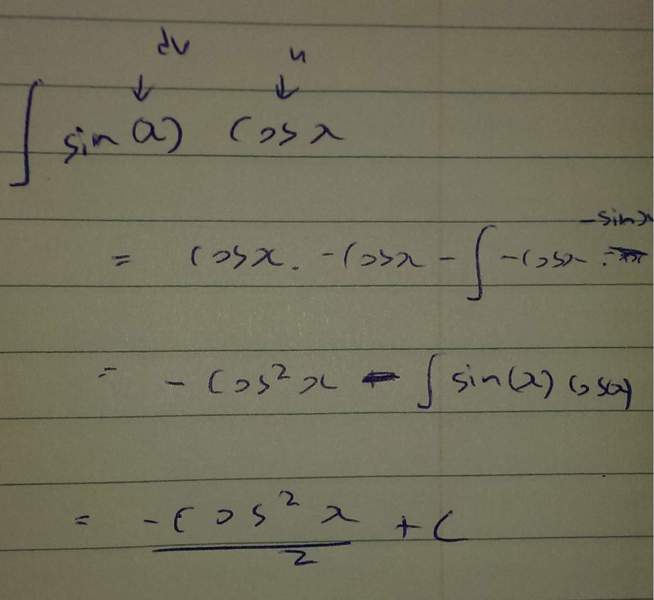
Now if I take u=cos(x) and dv = sin(x), the answer changes.
attachment.php?attachmentid=70184&stc=1&d=1401501227.jpg


Can you please explain this to me? Which is the 'right' answer?
 

Attachments

  • IMAG2553.jpg
    IMAG2553.jpg
    21.9 KB · Views: 1,742
  • Untitled.jpg
    Untitled.jpg
    20.6 KB · Views: 1,136
Physics news on Phys.org
Rather than answer your question directly, let me provide another example of the same phenomenon that might make it easier to identify why both answers are correct.

If you compute ##\int (x+1)\ dx## using the sum rule for antiderivatives and the "reverse power rule", you get $$\int x+1\ dx=\frac{1}{2}x^2+x+C.$$ If instead you use a ##u##-sub, with ##u=x+1##, you get $$\int (x+1)\ dx=\int u\ du=\frac{1}{2}u^2+C=\frac{1}{2}(x+1)^2+C.$$

Now the exact same thing is happening in your example as is happening here; you have two different-looking answers that are both correct. How can that be?
 
  • Like
Likes   Reactions: 1 person
And closer to home, let's do ##\int \sin(x) \cos(x) dx## a third way, using the trig substitution ##\sin(2x)=2\sin(x) \cos(x)##. Thus ##\int \sin(x) \cos(x) dx = \int \frac {\sin(2x)}2 dx = -\frac {\cos(2x)} 4 + C##.

To quote gopher_p,
gopher_p said:
How can that be?
 
  • Like
Likes   Reactions: 1 person
dear friend , all these answers are different only by a constant, so they are the same answers.
 
  • Like
Likes   Reactions: 1 person

Similar threads

  • · Replies 4 ·
Replies
4
Views
3K
  • · Replies 8 ·
Replies
8
Views
3K
  • · Replies 8 ·
Replies
8
Views
922
  • · Replies 5 ·
Replies
5
Views
3K
  • · Replies 5 ·
Replies
5
Views
2K
  • · Replies 6 ·
Replies
6
Views
3K
  • · Replies 5 ·
Replies
5
Views
2K
  • · Replies 8 ·
Replies
8
Views
3K
  • · Replies 4 ·
Replies
4
Views
3K
  • · Replies 3 ·
Replies
3
Views
3K