Intergration by parts for sin(x)cos(x)

  • Context: Undergrad 
  • Thread starter Thread starter uzman1243
  • Start date Start date
  • Tags Tags
    Intergration parts
Click For Summary

Discussion Overview

The discussion revolves around the integration of the function sin(x)cos(x) using different methods, specifically integration by parts and substitution. Participants explore the implications of using various approaches and the resulting expressions.

Discussion Character

  • Exploratory, Mathematical reasoning, Debate/contested

Main Points Raised

  • One participant notes the preference for the substitution method over integration by parts and seeks clarification on the differing results obtained from these methods.
  • Another participant provides an example of a different integral to illustrate that multiple methods can yield different-looking but equivalent results, suggesting that both answers can be correct.
  • A third participant introduces a trigonometric substitution to compute the integral, indicating another valid approach to the problem.
  • A later reply asserts that the different answers are equivalent, differing only by a constant, but does not resolve the underlying question of which method is 'right.'

Areas of Agreement / Disagreement

Participants do not reach a consensus on which method is superior or 'right,' but there is an acknowledgment that the different results are equivalent up to a constant.

Contextual Notes

The discussion highlights the nuances of integration techniques and the importance of understanding that different methods can yield results that appear distinct but are fundamentally the same due to the presence of integration constants.

Who May Find This Useful

Students and practitioners interested in calculus, particularly those exploring integration techniques and the implications of different methods on results.

uzman1243
Messages
80
Reaction score
1
I know its easier to use the substitution method, by I'm trying to see how it'll work for integration by parts. I follow the LIATE method for integration by parts.
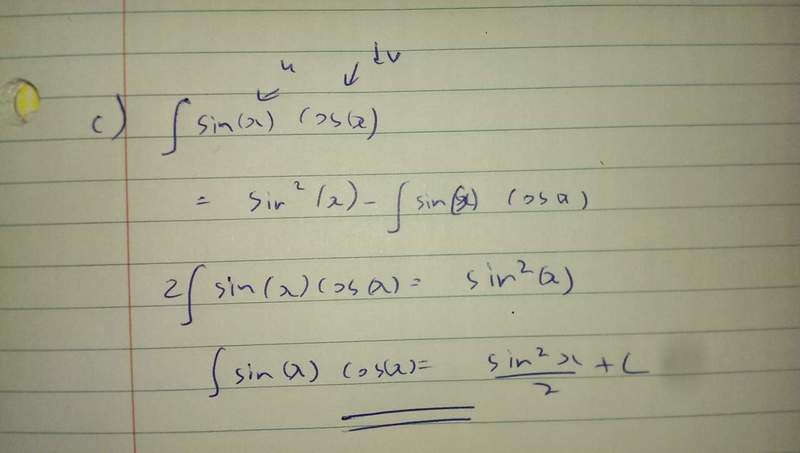
attachment.php?attachmentid=70182&stc=1&d=1401500731.jpg


Now if I take u=cos(x) and dv = sin(x), the answer changes.
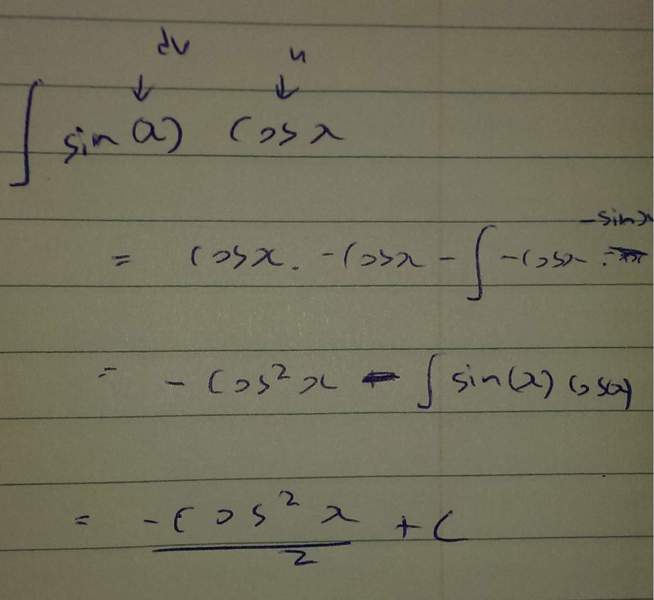
attachment.php?attachmentid=70184&stc=1&d=1401501227.jpg


Can you please explain this to me? Which is the 'right' answer?
 

Attachments

  • IMAG2553.jpg
    IMAG2553.jpg
    21.9 KB · Views: 1,752
  • Untitled.jpg
    Untitled.jpg
    20.6 KB · Views: 1,148
Physics news on Phys.org
Rather than answer your question directly, let me provide another example of the same phenomenon that might make it easier to identify why both answers are correct.

If you compute ##\int (x+1)\ dx## using the sum rule for antiderivatives and the "reverse power rule", you get $$\int x+1\ dx=\frac{1}{2}x^2+x+C.$$ If instead you use a ##u##-sub, with ##u=x+1##, you get $$\int (x+1)\ dx=\int u\ du=\frac{1}{2}u^2+C=\frac{1}{2}(x+1)^2+C.$$

Now the exact same thing is happening in your example as is happening here; you have two different-looking answers that are both correct. How can that be?
 
  • Like
Likes   Reactions: 1 person
And closer to home, let's do ##\int \sin(x) \cos(x) dx## a third way, using the trig substitution ##\sin(2x)=2\sin(x) \cos(x)##. Thus ##\int \sin(x) \cos(x) dx = \int \frac {\sin(2x)}2 dx = -\frac {\cos(2x)} 4 + C##.

To quote gopher_p,
gopher_p said:
How can that be?
 
  • Like
Likes   Reactions: 1 person
dear friend , all these answers are different only by a constant, so they are the same answers.
 
  • Like
Likes   Reactions: 1 person

Similar threads

  • · Replies 4 ·
Replies
4
Views
3K
  • · Replies 8 ·
Replies
8
Views
4K
  • · Replies 8 ·
Replies
8
Views
1K
  • · Replies 5 ·
Replies
5
Views
5K
  • · Replies 5 ·
Replies
5
Views
2K
  • · Replies 6 ·
Replies
6
Views
3K
  • · Replies 5 ·
Replies
5
Views
2K
  • · Replies 8 ·
Replies
8
Views
3K
  • · Replies 4 ·
Replies
4
Views
3K
  • · Replies 3 ·
Replies
3
Views
3K