Interpolate between 2 impact points only given the throw angles

Click For Summary
SUMMARY

The discussion focuses on solving the problem of interpolating between two impact points, P1 and P2, given specific throw angles. The proposed method involves creating a linear function that connects P1 and P2 and equating it to the function that determines the impact location of a third point, P3. Key concepts include the definitions of horizontal and vertical angles in relation to cannon tilt and rotation. The relationship between P3 and the line connecting P1 and P2 is clarified, emphasizing the need to express target coordinates in terms of muzzle velocity and the angles involved.

PREREQUISITES
  • Understanding of linear functions and interpolation
  • Familiarity with projectile motion concepts
  • Knowledge of horizontal and vertical angles in physics
  • Basic algebra for solving equations
NEXT STEPS
  • Research linear interpolation methods in physics
  • Study projectile motion equations and their applications
  • Learn about the effects of angle adjustments on projectile trajectories
  • Explore mathematical modeling of impact points in physics simulations
USEFUL FOR

Students and professionals in physics, engineers working on projectile motion simulations, and anyone interested in mathematical modeling of trajectories.

Werther
Messages
3
Reaction score
0
Homework Statement
A cannon shoots at target P1 and P2 with the given vertical/horizontal angles (α/b). But there is a third target (P3) left that is between P1 and P2. Unfortunately the soldier that shoots the cannon only knows the vertical angle (a3=65°) and not the horizontal angle. Notice that the velocity of the projectile and the position of the impact points are unknown.

What is the horizontal angle for shooting at P3 (b3)?
Relevant Equations
projectile velocity:
Vx = cos b * Vc
Vy = sin b * Vc

impact location:
x = Vx*t
Top-Down-Perspective:
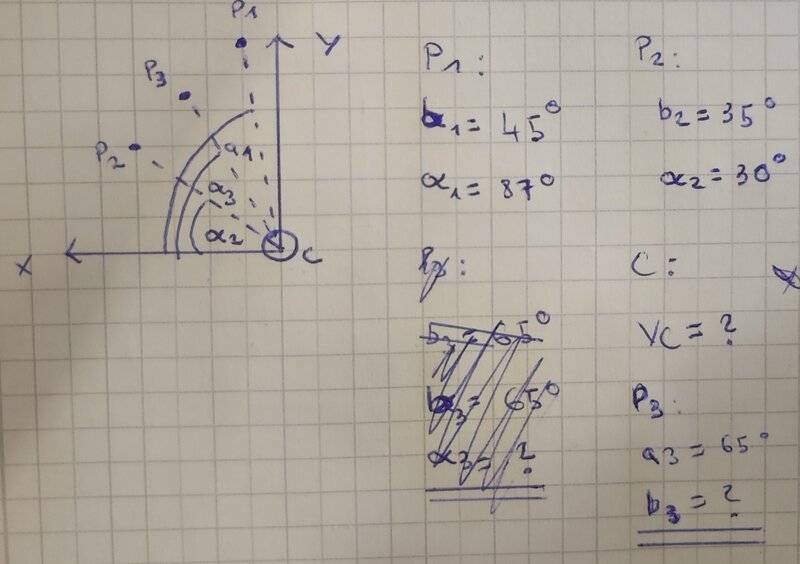
Pm (1).jpg


At first I am quite sure that the problem is not solvable since there are that many unknowns.
But my Approach would be to create a linear function with P1 and P2 and then set it equal to the function that gets me the impact location of P3 and then solve it by b3.

Thanks for the help in advance.
 
Physics news on Phys.org
What are "horizontal" and "vertical" angles?
 
  • Like
Likes   Reactions: nasu
PeroK said:
What are "horizontal" and "vertical" angles?
horizontal = tilt of the cannon
vertical = rotating the cannon left or right
 
Okay, and how is P3 related to P1 and P2?
 
Werther said:
horizontal = tilt of the cannon
vertical = rotating the cannon left or right
Really? Sounds backwards to me, but from the values given that must be right.

"that is between P1 and P2"
Merely somewhere between, or on the straight line joining them?
 
Last edited:
PeroK said:
Okay, and how is P3 related to P1 and P2?
P3 sits in the line If you would draw one through P1 and P2.
 
Let the muzzle velocity be v.
Write expressions for the target coordinates in terms of v and the two angles.
 

Similar threads

Replies
8
Views
5K
Replies
2
Views
3K
Replies
4
Views
4K
Replies
5
Views
3K
  • · Replies 21 ·
Replies
21
Views
3K
  • · Replies 2 ·
Replies
2
Views
5K
  • · Replies 1 ·
Replies
1
Views
2K
  • · Replies 16 ·
Replies
16
Views
4K
Replies
2
Views
3K
Replies
2
Views
2K