Interpretation of Bi-207 decay spectrum

Click For Summary

Discussion Overview

The discussion centers on the interpretation of the decay spectrum of Bi-207, specifically focusing on the beta and gamma emissions observed in measurements. Participants explore the nature of the spectrum, the origins of observed peaks, and the implications for detector response.

Discussion Character

  • Exploratory
  • Technical explanation
  • Debate/contested
  • Experimental/applied

Main Points Raised

  • One participant describes measuring the decay spectrum of Bi-207 and notes the emissions of beta particles and gamma rays, expressing confusion about the spectrum's interpretation.
  • Another participant suggests that the observed gamma emissions are from the decay of excited states of Pb-207 and recommends looking up level schemes for clarification.
  • Questions are raised regarding the calibration of the detector and the representation of energies in the spectrum, with a focus on the abscissa being channel number.
  • Some participants express an expectation for sharper peaks in the spectrum, indicating a potential discrepancy with typical responses to gamma emissions from Pb-207.
  • A later reply identifies the observed peaks as Compton edges of the Pb-207 gammas, indicating a resolution to some confusion but leaving questions about the absence of photo peaks.
  • Another participant reiterates the identification of the peaks as Compton edges and thanks the previous contributor for the clarification.

Areas of Agreement / Disagreement

Participants express differing views on the interpretation of the spectrum, particularly regarding the nature of the peaks observed. While some agree on the identification of Compton edges, there remains uncertainty about the expected photo peaks and the overall detector response.

Contextual Notes

Participants note the importance of experimental setup details and calibration in interpreting the spectrum, which may influence the observed results and their understanding of the decay processes involved.

Who May Find This Useful

This discussion may be of interest to those involved in experimental nuclear physics, particularly in the analysis of decay spectra and detector responses.

XLAYZ
Messages
7
Reaction score
0
TL;DR
Please help me interpret the Bi-207 decay spectrum, e.g. origin of the peaks, whether beta particles or gammas.
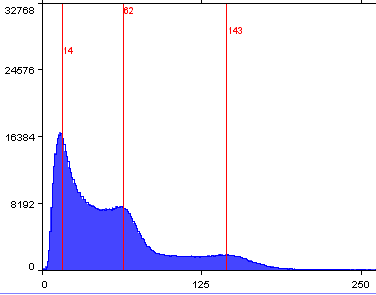
I measured the decay spectrum of Bi-207 as a beta source with scintillation detector and now I am trying to interpret the information given by the spectrum. As far as I know, the Bi-207 nuclei decay to the excited states of Pb-207 primarily via EC and a small beta+ branch, emitting beta particles of E_max=806keV, E_ave=383 keV, and the excited states of Pb-207 decays via IC, emitting conversion electrons of ~ 1 MeV. In addition, the Bi-207 decay was accompanied by emission of gamma rays of 570 keV (98%), 1064 keV(74.6%), and 1770 keV (6.87%).

In this measurement Bi-207 was used as the beta source to test the detector response to beta particles, however, in similar measured spectrum of Bi-207 made by others, it was described as the gamma spectrum with peaks at 570 and 1064 keV.
ask.png

Now I am quite confused of the measured spectrum, e.g. the origin of the two peaks, and what else information can be drawn from the spectrum.
Any helps would be very appreciated. Thank you in advance!
 
Physics news on Phys.org
Gammas from the decay of the 207Pb excited states. Look up the level schemes.
 
I am assuming the abscissa for your spectrum is channel number is that correct? If so what are the energies that the peaks represent? I also assume that at some point you calibrated the detector.
 
I would have expected to see a few sharper peaks also.
 
bobob said:
Gammas from the decay of the 207Pb excited states. Look up the level schemes.
Thanks, now I have figured it out. Those "peaks" were the Compton edges of the Pb-207 gammas.
 
gleem said:
I am assuming the abscissa for your spectrum is channel number is that correct? If so what are the energies that the peaks represent? I also assume that at some point you calibrated the detector.
Yes, they were the Compton edges of gammas. Thanks.
 
XLAYZ said:
es, they were the Compton edges of gammas. Thanks.

So where are the photo peaks? You should also describe your experimental setup. Your spectrum is not showing a typical response to gammas of the energy emitted by Pb207.
 

Similar threads

  • · Replies 2 ·
Replies
2
Views
2K
  • · Replies 1 ·
Replies
1
Views
7K
  • · Replies 4 ·
Replies
4
Views
2K
  • · Replies 3 ·
Replies
3
Views
5K
  • · Replies 2 ·
Replies
2
Views
21K
  • · Replies 2 ·
Replies
2
Views
9K
  • · Replies 50 ·
2
Replies
50
Views
11K