Interpreting VIA PCB through TDR and TDT

  • Thread starter Thread starter yefj
  • Start date Start date
yefj
Messages
69
Reaction score
2
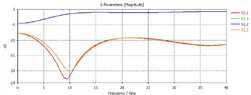
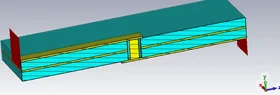
Hello ,I have simulated a basic VIA (shown in the photo) in CST EM simulator from 0 to 40GHz and extracted its attached S2P.
using the code below I resampled it and made IFFT with multiplied the normalised hamming window.
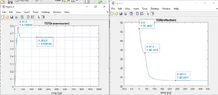
I got the following plots in MATLAB.
Is there a way to interpret the VIA properties threw these TRT and TDR plots?
Thanks.
Code:
clear all
Sp = sparameters('via.s2p');
Sp.Parameters(1,1,1)=0;
freqs=Sp.Frequencies; %40000X1
s11_half=Sp.Parameters(1,1,:);
s21_half=Sp.Parameters(2,1,:);
if freqs(1) ~= 0
           s11_dc = interp1(freqs, s11, 0, 'linear', 'extrap');
end

left_side=squeeze(s11_half);
left_side_s21=squeeze(s21_half);

% ===== Resample to uniform frequency grid =====
fi = linspace(freqs(1), freqs(end), length(freqs)).'; %40000X1
s11_resamples = interp1(freqs, left_side, fi, 'linear');
s21_resamples = interp1(freqs, left_side_s21, fi, 'linear');
right_side_miror=conj(s11_resamples(end-1:-1:2));
right_side_miror_s21=conj(s21_resamples(end-1:-1:2));
s11_full=[ s11_resamples;right_side_miror];
s21_full=[ s21_resamples;right_side_miror_s21]; %%


w = ifftshift(hamming(length(s11_full),'periodic'));
w=w./max(w);

%%%%%%%%%%%%%
df = fi(2) - fi(1);
N = length(s11_full);
t = (0:N-1).' / (N * df);   % time axis

rho = cumsum(real(ifft(s11_full.*w)));
z = (1+rho)./(1-rho)*50;

figure;
plot(t*1e12, z);
xlim([-100 450]);
xlabel('time [ps]');
title('TDR(reflection)');


figure;
plot(t*1e12, cumsum(real(ifft(s21_full.*w))));
grid on; grid minor; set (gca, 'gridalpha', 0.2); set(gca, 'minorgridalpha', 0.05);
xlim([0 1000]);
xlabel('time [ps]');
title('TDT(transmission)');
 

Attachments

  • Capture.webp
    Capture.webp
    19.9 KB · Views: 1
  • 3D_shape.webp
    3D_shape.webp
    20.2 KB · Views: 1
  • S_param.webp
    S_param.webp
    21.5 KB · Views: 1
Engineering news on Phys.org
Hello , I have resimulated the structure in another way and got a result much better to realistic DC value
s-parameters .
I made again IFFT to the S2p file and got the attached plots.

given my situation few questions:
1.given my 40GHz BW what kind of sizes I can use TDR TRT effectively
2.given my new IFFT plots is how can I see the geometrical properties of the VIA in them?
Is there some intuitions?

1775217703687.webp

1775217723603.webp

1775217749061.webp
 
yefj said:
Is there a way to interpret the VIA properties threw these TRT and TDR plots?
You have two tracks with known impedance, joined through the PCB by a short cylindrical via. The via will probably not match the impedance of the tracks, so it will appear to be a quarter wave transformer with the via length, adjusted for velocity factor √Er.

Usually, only ground and power are routed through vias, and then through multiple parallel vias. It is not good practice to run signals through vias, at microwave frequencies. Keep signals in the signal plane, between or above ground plane(s).

My guess is that the via will appear to be a short cylindrical transmission line, probably inductive. You should be able to see the length of the via in the wavelength of the highest transmission frequency, and the impedance of the via in the TDR. Thinner vias are more inductive, so you may be able to adjust the via diameter until it matches the track impedance on both sides of the PCB. Feathering the track as it approaches the via, may ease reflection from the transition. To get a first approximation, compute the impedance of the via as a longer cylindrical transmission line.
 
  • Like
Likes   Reactions: berkeman
yefj said:
I have simulated a basic VIA (shown in the photo)
1775251601608.webp


What you show is a 3-layer PCB, which is not used in practice.

Baluncore said:
It is not good practice to run signals through vias, at microwave frequencies. Keep signals in the signal plane, between or above ground plane(s).
This point made by @Baluncore should be emphasized. It is generally a design error to run high-frequency signals through vias, since the resulting ##Z_0## is not constant and does not match the transmission line. The transmission line physical structure and resulting ##Z_0## need to be maintained throughout the length of the TL from the transmit gate to the receive gate(s). Also, the TL must be properly terminated to avoid ringing (either forward-terminated for point-to-point TLs with a single receive gate, or back-terminated for TLs that have several receive gates).

Back in the early days of the FCC imposing EMI limits on electronic devices (like in the mid-1980s), one of the biggest problems in quieting down digital PCBAs was that little attention was paid to the routing of fast digital traces, and the resulting ringing from all the ##Z_0## mismatches caused lots of unintentional radiation from the PCBAs and the product enclosures and cables. [1]

Note also that this constant ##Z_0## requirement means that the TL signal trace should not pass close to other traces or grounded features, since this can also alter the ##Z_0## value.

[1] High Speed Digital Design, A Handbook of Black Magic, by Howard W. Johnson and Martin Graham, Chapter 7 on Vias, PTR Prentice Hall, 1993.
 
Last edited:
  • Like
Likes   Reactions: Baluncore
Hello, My goal is to learn to read TDT TRT and to see as much as possible about a VIA.
this imaginary PCB simulation is only an example for me to learn via responce in TDR.
later I will build multilayer VIA PCB.

few questions:
can I see threw tdr tdt responces peaks if its inductive or capacitative peak?
Is there mathematics explaining this?

can I see VIA structure properties threw the peaks of the TDT and TDR?
Thanks.
 
yefj said:
can I see threw tdr tdt responces peaks if its inductive or capacitative peak?
The "TD" in TDR refers to the time domain (Time Domain Reflectometer). It measures reflections in the time domain as seen at the transmitting port.
 
Hello , Yes I know what TDR is I need to know how to interpret its capacitance inductance. parts.
how do i do that?
can I see VIA structure properties threw the peaks of the TDT and TDR?
 
The direction of the reflection (adding or subtracting from the transmitted pulse) will tell you if the ##Z_0## mismatch at the via is positive or negative. From that you can probably infer whether it is inductive or capacitive. Most likely the ##Z_0## mismatch of the via will look positive/inductive in nature.
 
Hello,can you give me some manual regarding how to mathemtickally we prove that the reflection is capacitative or iductive?
 
  • #11
yefj said:
can I see VIA structure properties threw the peaks of the TDT and TDR?
BTW, do you want me to fix the "TRT" in your thread title to "TDT"?
 
  • #12
Yes sorry for the mistake.
Sorry for the stupid question but I know that I can get reflection coeffient threw the TDR by the formula below .
but how can I know that out ZL is inductive or capacitative?
Zc=1/jwc ZL=jwl
these formulas dont help me understand this in the wiki link you posted.
1775318428741.webp
 
  • #13
yefj said:
but how can I know that out ZL is inductive or capacitative?
Zc=1/jwc ZL=jwl
these formulas dont help me understand this in the wiki link you posted.
Sorry, I meant to post a different 2nd link: https://en.wikipedia.org/wiki/Telegrapher's_equations

This equation from that link should help:

1775321260272.webp
 
  • #14
I am trying to simulate time domain reflectometry and recognise threw the pulse responce if the load is capacitative or inductive.
As you can see its not working .
Where did I go wrong with the concept.
what is the proper way to see threw the time responce if the load is capacitative or inductive?
1775323152672.webp
1775323119384.webp
 
  • #15
TDR is a plot of impedance (driver voltage) against reflection time.
Z = √( L / C )
You cannot say if it is the inductance or the capacitance of the transmission line that has changed, only that the ratio and resulting impedance has changed.

There is an HP beginners guide to TDR here.
HP Application Note 62. Time Domain Reflectometry.
https://hparchive.com/Application_Notes/HP-AN-62.pdf

yefj said:
As you can see its not working.
During the pandemic, I wrote a TDR simulation in LTspice, when students could not get to the lab, so needed to simulate the practical. I will see what I can find from back then in the archives.
 
  • Like
Likes   Reactions: DaveE and berkeman
  • #16
Here is a simple TDR simulated in LTspice.
Remove the .txt extensions from both files, then run the LTspice file.asc
Start by changing the termination impedance and notice how the Vin changes later due to the reflection.
 

Attachments

  • Informative
Likes   Reactions: berkeman
  • #18
This LTspice model is sufficient to model the signal passing through a via.
T1 is the line on one side of the PCB. T2 will become the via, if it is shortened. T3 is the line on the opposite side of the PCB. Values that are unusual are marked with an asterisk, so they will not be missed or forgotten.
Schematic3.webp

This is the TDR response due to the T2 (via) impedance and the capacitive termination.
Plot3.webp

The green shows the driver pulse, the yellow the TD reflected signal, and the red the destination signal. TDR times are twice the transit times.

Notice how T2, the higher impedance line, shows as a higher voltage.
Notice how the capacitive load shows as a downward pulse, series inductance would make a positive pulse.
Notice the final output voltage settles to slightly greater than 0.5V, because the termination resistance is greater than 50R.

Following the capacitive pulse in the TDR, are secondary echos of the capacitive pulse in both end mismatches of T2, first positive, then negative. Change Zo of T2 to say 40R, so the T2 voltage will step down, and see those two echos invert.

This model shows how TDR can look down a line at impedance discontinuities, and how the reflection can be interpreted. That will give you an understanding of TDR. To model a real via using this schematic, you will need to significantly shorten the length of T2, and greatly reduce the rise time of the test pulse. Short TLs, and fast rise-times, will slow down the simulation.

The two text files are the source LTspice files, wrapped so they can be attached to this thread, then downloaded and run.
 

Attachments

Similar threads

  • · Replies 1 ·
Replies
1
Views
1K
Replies
2
Views
2K
  • · Replies 5 ·
Replies
5
Views
6K
  • · Replies 1 ·
Replies
1
Views
2K
Replies
5
Views
8K
  • · Replies 1 ·
Replies
1
Views
4K
  • · Replies 3 ·
Replies
3
Views
4K