Intuition for divergences in sunset diagram

Click For Summary
SUMMARY

The discussion focuses on the intuition behind divergences in the sunset diagram, specifically addressing quadratic divergence and the absence of quartic or higher divergences. Participants analyze the structure of the diagram, noting that it consists of two loops and three propagators. By counting the powers of momentum, they establish a naive estimate for the degree of divergence, leading to a clearer understanding of the underlying physics.

PREREQUISITES
  • Understanding of quantum field theory concepts
  • Familiarity with loop diagrams in particle physics
  • Knowledge of propagators and their role in Feynman diagrams
  • Basic grasp of divergence types in quantum calculations
NEXT STEPS
  • Study the implications of quadratic divergence in quantum field theories
  • Research the role of loop diagrams in advanced particle physics
  • Learn about regularization techniques for handling divergences
  • Explore the concept of renormalization in quantum field theory
USEFUL FOR

Physicists, graduate students in theoretical physics, and researchers interested in advanced quantum field theory and the mathematical treatment of divergences.

Higgsy
Messages
18
Reaction score
0
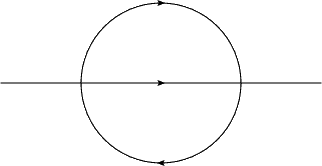
What is the intuition behind divergences for the sunset diagram? I know that there is quadratic divergence by why no quartic divergence or higher?
Figures_J_topology.png
 
Physics news on Phys.org
You have two loops and three propagators. Counting the powers of momentum in those gives you a naive estimate of the degree of divegence.
 
  • Like
Likes   Reactions: MrBrandonius

Similar threads

  • · Replies 1 ·
Replies
1
Views
2K
  • · Replies 2 ·
Replies
2
Views
1K
  • · Replies 8 ·
Replies
8
Views
2K
  • · Replies 2 ·
Replies
2
Views
2K
  • · Replies 3 ·
Replies
3
Views
1K
  • · Replies 7 ·
Replies
7
Views
2K
  • · Replies 0 ·
Replies
0
Views
1K
  • · Replies 1 ·
Replies
1
Views
1K
  • · Replies 10 ·
Replies
10
Views
2K
  • · Replies 2 ·
Replies
2
Views
2K