Investigating Magnetic Train Forces: A Puzzling Inquiry

Click For Summary

Homework Help Overview

The discussion revolves around the investigation of forces in a magnetic train system, particularly focusing on how these forces relate to velocity and the parameters affecting it. Participants explore the principles of electromagnetic phenomena as they relate to the operation of such trains.

Discussion Character

  • Exploratory, Conceptual clarification, Assumption checking

Approaches and Questions Raised

  • Participants discuss the relationship between force and velocity, questioning how a constant velocity can exist in the presence of forces. They explore the roles of magnetic forces, gravity, and friction, and some participants suggest examining the effects of back-EMF and inertia in the context of the system.

Discussion Status

The discussion is active, with various interpretations being explored regarding the forces at play in the magnetic train system. Some participants have provided insights into the balance of forces and the potential for constant velocity, while others are questioning the assumptions about the forces involved.

Contextual Notes

Participants note the complexity of analyzing the forces due to the interactions between magnetic fields and gravitational forces, as well as the challenges in calculating velocity and other parameters without extensive effort.

mathewmical
Messages
21
Reaction score
0
Hello
I hope you know the phenomenon called "Magnetic train". My teacher used it in classes to demontrate electromagnetic phenomena. So he told the advanced learners (however, here I am xD) to investigate it, especially the forces and how certain parameters affect the velocity. But I do not understand at all how there can be a velocity with a force? and which forces appear? I hope you can give me at least a thought-provoking impulse.

thanks a lot

Ray
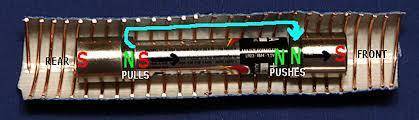
upload_2015-12-20_20-21-53-jpeg.93542.jpg

Image added by mfb to clarify which type of train is meant (see page 2)
 
Last edited by a moderator:
Physics news on Phys.org
mathewmical said:
But I do not understand at all how there can be a velocity with a force?
How do you mean that question?
A force can change velocity.
mathewmical said:
and which forces appear?
Descriptions of the train concepts discuss that.
 
yes but there seems to be a constant velocity and i wonder how this can be. woundn´t it be changing all the time?
 
Due to inertia, something with no net force will maintain a constant velocity. A magnent suspending a train can precisely counteract the force of gravity, allowing the train to move at a constant velocity because the sum of forces is zero (they act in opposite directions). I think you might be asking something deeper than that, though, I'm not sure.
 
  • Like
Likes   Reactions: mathewmical
very interesting, thank you! i agree but how does a magnet counteract the force of gravity when they are perpendicular to each other?

i think there is only the force of attraction and the force of repelling. and the force caused by friction that opposes these two other forces. And gravity.
 
It may be called a "magnetic train" but the magnets are not used to attach each carriage to the next one; the main function of the magnetic field is to raise the train off the tracks...to give a small clearance. [emoji52]
 
that´s not what i meant, my experiment refers to a battery in a solenoid where there are magnets attached on each side of the battery. if you put it into, it´ll start to move.
 
I think the OP is referring to this particular experimental demonstration, where the "train" is a battery with magnets attached to its ends, traveling through a wound copper wire "track".
 
yes that´s right
 
  • #10
mathewmical said:
yes but there seems to be a constant velocity and i wonder how this can be. woundn´t it be changing all the time?
My instinct would be that this is due to the back-emf that arises from electromagnetic induction effects...though I'm not that sure...imhomogenous magnetic fields are always tricky to analyse
 
  • #11
so it is possible that it gains speed due to the back-EMF and than move till the battery is empty because of the forces.?
 
  • #12
mathewmical said:
very interesting, thank you! i agree but how does a magnet counteract the force of gravity when they are perpendicular to each other?
It does not, and there is no need to. The train is supported from below by the coil.
i think there is only the force of attraction and the force of repelling. and the force caused by friction that opposes these two other forces. And gravity.
It is useful to analyze horizontal and vertical forces separately.
 
  • #13
hmm i just thought there are only horizontal forces because of the friction
 
  • #14
Well, there is certainly a vertical force from gravity, and something balancing it (so the train doesn't fall through the table). Otherwise the train would float, and there would be no (horizontal) friction either.
 
  • #15
of course, but theforce from gravity is only important for the friction and the normal force neutralize it. right?
 
  • #17
How a maglev train works..

https://www.quora.com/How-magnetic-levitation-train-works
 
Last edited by a moderator:
  • #18
CWatters said:
How a maglev train works..

https://www.quora.com/How-magnetic-levitation-train-works
This is not the type of train discussed here.
 
Last edited by a moderator:
  • #19
mathewmical, I think you should edit your first post to include a picture of that particular experimental demonstration you're referring to, because "magnetic train" immediately causes most people to think about maglev trains =p
 
  • #20
okay i´ll do so :D
 
  • #22
I added it to the first post.
 
  • #23
thanks a lot
 
  • #24
okay i just got another idea: if i only focus on, like, 3, single loops. if the battery touchs two of them, the current flows and the like pols repel each other with FR, so on the battery there will be twice the force because of Newtons third law. the same with the unlike poles . so all in all there's four times FR so there's an acceleration. then, due to inertia it moves on to the next loop and then it starts again? then its resonable to have an apparently constant velocity. what do you think about it?
 
  • #25
If FR refers to friction: why do you expect fixed relations between magnetic forces and friction?
 
  • #26
FR refers to the force one magnet exerts on the other one (R due to 'repelling'). maybe if i manage to calculate the force I can figure out the acceleration between two loops.
 
Last edited:
  • #27
or wait could it be that first there's an acceleration, but due to the voltage induced by the fixed magnets the voltage of the battery will be compensated so it will remain with a constant velocity?
 
  • #29
That´s all? then is there a way to calculate the velocity?
 
  • #30
Not with reasonable effort.
You can make rough estimates if you know friction and some coil properties, but it's not like a typical homework problem where you plug in 3 numbers in a formula and you are done.
 
  • Like
Likes   Reactions: mathewmical

Similar threads

  • · Replies 49 ·
2
Replies
49
Views
7K
  • · Replies 3 ·
Replies
3
Views
2K
  • · Replies 20 ·
Replies
20
Views
3K
Replies
4
Views
3K
  • · Replies 6 ·
Replies
6
Views
3K
Replies
1
Views
2K
  • · Replies 1 ·
Replies
1
Views
4K
  • · Replies 8 ·
Replies
8
Views
3K
  • · Replies 6 ·
Replies
6
Views
6K
  • · Replies 20 ·
Replies
20
Views
5K