Is a rope stronger when looped double?

  • Thread starter Thread starter DaveC426913
  • Start date Start date
  • Tags Tags
    Rope
Click For Summary
SUMMARY

The discussion centers on the strength comparison between a double-loop line (B) and a single loop (A) in the context of safety lines on boats. While a double-loop line nominally offers double the strength, factors such as knot integrity, friction, and load distribution significantly affect its performance. The consensus suggests that independent loops may provide a backup in case one fails, but unequal tension can lead to failure of the weaker loop. For optimal safety, using a combination of strong and elastic lines is recommended to manage tension and prevent damage during heavy loads.

PREREQUISITES
  • Understanding of knot tying techniques, specifically half hitches and hangman's knots.
  • Knowledge of load distribution principles in rigging.
  • Familiarity with safety line terminology, including "jack lines" and "tether lines."
  • Basic concepts of friction and its impact on rope performance.
NEXT STEPS
  • Research the Ashley Book of Knots for detailed knot tying techniques.
  • Study the principles of load distribution in rigging systems.
  • Explore the use of turnbuckles in adjusting tension in safety lines.
  • Investigate the design and application of jack lines for enhanced safety on boats.
USEFUL FOR

Boat owners, sailors, rigging professionals, and anyone involved in marine safety and equipment optimization will benefit from this discussion.

DaveC426913
Gold Member
2025 Award
Messages
24,251
Reaction score
8,368
This seems like a naive question, yet I keep pondering it while looking at the safety lines on my boat.

They're braided cable with thimbles:
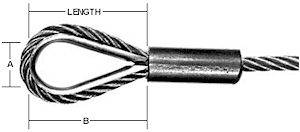
ThimbleAN100.jpg

The length is not adjustable, so I need to finish them with strong line (one zillion pounds breaking force) that can be adjusted to make the safety line taut.

My question is this:

Is a double-loop line (B) functionally stronger than a single loop (A)?

It is elementary that, if the line breaks in either A or B (say, due to rubbing wear), it doesn't matter how many loops I have, it will come apart.

But does the double loop distribute the load, so that it will hold more weight?
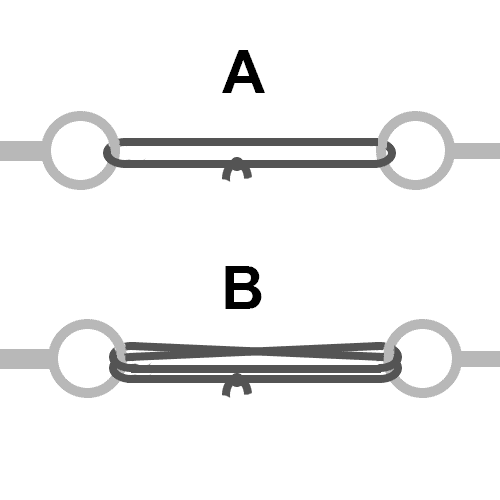
safety-line.png
 
Engineering news on Phys.org
DaveC426913 said:
This seems like a naive question, yet I keep pondering it while looking at the safety lines on my boat.

They're braided cable with thimbles:

ThimbleAN100.jpg

The length is not adjustable, so I need to finish them with strong line (one zillion pounds breaking force) that can be adjusted to make the safety line taut.

My question is this:

Is a double-loop line (B) functionally stronger than a single loop (A)?

It is elementary that, if the line breaks in either A or B (say, due to rubbing wear), it doesn't matter how many loops I have, it will come apart.

But does the double loop distribute the load, so that it will hold more weight?

View attachment 102446
The doubled line is, of course, nominally double the strength. But the strength is reduced by the tight radius at the rings, and also by the knot. And of course, if one breaks, you lose everything. Having said that, I think that many loops in the way illustrate is still good practice, and I use it for the shrouds and forestay of my my small boat. Rather than the knot shown, I suggest making several turns then putting half hitches around the bundle in the traditional manner. Actually, for a safety line, I think you can by an adjuster device, which would be safer.
 
If you double up it's also easier to get tension in the wire because it acts like a block and tackle.
 
Although it may not apply to the simple examples you presented, don't neglect the friction force in a multiple loop arrangement. It could be beneficial (It may be enough to keep the integrity of the link even if one loop is broken or at least give some reaction time to do something before failure) or it may be detrimental (The friction force may prevent one loop to be fully taut, thus essentially useless).

It all depends on how many loops you have, how you twist them together and what type of rope you are using.
 
jack action said:
Although it may not apply to the simple examples you presented, don't neglect the friction force in a multiple loop arrangement.
Yes, I'd thought of this. Wind enough small lines together and you essentially have one thicker line. But it wouldn't apply in this case.

I suppose the simplest solution, given my circusmtances, is to make the two loops independent. Now, if one break, you have a backup.

On the other hand, that arrangement will certainly mean that one will always take more weight than the other, because you can't set them to the exact same tension. That means one of them will always be more likely to fail.

tech99 said:
Rather than the knot shown, I suggest making several turns then putting half hitches around the bundle in the traditional manner.
This is sort of what I did, though I'm not sure what the "traditional manner" is.
 
DaveC426913 said:
On the other hand, that arrangement will certainly mean that one will always take more weight than the other, because you can't set them to the exact same tension. That means one of them will always be more likely to fail.
This is only true if you can ensure that both loops will carry relatively equal weight.. If one is looser than the other, it will take all the load, and break just like if it were the only one, and the remaining loop will do the same.

If you can use several loops, and then wrap the bundle several times at each end (Like a hangman's knot), they'd all be load carrying, and even with 1 failing, there's a good chance there's enough friction from the wraps on each end to prevent it from completely unraveling... I'm sure the Ashley book of Knots has specifics on this, but I don't have it handy
 
Rx7man said:
This is only true if you can ensure that both loops will carry relatively equal weight.. If one is looser than the other, it will take all the load, and break just like if it were the only one, and the remaining loop will do the same.
? That's what I said.

Rx7man said:
If you can use several loops, and then wrap the bundle several times at each end (Like a hangman's knot), they'd all be load carrying, and even with 1 failing, there's a good chance there's enough friction from the wraps on each end to prevent it from completely unraveling... I'm sure the Ashley book of Knots has specifics on this, but I don't have it handy
Yeah. That's good. I'll do that.
 
My reading comprehension is bad today.. sorry..
 
  • Like
Likes   Reactions: DaveC426913
If they are the safety lines that you clip your safety harness onto, then they are usually called “tether lines”, “jack lines” or “jack wires”. A jack line only needs to be tight enough not to flap in the wind. The jack line also needs to be lossy so fatigue due to vibration in steady winds does not occur. Threading a short piece of lose fitting rubber tube onto a wire will stop it singing in the wind.

The stretch in your harness strap should prevent injury to you. If the jack line is taught between two fixed points, some elasticity in the jack line will be essential. If you load the taught jack line near the centre, the triangle of forces multiplier effect could pull an end fitting out of the boat, something must give a little somewhere to prevent that.

There is a third way...
I would use one big loose loop of the zillion pound line. I would also use a tight loop of a weaker or elastic line to maintain the tension. After a heavy fall, the weak sacrificial loop could break or stretch well before the jack line tie points are torn from the boat. The longer stronger loop would then come into play which would allow a wider angle in the triangle of forces. That would prevent damage to the boat fittings and increase the safety of the system as a whole.
 
  • Like
Likes   Reactions: Tom.G
  • #10
Google 'rigging jacklines' for more information.
http://www.mysailing.com.au/news/practical-tips-for-using-jacklines
https://www.cruisingclub.org/sas/jacklines
 
  • #11
Sorry, you're right. I've been using the wrong term.

Lifelines.

They run between the stanchions.

lifeline_measurement_form.gif
 
  • #12
Hm. That last diagram gives me an idea. I should have used turnbuckles. Too late now. I can't alter the length of the wire cables.
 
  • #13
if the thickness(diameter) of A is same to B while they work, double-loop B is stronger than A . as long as you analyse the force that each rope section bear.

As for double times, I do n't think it is definite. We should consider the friction,and others factors.
 

Similar threads

  • · Replies 17 ·
Replies
17
Views
11K
  • · Replies 6 ·
Replies
6
Views
2K
Replies
16
Views
2K
  • · Replies 30 ·
2
Replies
30
Views
5K
  • · Replies 5 ·
Replies
5
Views
3K
  • · Replies 2 ·
Replies
2
Views
3K
  • · Replies 2 ·
Replies
2
Views
4K
  • · Replies 1 ·
Replies
1
Views
4K
  • · Replies 1 ·
Replies
1
Views
3K
  • · Replies 1 ·
Replies
1
Views
4K