Discussion Overview
The discussion centers on the classification of ionic compounds and whether they can be considered molecules, using table salt (NaCl) as a primary example. Participants explore definitions, bonding characteristics, and the implications of these classifications in both theoretical and practical contexts.
Discussion Character
- Debate/contested
- Conceptual clarification
- Technical explanation
Main Points Raised
- Some participants assert that table salt is composed of molecules, specifically stating it consists of one sodium atom and one chlorine atom (NaCl).
- Others argue that table salt is an ionic compound made up of sodium and chlorine ions in a crystal lattice, not discrete molecules, and that this structure only exists in gaseous form.
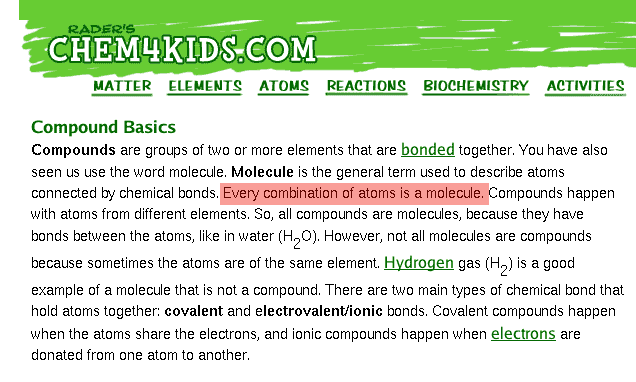
- There is a contention regarding the accuracy of certain screenshots that participants reference, with some claiming the first screenshot is incorrect and the second poorly worded.
- One participant emphasizes the need for detailed explanations regarding the nature of ionic versus covalent compounds, particularly in relation to electron sharing and bonding.
- Another participant expresses frustration over the formatting of posts, defending the use of bold text for clarity while also seeking further clarification on the inaccuracies pointed out by others.
- Some participants express skepticism about the reliability of online sources for basic science information, suggesting that certain educational resources may not be accurate.
Areas of Agreement / Disagreement
Participants do not reach a consensus on whether ionic compounds can be classified as molecules. There are competing views on the definitions and characteristics of ionic versus covalent compounds, and the discussion remains unresolved.
Contextual Notes
Participants note the complexity of definitions and the potential for misunderstanding due to varying interpretations of terms like "molecule" and "compound." There is also mention of the limitations of certain educational resources in accurately conveying these concepts.