Is Choice A Correct for Comparing GRE Math Quantities?

Click For Summary
SUMMARY

The forum discussion centers on a GRE Quantitative Practice Test question regarding the comparison of two quantities, x (Quantity A) and y (Quantity B). The values for x are derived from the equation x² - 5x - 6 = 0, yielding solutions of 6 and -1, while y is determined from (y + 3)² = 0, resulting in y = -3. Participants conclude that the correct answer should be A, as both values of x are greater than the single value of y, despite initial confusion over the problem's wording and potential typos.

PREREQUISITES
  • Understanding of quadratic equations and their solutions
  • Familiarity with GRE quantitative reasoning format
  • Basic algebraic manipulation skills
  • Knowledge of complex numbers and their comparison
NEXT STEPS
  • Review GRE Quantitative Practice Test strategies
  • Study quadratic equations and their graphical representations
  • Learn about comparing real and complex numbers in mathematical contexts
  • Explore common GRE question types and answer strategies
USEFUL FOR

Students preparing for the GRE, educators teaching quantitative reasoning, and anyone seeking to improve their algebraic problem-solving skills.

MartinV279
Messages
5
Reaction score
0
I was going through some GRE Quantitative Practice Tests, and found this question. Maybe I'm not understanding the question right (not a native speaker, and have never solved math problems in English), but choice B doesn't seem correct to me.
Solutions for x (Quantity A) are 6 and -1, and for y(Quantity B) are -3 and -3. Meaning, -3<6 and -3<-1.
Shouldn't A be correct?
Also, there's an explanation at the bottom which is correct in general but can't seem to understand how it proves the correct choice.
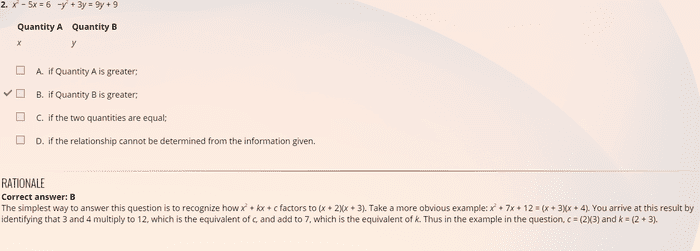
X4x7Qis.png
 
Mathematics news on Phys.org
Yeah, I think you're right. The answer makes no sense. Also the explanation seems to be geared toward a problem of quantity A=c value and quantity B=k value.

Perhaps you can send it to someone at the GRE center for clarification.
 
  • Like
Likes MartinV279
The answer given doesn't match the question, as far as I can see, so my guess is that there is a significant typo in the question. In the answer shown, they talk about factors (x + 2) and (x + 3).
The equation in x that they give is equivalent to x2 - 5x -6 = 0, or (x - 6)(x + 1) = 0, so x = 6 or x = -1.
The equation in y is equivalent to (y + 3)2 = 0, so y = -3.

For the two equations, both values of x are larger than the single y value.
 
Last edited:
Unless I miscalculated, if ## y = -3 ## then ## x^2 - 5x + 18 = 0 ## which gives ## x ## the value ## {5 \pm i\sqrt{47}} \over {2} ##. Since reals and complexes cannot be compared, I would say D! (I think there's a mistake in the printing.)
 
aikismos said:
Unless I miscalculated, if ## y = -3 ## then ## x^2 - 5x + 18 = 0 ##
I don't see how you got your last equation. The two equations are independent of one another, so how does a value for y result in ##x^2 - 5x + 18 = 0##?
aikismos said:
which gives ## x ## the value ## {5 \pm i\sqrt{47}} \over {2} ##. Since reals and complexes cannot be compared, I would say D! (I think there's a mistake in the printing.)
 
Mark44 said:
I don't see how you got your last equation. The two equations are independent of one another, so how does a value for y result in ##x^2 - 5x + 18 = 0##?

<EDIT> Ignore this post. Misread the scanned problem. </EDIT>

Since you have ## E_1 = E_2 = E_3 ##, you merely solve ## E_2 = E_3 ## first, and then substitute your value of ## y ## back into ## E_1 = E_2 ##.

## E_2 = E_3 : -y^2 + 3y = 9y + 9 ##
## -y^2 + 3y = 9y + 9 \rightarrow (y + 3)^2 = 0 \rightarrow y = -3 ##

## E_1 = E_2 : x^2 - 5x = -y^2 + 3y ##
## x^2 - 5x = -y^2 + 3y \rightarrow x^2 - 5x = -1 \cdot (-3)^2 + 3 \cdot (-3) \rightarrow x^2 - 5x = -18 \rightarrow x^2 - 5x + 18 = 0 ##
 
Last edited:
aikismos said:
Unless I miscalculated, if ## y = -3 ## then ## x^2 - 5x + 18 = 0 ## which gives ## x ## the value ## {5 \pm i\sqrt{47}} \over {2} ##. Since reals and complexes cannot be compared, I would say D! (I think there's a mistake in the printing.)

Oh, wait, one could take the magnitude of both numbers!
 
aikismos said:
Since you have ## E_1 = E_2 = E_3 ##, you merely solve ## E_2 = E_3 ## first, and then substitute your value of ## y ## back into ## E_1 = E_2 ##.

## E_2 = E_3 : -y^2 + 3y = 9y + 9 ##
## -y^2 + 3y = 9y + 9 \rightarrow (y + 3)^2 = 0 \rightarrow y = -3 ##

## E_1 = E_2 : x^2 - 5x = -y^2 + 3y ##
## x^2 - 5x = -y^2 + 3y \rightarrow x^2 - 5x = -1 \cdot (-3)^2 + 3 \cdot (-3) \rightarrow x^2 - 5x = -18 \rightarrow x^2 - 5x + 18 = 0 ##
I don't think the intent was to find a simultaneous solution; i.e., a solution (x, y). My take is that the intent was merely to compare the solutions to the two equations, in which case answer A would be the correct response.
 
Mark44 said:
I don't think the intent was to find a simultaneous solution; i.e., a solution (x, y). My take is that the intent was merely to compare the solutions to the two equations, in which case answer A would be the correct response.

Sorry. Small screen display. I saw the problem wrong. :D
 

Similar threads

  • · Replies 3 ·
Replies
3
Views
1K
Replies
11
Views
6K
  • · Replies 4 ·
Replies
4
Views
4K
  • · Replies 10 ·
Replies
10
Views
3K
  • · Replies 3 ·
Replies
3
Views
4K
  • · Replies 1 ·
Replies
1
Views
2K
  • · Replies 1 ·
Replies
1
Views
2K
  • · Replies 15 ·
Replies
15
Views
2K
  • · Replies 2 ·
Replies
2
Views
3K
  • · Replies 19 ·
Replies
19
Views
11K