Pjpic
- 235
- 1
Does energy take up space? In other words; if one particle has more energy than another, does the more energetic particle have to be larger in size?
The discussion centers on whether energy occupies physical space, with participants asserting that energy is an abstract concept and does not inherently take up space. Key points include the distinction between different types of energy—kinetic, potential, mass, momentum, and heat—and their effects on the size of particles. It is concluded that while energy can influence the behavior of particles, such as electrons in excited states, it does not equate to an increase in physical size. The consensus is that energy is a property of systems rather than a tangible entity that occupies volume.
PREREQUISITESPhysicists, students of quantum mechanics, and anyone interested in the fundamental properties of energy and matter will benefit from this discussion.
is never true even if one particle has more mass than another, heavier particle can by much smaller in sizePjpic said:if one particle has more energy than another, does the more energetic particle have to be larger in size?
I'm pretty sure it is its own type of energy (I generally call it combined with momentum energy "relativistic energy", as the energy is described in relativity however I don't know if that is an accepted name).hackhard said:mass is a form of potential energy so energy sometimes takes up space.
It is not never true, it is just not always true, or sometimes true.hackhard said:is never true even if one particle has more mass than another, heavier particle can by much smaller in size
No. Energy is an abstract physical concept and can only be measured or calculated indirectly.Pjpic said:Does energy take up space? In other words; if one particle has more energy than another, does the more energetic particle have to be larger in size?
hackhard said:mass is a form of potential energy so energy sometimes takes up space.
it can never be said that a particle has more total energy than another since total energy of body in not measurablePjpic said:f one particle has more energy than another
Pjpic said:Does energy take up space? In other words; if one particle has more energy than another, does the more energetic particle have to be larger in size?
Things take up space. If energy (if that is a thing) is added to an electron; it would seem that the electron would either have to get bigger or that there was empty space inside of the electron where the additional energy could fit. On the other hand, if electrons are dimensionless points; maybe my question isn't valid.jtbell said:Why do you think this might be the case?
So energy is one property of a force carrying particle?jtbell said:Energy isn't a "thing" in itself. It's a property of a "thing," or system. You can't isolate "pure energy", just as you can't isolate "pure color".
Not necessarily a force carrying particle, it can be a property of a system for instance.Pjpic said:So energy is one property of a force carrying particle?
"force carrying particle" does not make sense.Pjpic said:So energy is one property of a force carrying particle?
I find the concept of volume to be perfectly defined in physics.Khashishi said:"take up space" is not something that is clearly defined in physics.
jtbell said:Why do you think this might be the case?
256bits said:It seems as energy is added to the electron-protron system, it does get bigger.
Object, or particle, in question is the electron-proton composite, not just the electron nor the proton each individually. And this composite has the gain in potential energy when the atom is excited. The excited atom as a particle takes up extra space.Drakkith said:Sure, because the addition of energy excites the electron to an orbital with a larger average radius. But it is the electron that takes up space, not the energy itself.
Yes it does. So what?256bits said:Object, or particle, in question is the electron-proton composite, not just the electron nor the proton each individually. And this composite has the gain in potential energy when the atom is excited. The excited atom as a particle takes up extra space.
So What, what?.Drakkith said:Yes it does. So what?
Pjpic said:Does energy take up space? In other words; if one particle has more energy than another, does the more energetic particle have to be larger in size?
Isaac0427 said:I want to reiterate my first comment (#3). Different types of energy under different circumstances can or can not take up space.
But is that space really "taken"?256bits said: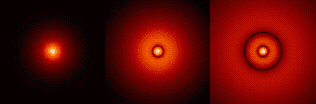
That is a representation of a hydrogen atom in its ground state, and in two different exited states.
Seems bigger when exited.
Energy level at ground state Eo= -13.6eV
Energy level at first exited state = -3-4eV
At infinity, E∞ = 0 eV
It seems as energy is added to the electron-protron system, it does get bigger.
What I meant was a particle with more energy.Vanadium 50 said:And it's as wrong now as it was the first time you said it.
Energy is not a thing. It does not take up space. Configurations of objects take up space, and their energy may depend on their configuration.
Pjpic said:In other words; if one particle has more energy than another, does the more energetic particle have to be larger in size?
But that just begs the question. Does density have to remain constant when adding energy?Isaac0427 said:What I meant was a particle with more energy.
Example: keeping density constant, more mass energy means more space is taken up.
That is why I said certain circumstances. The circumstance for that example was a constant density.jbriggs444 said:But that just begs the question. Does density have to remain constant when adding energy?
256bits said:So What, what?.
Refer to the original posting.
Fair enough question, but not exactly what I had said or think, but anyways.Drakkith said:Okay. Now I would like you to elaborate on your answer. How does the excitation of an electron mean that energy takes up space given that a hydrogen atom is a system of more than one particle?
if one particle has more energy than another, does the more energetic particle have to be larger in size?