Is it necessary to calculate acceleration for this problem?

  • Thread starter Thread starter Benjamin_harsh
  • Start date Start date
  • Tags Tags
    Acceleration
Click For Summary
SUMMARY

The discussion centers on the necessity of calculating acceleration when a force of 100N is applied to a 5kg mass with static and kinetic friction coefficients of 0.60 and 0.55, respectively. The maximum static friction force is calculated as 29.4N, resulting in a net force of 70.6N and an acceleration of 14.1 m/sec². When considering kinetic friction, the frictional force is 26.95N, leading to a net force of 73.05N and an acceleration of 14.61 m/sec². The conclusion emphasizes the importance of determining whether the applied force exceeds static friction before proceeding to calculate acceleration.

PREREQUISITES
  • Understanding of Newton's laws of motion
  • Knowledge of static and kinetic friction coefficients
  • Ability to calculate net force and acceleration
  • Familiarity with basic physics formulas, including F = ma
NEXT STEPS
  • Study the principles of static and kinetic friction in detail
  • Learn how to apply Newton's second law in various scenarios
  • Explore advanced problems involving friction and acceleration
  • Investigate the effects of different mass values on acceleration calculations
USEFUL FOR

Physics students, educators, and anyone interested in understanding the dynamics of forces, friction, and motion calculations.

Benjamin_harsh
Messages
211
Reaction score
5
Homework Statement
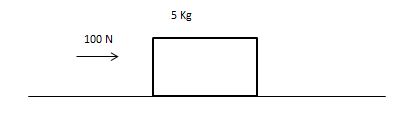
A force of 100N applied to a body which has 5kg mass. Coefficient of static friction(##μ_{s}##) is 0.60 and Coefficient of kinetic friction(##μ_{k}##) is 0.55.
Relevant Equations
Acceleration from Net force, ##a = \large \frac{70.6}{5}## = ##14.1 \;m/sec^{2}## to the right.

Acceleration from Net force, ##a = \large \frac{73.06}{5}## = ##14.61 \;m/sec^{2}## to the right.
A force of 100N applied to a body which has 5kg mass. Coefficient of static friction(μs) is 0.60 and Coefficient of kinetic friction(μk) is 0.55.
244844


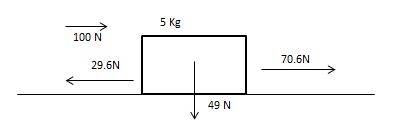
A) ##μ_{s} = 0.60##; ##μ_{k} = 0.55##
##F_{s}^{max} = F_{n}*μ_{s}##
##F_{s}^{max} = 49*0.60 (F_{n} = 9.8 \;m/sec^{2} *(5kg) = 49N)##
##F_{s}^{max} = 29.4 N##
Net force, ##F_{net} = 100 – 29.4N = 70.6N##
Acceleration from Net force, ##a = \large \frac{70.6}{5}## = ##14.1 \; m/sec^{2}## to the right.
244845


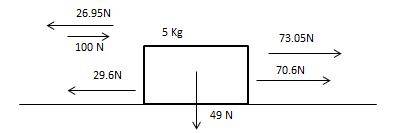
Frictional force = ##F_{n}*μ_{k}##
Frictional force = ##49*(0.55) = 26.95N##
Net Force, ##F_{net} = 100 – 26.95 = 73.05N##
244846


Acceleration from Net force, ##a = \large \frac{73.06}{5}## = ##14.61 \; m/sec^{2}## to the right.
 
Physics news on Phys.org
First, calculate if the force is great enough to overcome the static friction. If not, it will not move. If it is great enough, use the kinetic friction to calculate whatever the problem asks you to calculate. Your statement of the problem is not complete. You do not say what it asks you to calculate.
 

Similar threads

Replies
2
Views
687
  • · Replies 27 ·
Replies
27
Views
3K
  • · Replies 2 ·
Replies
2
Views
2K
Replies
6
Views
2K
  • · Replies 16 ·
Replies
16
Views
2K
  • · Replies 28 ·
Replies
28
Views
6K
  • · Replies 4 ·
Replies
4
Views
8K
  • · Replies 2 ·
Replies
2
Views
15K
  • · Replies 1 ·
Replies
1
Views
3K
  • · Replies 2 ·
Replies
2
Views
2K